Kenyan politicians, you keep using that word [culture], I don’t think it means what you think it means

Here is the Standard reporting on the proposed amendments to the Marriage Bill:

The Bill passed through its second reading in the House Wednesday, even as controversy raged over how much say women should have on their husbands’ choice to get them co-wives [?!!!???!?!??!?!?!?!?].

Although the Bill has wide ranging provisions touching on marriage, the clause on polygamy has assumed a life of its own, with debate in the House and in the public zeroing in on the controversial clause. During debate last week, the chairman of the National Assembly’s Legal Affairs Committee Mr Samuel Chepkonga said they had considered an array of opinions before the decision to introduce the amendment that may see the controversial clause deleted when the Bill comes before the Committee of the Whole House.

Predictably, the reaction during debate was sharp and immediate, with mostly male MPs supporting the amendment, terming the consent clause “impractical and unrealistic” in the context of African culture [emphasis mine].

To which I say:

[youtube.com/watch?v=G2y8Sx4B2Sk]


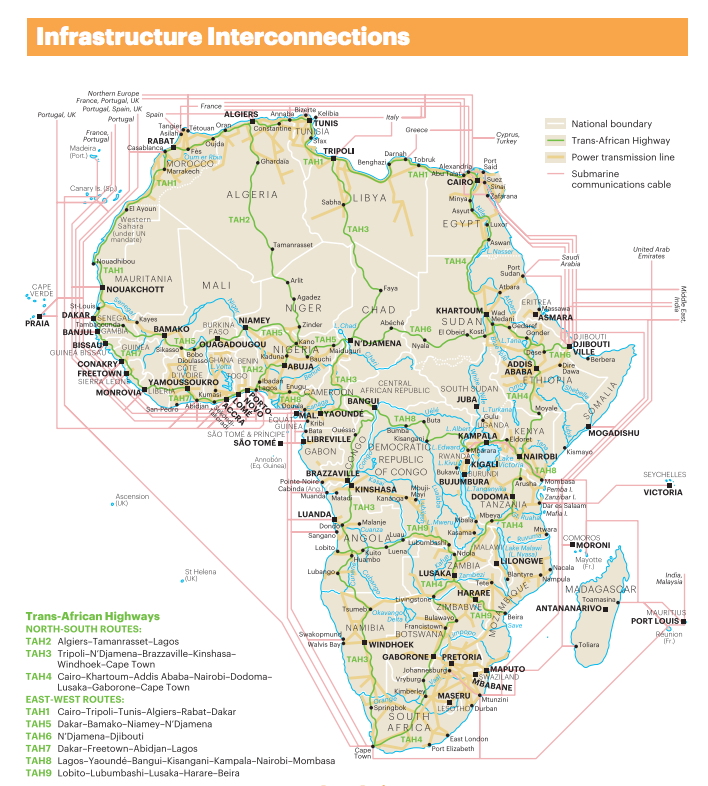
Infrastructure Interconnections in Africa

ImageHere is a crazy idea, why did we stop building canals? Look at all those potential waterways (which might prove cheaper in the long run than roads). And don’t tell me its all about rapids and waterfalls, those can be overcome.

Also, notice how “landlockedness” is not just about national boundaries but about access to the sea and transport infrastructure.

No shortcuts to sustained economic growth

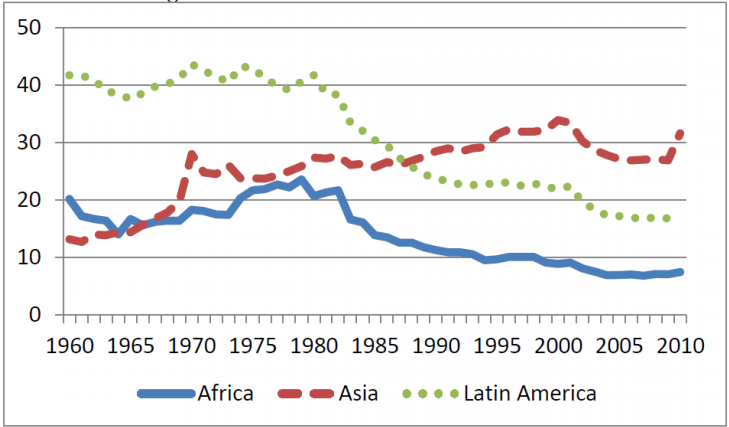
Dani Rodrik keeps reminding us that one of the factors slowing down the anti-poverty fight in Africa is the slow growth in manufacturing which comes with the risk of “premature” de-industrialization. Economic histories of several countries over the last two centuries tells us that rapid and sustained growth only occurred on the back of industrialization. In Africa on the other hand manufacturing is still a paltry 10.1% of annual output on average (and ranges between 10-14%, which is bad for a developing region). Compare this to 34% in Thailand, 31% in South Korea and 24% in Malaysia. Furthermore, productivity in the manufacturing sector in Africa has actually declined over the last 40 years (see figure below).

Image

Productivity in Manufacturing (USA=100)

Now, starry-eyed technophile African leaders can talk about leapfrogging the historical stages of economic growth until the cows come home but there is no hiding from the fact that sustained growth and reduction of poverty will only come once Africa’s poor (up to 70% of whom still depend on subsistence agriculture in SSA) have access to well paying jobs. Yes, the types of jobs and products will be different, from say steam powered 18-19th century northwestern Europe or even 20th century East Asia, but there will have to be jobs for the masses. M-apps won’t do, as they will only benefit those who are already well off (mainly the creators), once they are sufficiently monetized. Asking poor people to be “entrepreneurial” with high interest micro-loans and grow themselves out of poverty as a matter of national development policy will also not work.

To quote Chris Blattman:

The difference between a country with $1,500 and $15,000 of income a head is simple: industry. All the microfinance and microenterprise programs in the world are not going to build large firms and import technology and provide most people with what they really want: a stable job, regular wages, and a decent work environment.

The good thing is that in quite a few countries on the Continent structural conditions favorable to mass job creation are beginning to congeal. Hopefully sooner, rather than later, PRSPs will start focusing less on pro-poverty “pro-poor” initiatives and more on strategies for mass job creation. Remember, “making the lives of poor people better is not the same thing as fighting poverty.” Over to you Development Economists and African policymakers.

Kenya’s super rich are betting on future stability, and that is a good thing

One of the historical features of “Kenyan exceptionalism” in Africa – outlined by Bob Bates and others – has been its elites’ reliance on immovable assets, mostly agricultural land. This is in contrast to most other African countries where insecure property rights, lack of good investment opportunities, and outright kleptocracy have over the years bled national economies dry of capital. A study of 33 countries in Sub-Saharan Africa showed that between 1970-2010 about 0.814 trillion dollars left the region (in constant 2010 dollars). That was more than the total aid ($659 billion), and more than two and a half times the FDI ($306 billion) received over the same period.

The study shows Kenya to have lost $4.9 billion in capital, ranking it 21st on the list. This despite having been among the region’s top five economies and its largest non-mineral economy over the same period. Kenyan politicians and their associates were by no means less venal than their regional counterparts. They definitely stole, too. A lot. The difference is that they invested a good chunk of the stolen money in land (agriculture) and other assets within the country.

The same Kenyan trend appears to continue, even in an era of relatively liberalized financial flows. A recent report on Kenya’s top 8,300 wealthiest high net worth individuals – who also control wealth the equivalent of about two thirds ($31 billion) of the country’s annual output – shows that they have put more than a quarter (26%) of their wealth in real estate, a most immovable asset. 18% of this wealth is in equities, with only 12% in liquid cash [Just to be clear, $31.4b is 62% of Kenya’s GDP, not its total wealth. The latter figure includes the total accumulated net value of all wealth in Kenya, including both public and private household wealth].

The Business Daily reports that:

This level of wealth multiplication has caught the attention of Kenya’s super-rich making them invest 19.5 per cent of their total assets in residential property, 5.4 per cent in commercial property and 1.3 per cent in foreign property in 2013.

Obviously the wealth disparities outlined in the report should concern Kenyan politicians and the super-wealthy elite alike. 8,300 people make up 0.0002075% of Kenya’s 40 odd million people. This is total insanity. But the investment choices of the country’s wealthiest are an implicit endorsement of the country’s property rights laws and a sign that the super rich are betting on the continued stability of the country and its economy.

Now the challenge for chaps at State House, the Treasury and the Ministry of Industrialization and Enterprise Development (of course with some help from Parliament) should be how to incentivize investments in sectors that will generate mass employment. This is a drum that I have been beating for a while now (see also here). It is also the point that David Ndii neatly summarized in his recent critique of the government’s apparent blind belief in mega-projects as the panacea to Kenya’s endemic poverty problem. Dr. Ndii’s argument was that mega infrastructure projects only target the middle class and up, forgetting the rural poor who need investments in agricultural productivity. While I wouldn’t go as far as outrightly dismissing the utility of new major roads and railways, I think that the government should be a bit more proactive in ending rural poverty – a task that will necessarily require getting people off the land and providing alternative livelihoods in wage paying jobs.
Does female empowerment promote economic development?

The conventional interpretation of the observed gender expenditure patterns re- lies on women and men having different preferences.4 And indeed, if all women highly valued children’s human capital whereas all men just wanted to consume, putting women in charge of allocating resources would probably be a good idea. However, we show that the facts can also be explained without assuming that women and men have different preferences. We develop a model in which women and men value private and public goods (such as children’s human capital) in the same way, but that nevertheless is consistent with the empirical observation that an increase in female resources leads to more spending on children.

Our theory does not lead to clear-cut implications for economic development. In particular, we find that empowering women is likely to accelerate growth in advanced economies that rely mostly on human capital, but may actually hurt growth in economies where physical capital accumulation is the main engine of growth.

…… Given that the human capital share tends to in- crease in the course of development, our results imply that mandated transfers to women may be beneficial in advanced, human capital-intensive countries, but are unlikely to promote growth in less developed economies.

That is Doepke and Tertilt in an NBER working paper (HT Marc F. B.)

This paper reminded me of of the BIG vs Small Development dichotomy, and why we should not take cash transfers (despite recent glowing reviews) to be a panacea to poverty and underdevelopment. Cash transfers (whether targeting poor men or women) should be seen as short-term relief whose development impact are, at the very best, highly contingent and long-term (especially if the transfers are used to increase the quality of human capital through schooling for kids). I could be totally wrong, but I think that the promise for real and lasting rapid development lies in creation of mass employment. And on this front the shoots are beginning to show on the Continent.

I wish more development economists were thinking of ways of growing African SMEs into mass employers, even if it meant flirting with the idea of Industrial Policy.

A New TV Show About Aid and Development

Just saw this over at Africa is a Country:

Finally, a new TV show exists to highlight some of the absurdities of the international aid sector. The slyly named The Samaritans is a comedy about the perils – and pleasures – of the “NGO world”. Created by a Kenya-based production company, it chronicles the work of Aid for Aid – an NGO that, in the words of its creator, “does nothing”.

[youtube.com/watch?v=ZTFhFvo3gQI]

H/T D. Waweru

Mapping Nairobi’s Informal Transit System

Researchers and students at the University of Nairobi, the Center for Sustainable Urban Development at Columbia University, and the Civic Data Design Lab at MIT produced the map below – and the underlying data behind it – after carrying cell phones and GPS devices along every route in the network. Result? There is order to Nairobi’s seemingly chaotic matatu industry.

Pretty cool stuff. 

Image

 More here.

H/T Amanda R.