On Kenya’s diplomatic delusion

So far the ICC question has been the singular preoccupation of the Kenyatta administration. It appears that the Kenyan government is willing to pull out all the stops to halt the cases against the president and his deputy. Sadly, instead of a sober approach to the process of doing so, Nairobi has chosen to antagonize both the Hague Court and the West.

As I have argued before, Kenya has leverage vis-a-vis the West (security in the Horn and Somalia in particular; its status as host to regional diplomatic and aid efforts; and role as the biggest economy and potential gateway to the region) that it can use in a smart way to get concessions from Washington, London and Paris on key issues. Rather than wish for a restructured P5 (see post below), Nairobi should think of how to get its way with the current one.

Instead of the misguided chest-thumping about hollow sovereignty in a Chinese built conference hall in Addis under the banner of an organization partly funded by the EU, Nairobi could have chosen a different path.

Writing in the Daily Nation, Paul Mwangi, in a nutshell describes what is wrong with Kenya’s current approach to international diplomacy (Must read, more here):

The reality is that gone are the days when we were the “island of peace” in an unpredictable and violent part of the world. Over time, the world around us has changed, but we are yet to wake up and smell the coffee. Ethiopia is no longer in civil war and is quickly becoming a better investment opportunity for manufacturers both due to the low price of its electricity and the size of its population, about 90 million people. It is one of the fastest-growing economies in the world.

Tanzania is no longer socialist and is now the darling of America. Apart from its own vast mineral, oil and gas deposits, Tanzania is the new gateway to the DRC and is receiving mammoth investment from both China and America. China is building what is being called a “mega port” for Tanzania at Bagamoyo, which is more than 30 times the size of Mombasa, as part of a $10 billion investment package for Tanzania. When completed, it is bound to take away all central Africa business from Mombasa port, which will be left to serve only Kenya and Uganda.

……. Let us stop comparing ourselves with other countries. The painful truth is that Kenya is not Syria. In the Middle East, Syria is the only foothold for China and Russia. The rest of the countries are either fundamentalist or pro-Western. In Africa, China and Russia are spoilt for even better choices.

They will only go so far to help us out [Indeed some have started asking of the Afro-Chinese engagement has peaked].

The complete madness lack of tact that Mr. Mwangi points out will no doubt be on display this afternoon as the National Assembly debates Kenya-UK relations (Recently Kenyan MPs allied to the president have chosen to prove their loyalty by taking extreme positions on the ICC issue). This comes in the wake of the UK’s support of an amendment of the ICC statutes to allow President Kenyatta and his deputy to attend their trials via video-link; and stated opposition to granting sitting presidents full immunity from any prosecution under international law while in office as has been demanded by Kenya. The hurdle remains high for the Kenyan (AU) amendment proposals to the Assembly of Member States, especially after it emerged that 9 African states may not be illegible to vote on account of not having paid their dues.

According to a recent poll, 67% of Kenyans are of the opinion that President Kenyatta should attend trial at the Hague in person to clear his name.

Making sense of the Kenyan government’s reaction to UNSC vote on ICC deferral

The UN Security Council has rejected Kenya’s (and the African Union’s) request for a one year deferral of the case against President Uhuru Kenyatta and his deputy at the Hague. The two stand accused of crimes against humanity committed following the disputed elections in 2007. More than 1300 people died, and hundreds of thousands were displaced.

The US, UK, France, Australia, Guatemala, Luxembourg, South Korea and Argentina abstained to stop the deferral request. China, Russia, Togo, Morocco, Pakistan, Azerbaijan and Rwanda voted for a deferral. African leaders have in the last two years been on an ill-advised crusade against the ICC, terming it as a “race hunting” tool of “declining” Western powers.

Kenyatta and Ruto are innocent until proven otherwise, but their attempts to make their personal cases at the ICC a regional struggle of Africans against imagined neo-colonialists bent on usurping African sovereignty is a little misguided. The Kenyan case is different (Kenya is not Sudan or the DRC) and ought to have attracted special consideration from the court (see closing remarks below). However, despite its faults the ICC is all the continent has in the quest to hold its leaders accountable. I reiterate, murderous dictators in Africa and elsewhere should never be allowed to have internal affairs.

Here is the government’s total freak out response following the UNSC vote, with some comments from yours truly.

STATEMENT FROM THE FOREIGN AFFAIRS MINISTRY IN KENYA

Kenya takes note of the outcome of the United Nations Security Council meeting on peace and security in Africa, and specifically on the subject of the request for deferral of the Kenya ICC cases. Kenya wishes to thank China and Azerbaijan who, during their stewardship of the Security Council, have been professional and sensitive to the African Union agenda.

Wow, this is how bad things have become. That Kenya finds friends in states like Azerbaijan. Yes, this is the place in which the president recently announced the election results even before the polls opened. These are our new committed friends. We are going places. 

Kenya wishes to thank the seven members of the Security Council who voted for a deferral and is particularly grateful to Rwanda, Togo and Morocco – the three African members on the Security Council – for their exemplary leadership.

Again, the only country we should be associated with on this list is perhaps Rwanda. I wish we could do what they have done with their streets, and corruption, and ease of doing business. But by all means we should not borrow their human rights record. Oh, and please let’s stay away from their variety of democracy.

This result was not unexpected considering that consistently some of the members of the Security Council, who hold veto powers, had shown contempt for the African position. The same members and five others chose to abstain, showing clear cowardice in the face of a critical African matter, and a lack of appreciation of peace and security issues they purport to advocate.

Letting the trial go on does not threaten peace and stability in Kenya. This is an empty argument. There will not be any spontaneous violence. Furthermore, the president is not the operational commander of the KDF. He is the Commander in Chief. He gets to issue orders from some room somewhere. Orders can be issued from anywhere. And remind me again how this trial impacts security ALL OVER AFRICA, other than by raising the cost of genocidal activities by African presidents?

Oh, and did I mention that the African Union Mission in Somalia (AMISOM) is almost entirely paid for by the European Union?

Inevitably, it must be appreciated that the outcome of this vote demonstrates that the Security Council does not serve the interests of a majority of its members and is clearly in need of urgent reform. It cannot be that a few countries take decisions that go against reason and wisdom in a matter so important to nearly one billion Africans.

One billion Africans. Really? I had no idea our president was this important of a man. One billion Africans. Many of whom starve to death; or die of treatable illnesses; or never make it to their first or fifth birthday because their leaders steal all the money meant for medicine. These Africans? Why should their names be invoked to protect the same leaders that have confined them to degrading penury for the last half century? Why, I ask? 

Also, the claim that Africa is united against the ICC is false. We all know about the divisions that stalled the silly idea of a mass walkout from the ICC by African states.

The African Union, in one voice, took the unprecedented step of making a simple request to the Security Council, bearing in mind the security and stability it seeks to achieve on the continent. But the Security Council has failed to do this and humiliated the continent and its leadership.

Ahh. Now the truth comes out. It is not about the one billion Africans after all. This is about the humiliation of the African leadership. It is about protecting the sovereignty of a few inept rulers. Forget the one billion Africans. It is about their big men rulers who steal tax money and stash it away in bank accounts in the same Western countries they like to call names.

The Security Council has failed the African continent, which will have to make its own judgment in the coming days and weeks about how it wishes to engage with the Security Council, which obviously does not believe the voices of more than one quarter of its members is significant enough to warrant its serious and purposive attention.

The security council has failed African leaders. Not the African people en masse. Africans want to have elections without having to worry that voting one way or the other will result in their houses being torched or their mothers, sisters and brothers murdered or raped. They also want freedom from ignorance, disease and material want. Is that too much to ask?

The African Union’s request to the Security Council included its key resolutions at the Special Summit on the ICC. The important one for the Security Council to note was the one that categorically says that no sitting Heads of State or Government may appear before the ICC. Kenya regrets failure of important members of the UN Security Council to have due consideration of Kenya’s critical role in stabilizing the Horn of Africa and the Great Lakes regions, and their reckless abdication of global leadership.

Wait, are these important global leaders in the UNSC the same ones President Kenyatta termed as “declining powers”? What makes them important now? 

Just for the record, I am part of the 67% of Kenyans who in a recent poll were in favor of the president attending court at the Hague. Having both the president and his deputy on trial will serve a great symbolic task of demystifying the Kenyan political leadership. The demonstration effect to all politicians, voters and criminal gangs alike will be clear: You cannot kill innocent civilians and get away with it.

In my view, the best case scenario is having both men attend trial and then get a not guilty verdict.

Kenyans are nowhere near ready to discuss frankly what happened in 2007-08 or the deeper issues of ethnicity and economic disparities that often mirror ethnic lines and how to deal with these issues at the national level. A forced conversation, especially one that has a foreign touch in the form of a court verdict, may result in unpleasant consequences. This would be a less than ideal outcome, but one that would not necessarily be catastrophic for the country. The constitution is clear on succession should either one or both leaders be found guilty and jailed.
More on direct cash transfers

As Chris Blattman put it, the Cashonistas are rejoicing. And with very good reason.

There is mounting evidence that giving money directly to poor people does a much better job of improving their welfare than traditional channels of institutional(ized) aid-giving. On a related note, this evidence lends credence to claims by proponents of oil-to-cash programs. Oil to cash enthusiasts advocate for direct payments to citizens of revenues from extractive sectors (and especially oil) so as to avoid what is commonly known as the resource curse (more on oil-to-cash here). I am not one to argue against evidence, so I am intrigued by the success of Give Directly, and look forward to further impact assessments to ascertain the stickiness of the observed welfare gains.

However, I agree with Brett Keller that we shouldn’t allow the present evidence to distract us from thinking about things like schools, hospitals, business-promoting state institutions, etc.

Despite the within-community evidence of positive effects of direct cash transfers, we shouldn’t forget that these communities do not exist in a vacuum but within political economies of various states. For instance, given what we know about ethnicity and attendant barriers against collective action, what would be the effect of giving all the money to the people and then requiring them to comply with tax regimes and other collective action endeavors?

Furthermore, giving poor people money is often based on an implicit premise that the poor ought to become entrepreneurs and lift themselves out of poverty (People respond to incentives, and we know what would happen if say we guaranteed them direct cash transfers in perpetuity. So the scheme only works if poor people can use the money to start businesses). But entrepreneurship is hard. Even for people with trust funds and super-charged business incubation resources. So is it really fair to require that the objectively most risk averse among us lift themselves out of poverty by starting businesses? Isn’t this the role of the middle and upper middle classes who can tolerate the risk? I am not saying that entrepreneurship is limited to particular classes (lots of people from humble backgrounds have created wildly successful businesses the world over). What I am saying is that as a matter of policy we shouldn’t unnecessarily burden the most vulnerable among us.

Also, to borrow from Huntington, we are well advised to keep in mind that even though economic success leads to stabilization, the process of development can be destabilizing. With this in mind, for most development initiatives to succeed, they need political cover (broadly defined as the ability to shape or influence government policy). Interventions to accelerate growth must never lose sight of this fact. Those who make and/or can influence policy matter a great deal.

This might sound very 20th century, but I think that the best anti-poverty measure out there is still mass job creation by BIG business (and agree with Chris Blattman here). It beats all the pro-poverty pro-poor interventions I can think of. So may be instead of raining cash on the poor it might be better to think of smart ways of jumpstarting the growth of SMEs in the developing world into mass employers. This is not a trickle down economics argument. It is an argument for the continued emphasis on macro reforms in the political economy to provide an enabling environment for mass job creation.

We can’t continue to insist that institutions matter but then turn around and do our best to device anti-poverty interventions that skirt the very same institutions that we insist are the fundamental cause of long-run growth.

Direct cash transfers might prove to be a key part of the shortcut to Denmark (and I hope the successes stick). But like with most shortcuts, the potential for disappointment is a little higher than most of us would like to admit.

On direct cash transfers: a look at US domestic politics of aid-giving

This is a guest post by my colleague at Stanford, Lauren Prather, who works on the determinants of individual attitudes towards inequality, poverty, and redistribution, in both domestic and international contexts.

Does the American public oppose giving cash to poor people in developing countries? Giving cash instead of in-kind aid like food is a hotly debated subject in development circles and has recently received increased attention from the media. The apparent success of GiveDirectly, a charity that gives unconditional cash transfers to poor people in Kenya, has added fresh fodder to the discussion. Even the Obama administration entered the fray earlier this year by proposing changes to the way U.S. food aid is distributed.

Traditionally, much of the food aid provided by the U.S. government is procured in the U.S. and shipped abroad. The reforms would relax these requirements and include more flexible approaches to food aid provision including possibly giving cash or vouchers to people in poor countries to help them buy food locally.

Proponents of cash transfers argue that the poor know their needs best and therefore giving cash is a more efficient way of providing aid. With food aid in particular, providing aid in kind can be more expensive and can damage local economies by driving out local farmers. Giving people cash on the other hand can allow them to buy food locally, which can be more cost-effective for donors and can actually support local agriculture.

What are the political constraints to reforming aid to include cash transfers to the poor? While most of the opposition to the food aid reforms has come from the farm lobby, public opinion may be another constraint. Indeed, research on American political attitudes suggests that Americans oppose giving cash to the poor, at least to poor Americans. But do Americans exhibit the same level of opposition to cash transfers targeting the foreign poor?

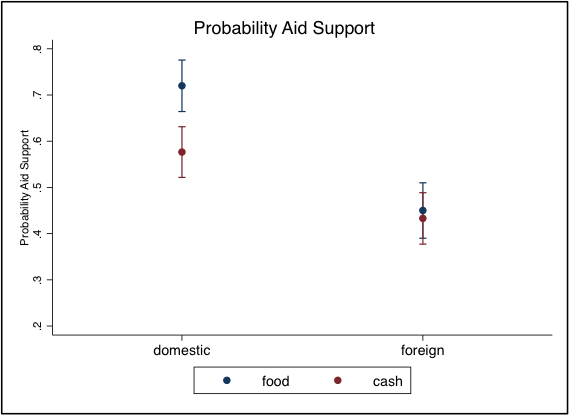
To shed light on this question, I used a randomized experiment embedded in a survey fielded in July of 2013 to a representative sample of 1,000 Americans. In the survey, I gave individuals a fictional news article that described a government hunger relief program. The news article contained two experimental treatments. In the first treatment, I randomly told half of the survey respondents that the program gave the poor cash, while the other half read that the poor were given food. The second treatment was randomized independently of the first treatment: half the respondents were told that the program helped Americans and the other half read that it helped people living in other countries. After reading the article, survey respondents were asked whether or not they thought the government should cut the program. 

ImageThe results were surprising. Among those who read about the foreign hunger relief program, the cash treatment had little effect: 45% of respondents thought officials should not cut the program giving food, while a similar 43% thought officials should not cut the cash program. For those that read about the domestic program, however, the results were more expected: 72% of respondents wanted to keep the food program, whereas only 58% wanted to keep the program that gave the poor cash.

Two important conclusions can be drawn from these results. First, policymakers shouldn’t necessarily look to how the public thinks about domestic welfare programs to predict how they would respond to similar foreign aid programs. Instead, it appears that support for foreign aid remains relatively low regardless of whether the aid is distributed in kind or in cash.

Second, advocates of giving cash to the poor in developing countries need not fear the public; at least not any more than is usual for foreign aid. In the eyes of the public, the real issue seems to be whether to give any foreign aid at all.