Insecurity in Kenya and the upcoming March 2013 elections

It is a mere three and a half months before the March 4th elections in Kenya and compounding the problems facing the electoral commission (which is riddled with corruption allegations and is yet to register voters) is the fact that insecurity in the country appears to be on the rise. The recent killing of at least 40 police officers in Baragoi (in northwestern Kenya) says it all. This comes just a couple of months after the Tana River massacre that left over 100 villagers and police officers dead in mid-September.
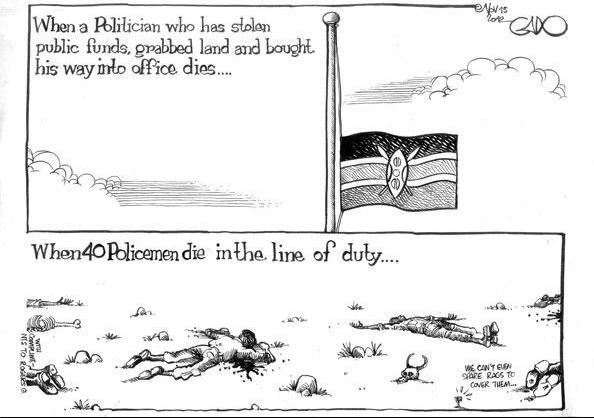
(credit: Gado)

The Tana Delta and Baragoi massacres exposed the failures of the intelligence and policing operations in the less-governed parts of Kenya (roughly the northern half and most of the east and southeast of the country). In both cases the government was caught flat-footed and unable to respond rapidly to emergent security threats.

A lot of finger pointing followed both incidents, with the police claiming that their hands were tied by strict laws on the use of force (thanks in part to the justifiably hyperactive human rights crowd in Nairobi) and the politicians blaming one another for incitement of the perpetrators of the crimes.

The latest incident in Baragoi has forced the president to order the deployment of the Kenya Defense Forces to assist in bringing to book the bandits behind the murder of dozens of policemen.

But the deployment of the security forces alone will not bring an end to the cycle of killings that have plagued Kenya in the last several months. In order to clean up the toxic mix of archaic cultural practices, local politics and economic interests, the government will have to be a little bit more broad and nuanced in its approach. What ought to be done about the cultural practices behind cattle rustling? How, if at all, are local leaders ever involved in these operations? What is the local political impact of these raids?

Which brings me back to the 2013 elections. The electoral commission has only one month beginning on Monday Nov 19 to register 18 million voters. Serious lapses in security that seem to be commonplace in large parts of the country do not inspire confidence in the agents of the commission who are supposed to traverse the whole country to build a new voter roll.

A failure to register enough voters for the election due to insecurity will de-legitimize the whole process, with dire consequences.

I hope that the electoral commission is following the investigations of these incidents of violence closely (especially since it has the power to punish those in contravention of election laws). Many Kenyans trust that the commission will be fair on election day. It is therefore not inconceivable that knowing that they won’t change the results after people have voted, crooked politicians have resorted to gerrymandering by other means – by dislocating certain pockets of voters or instigating violence to suppress voter registration and eventual turnout.
Kenyan Elections 2013 and The High Potential for Violence

In an excellent piece over at African Arguments Sheekh and Mosley give a comprehensive discussion of the recent outbreak of violence in the Tana Delta region of Coast Province, Kenya. According to the authors:

Long-standing competition and conflict over access to pasture and water resources were important factors, but did not alone provide the trigger for violence.  A range of political and economic factors have fed into the local dynamics in Tana Delta. These include longer-term trends related to alienation of local people from land due to large-scale government and private sector purchases, and shorter-term impacts related to the process of delineating electoral constituency boundaries and county districts in line with Kenya’s new constitution. The ready availability of small arms has also seen such conflicts intensify in recent decades. Lack of livelihood opportunities for the youth is also a major factor.

As such, the recent clashes are emblematic of wider trends.  Although the Tana Delta (along with the rest of Coast Province) has tended to be politically marginalised, tensions in other areas – such as Mt Elgon and parts of the Rift Valley including Eldoret, Nakaru and Naivasha, and counties in northern Kenya – could also be exacerbated by the same political factors.  Some of these areas were flash-points in the post-poll violence of late 2007 and early 2008, with major national and regional ramifications.”

Spot on.

The Tana Delta conflict is symptomatic of a larger dynamic that will play out in anticipation of the March 4th 2013 elections in Kenya. The new constitution has created 47 county governments, many of them multiethnic or otherwise diverse, that will each have three county-wide elected officials (a governor, deputy governor, and a senator). Ethnic and communal rivalries will inevitably surface in these county contests, with potentially disastrous outcomes such as what we’ve seen so far in Tana River County.

The potential for decentralized violence in Kenya’s 47 counties is a real cause for concern.

In order to limit the potential for violence, the national commission charged with policing ethnic harmony has initiated talks in potential flash-points to broker inter-ethnic power-sharing deals with the hope of avoiding a situation in which certain communities are totally excluded from county-wide elected offices. Sadly, so far there is no sign that these initiatives will work (Not to mention how un-democratic such back room arrangements will be). Plus the violence will not necessarily be exclusively of the inter-ethnic variety (which is what the commission is fixated on at the moment). Even ethnically homogenous counties might experience inter-clan violence.

While most of the attention in the next few months will be on how to avoid a repeat of the aftermath 2007-08 election, Kenya watchers should be warned that the problem will be much more complicated. If nothing is done, many counties will experience inter-communal violence. The new county governments will have real resources (about a third of national revenue) that will generate real patronage networks worth fighting for.

Given the nature of Kenyan politics, the race for the presidency (more blog posts on this soon) will inevitably hog all the attention in the next five months. I hope the contest for State House and its own risks for violence will not overshadow the county-level contests which will also be just as intense and likely to result in violence.

There is no way around the basics: Development will take time

I just read Chris Blattman’s response to the UK Prime Minister’s op-ed in the Journal. It reminded me of a lot of the things that I have been reading lately in preparation for my fieldwork (My dissertation will tackle the subject of legislative (under)development in Africa, with a focus on the Kenyan and Zambian legislatures).

Cameron’s sentiments in the op-ed are emblematic of the problems of development assistance. Like in all kinds of foreign intervention, developed states often try to externalize their institutions (and more generally, ways of doing things). These attempts often ignore the lived realities of the countries being assisted.

Forgetting the history of his own country (think autocratic monarchs, monopolies, limited suffrage), Cameron thinks that democracy, human rights and free markets (all great things) will magically create jobs in the developing states of the world. They don’t. In fact, they often lag the job creation process. For development assistance to be effective it must eschew these feel-good approaches to the problem of underdevelopment.

Blattman is spot on on a number of points:

  1. Unchecked leaders are bad for economic development (this is why I am so much into PARLIAMENTS!!!): Also, democracy is NOT synonymous with limited government. Heads of state like Queen Victoria or Hu Jintao or Bismarck or even Seretse Khama were in no measure democrats. However, they ruled under systems with strong (sometimes extra-constitutional) checks to their power. That made a difference.
  2. Institutions rule, yes, but the right kinds of institutions: 1688 moments do not drop out of the sky. They are often preceded by decades if not centuries of civil strife, economic change and plain old learning. Institutional development takes time. Plus each society requires its own unique and appropriate mix of institutional arrangements to meet unique economic and social needs. A procrustean approach to institutional development (embodied in global capacity building) will inevitably fail. Institutional development must never be allowed to be captured by those who think that we can transform Chad simply by having them adopt Swedish institutions.
  3. Growth will require creation of jobs, i.e. industrial development: The poor countries of the world need real jobs for high school-leavers and other less educated people. The present focus on the “sexy” entrepreneurial sectors – whether they are small businesses for the poor or tech hubs for the very highly educated – as the engines for growth in the developing world is misguided. I reiterate, starting a business is a very risky venture that should be left to the wealthy and the occasional dare devil. The poor in the global south need stable 9-5 jobs. Lots of them.

And lastly, where do strong institutions come from? There is no easy answer to this question. What we know is:

  1. History matters: Present countries with a long history of stateness have a better track record of building strong institutions for development. Yes, they may not always be democratic, but countries with a long history of centralized rule have strong states (and institutions) that deliver for their people (for more on this see Englebert and Gennaioli and Rainer).
  2. Democracy does not always create strong institutions: Since 1945 many have chosen to forget the fact that universal suffrage is a pretty recent phenomenon in the political history of the world. For the longest time world polities were ruled by power barons who held de facto power (as opposed to the procedural de jure power in democracies). When democracy came along after the Enlightenment the resulting structures of rule often reflected these de facto configurations of power. Over time institutions in these countries were cemented enough to allow for complete outsiders like say the current president of the United States to be elected without upsetting the balance of power (in another era he would have had to have mounted a coup). This is the challenge of the democratization in the new post-WWII states. How do you make democracy serve the interests of the people, rather that purely that of the elite? How do you use democracy to create strong institutions? Is this even possible? And if not, what other options do we have?

Kismayu Falls, Potential for Consolidation of Gains Still Unclear

Kismayu, the southern Somalia town that was the last holdout of Al-Shabaab has fallen. Kenya Defense Forces (KDF) took control of the town early Friday. It is still unclear what happened to many of the fighters that had dug in to defend the town from KDF and AMISOM.

Somalia recently elected a new president and has shown signs of getting its act together after more than two decades of anarchy.

I hope that AMISOM will consolidate the recent gains and that Somali politicians will seize this opportunity to lay the groundwork for peace and stability moving forward.

I also hope that for KDF’s troubles Somali townspeople in Kismayu, Mogadishu and elsewhere will soon get to enjoy the services and products of Equity, KCB, Uchumi, Nakumatt, among other Kenyan companies. Economic integration of Somalia into the EAC, and similarly South Sudan and Eastern DRC, will be one of the key ways of guaranteeing a lasting peace in these trouble spots and in the wider Eastern Africa region.

More on the developing story here and here. You can also follow updates from the al-Shabaab’s twitter handle @HSMPress.

Photo credit.

Free Schooling and the Education Gender Gap

We identify the impact of the 2003 Kenyan Free Primary Education (FPE) programme on gender imbalances in the number of students graduating from primary school and achievement on the primary school exit examination. Our identification strategy exploits temporal and spatial variations in the pre-programme dropout rates between districts in a difference-in-differences strategy. We find that the programme boosted primary school completion rates of both boys and girls, but had a larger effect for boys, thereby increasing the gender gap in graduation. Additionally, the programme led to a widening of the achievement gap in government schools. Overall, FPE increased educational access, but did not close gender gaps, suggesting that complementary programmes that specifically target girls may be necessary to reduce these gaps.

That is Lucas and Mbiti writing in the latest issue of the Journal of African Economies.

More on this here.

Is our children learning? (Credit to Bushism)

The Guardian reports:

More than two out of every three pupils who have finished two years of primary school in east Africa fail to pass basic tests in English, Swahili or numeracy, according to a new report, Are our children learning?.

The differences in performance vary both across and within countries:

The report found large differences in average test scores between countries in east Africa. Kenyan pupils perform best in literacy and numeracy. Ugandan children perform worst in the lower school years, but slowly overtake Tanzanian children and outperform them after six years in school.

But it is the within-country differences that are cause for a rethink of education policy in east Africa. Kids in private schools appear to do much better than those in public schools (the gap is most stark in Tanzania, 28 percentage points). The Ugandan school system appears to be the worst, with barely half of EVEN the private school kids passing.

In a finding likely to fuel the debate on public versus private schools, the report said students in private schools perform better than pupils in state schools in all three countries – a difference particularly marked inTanzania, where the pass rate among 10 to 16-year-olds for numeracy and literacy tests was 47% in state schools, compared with 75% in private schools.

“In part, the difference between Tanzania and the other countries is likely to be driven by the much smaller share of pupils attending private schools, even among the non-poor, suggesting they must be particularly selective,” said the report. In Kenya, the pass rate in private schools was 83%, compared with 75% in government schools, while in Uganda the gap was 53% to 36%.

As a product of the Kenyan public school system (and a Wazimba for life), I believe that public schools are the way to go. With some thought and innovation, public schools can be made to work – and in the process serve as the best chance for inter-generational SES mobility. The debate should be about how to improve public schools, as opposed to over the false choice of quantity vs. quality.

A possible model could be something akin to the Kenyan National Schools concept in which select schools across the country get extra resources not only to boost performance but also to act as testing grounds for new learning tools – which can then inform policy to help “Provincial Schools” catch up. Of course this would ineluctably create a multi-tier school system at the beginning, but it is arguably better than a system in which most (if not nearly all, see Uganda and Tanzania) public schools are failing.

It is important to note that in Kenya the best high schools have historically been public. With investment and openness to experimentation and innovation this tradition can be maintained.

H/T @AAA_ipregroup 

Energy in East Africa

Still on my ongoing project on commodities in Africa, I came across an interesting piece on prospecting for oil in East Africa in which an industry expert had this to say:

The success rate in this region is outstanding. To provide some context, oil and gas exploration typically has a success rate just 10-20%. That’s terrible when you think about. It can cost $50 million to sink an offshore well, and the chance of making a financial return could be as low as one in ten.

But East Coast African energy exploration stands out from the crowd because in all but a few cases they hit oil or gas. To be exact — the success rate has been 87%. A strike rate of close to 9 out of 10 is almost unheard of.

Kenya, South Sudan and Uganda have commercially viable oil reserves. Tanzania has gas and, together with Kenya, has stepped up offshore prospecting in the Indian ocean.

And it is not just foreign MNCs that are in on the game. Locals, in collaboration with foreign investors, are also getting a piece of the energy bonanza in East Africa. Business Daily, a Kenyan paper, recently profiled one George Kariithi, a businessman who started off as a marketing executive and has since built multiple companies in the wider region. His latest investment is in Kenya’s emerging coal sector.

The Material Value of the Kenyan Presidency

The following campaign message by Martha Karua, a presidential candidate in Kenya’s election in March of 2013, highlights the material value of the Kenyan presidency.

“Tufanye hesabu tena…Let’s count the cost and keep all of us accountable. A recent research suggested that some presidential candidates will spend as much as Ksh. 11 billion shillings ($130 million) each to try and capture the presidency. Now, at around Ksh. 3.2 million a month including allowances, the President of Kenya earns Ksh 38.4 million ($452,000) a year, much more than what President Obama, the German Chancellor and the PM of England earn, and which translates to Ksh. 192 million in a five year term. So in one five year term, the most a president can hope to earn is around Ksh. 192 million, quite a substantial sum by world standards.

My question; why would anyone spend Ksh. 11 billion to only earn Ksh. 192 million? Does this math add up to you dear Kenyans? How would that individual be hoping to recover the remaining Ksh. 10.78 billion to cover their campaign expenses including buying of votes and bribery? The answer is simple! Corruption and impunity! Inflated government tenders to well connected family and friends. These inflated tenders drive the cost of living for all Kenyans sky high, the very reason ordinary Kenyans can barely make ends meet last 49 years!
Do the Math!”

Saitoti, Ojode Dead in Copter Crash

Internal security minister George Saitoti and his assistant Orwa Ojode died in a helicopter crash in Ngong Forest on Sunday. Messrs Saitoti and Ojode were headed to Ndhiwa in Nyanza Province. The cause of the accident is unknown. Five other people died in the crash.

More on this here.

More on Drug Trafficking in Kenya (Complete Edition)

The scary part of all of this is that President Kibaki’s alleged mistress and daughter are implicated to have been at the center of a drug trafficking ring. The elite presidential escort group was involved in the protection of Armenian drug traffickers.

The only good thing in all of this is that KTN has been able to air the truth, despite earlier attempts by the police to intimidate the two investigative journalists.

[youtube.com/watch?feature=player_embedded&v=q4RAAwz9jko#!]

Reality Show Meets Agricultural Extension in Kenya

[youtube.com/watch?feature=player_embedded&v=lQABDLVoQWM#!]

H/T The Guardian.


Kenya’s Obscene Politician’s Salaries: Still a Problem

President Kibaki will probably not win the Mo Ibrahim Prize because of his questionable reelection but he sure will leave office a happy man.

According to the Star:

“When President Kibaki walks out of State House after the next elections, he will go home with a hefty gratuity—Sh50 million. The gratuity, the highest to be paid in the history of the country, has already been factored into the 2012/2013 budget by newly appointed Finance minister Njeru Githae.

Apart from the one-off payment of the gratuity, Githae also proposes to increase the annual allocation for retired presidents from the current Sh17.7 million to Sh30.2 million. The increase is meant to cater for the monthly pension which is due to Kibaki plus what taxpayers have been paying Moi since he left office in early 2003. The two will continue to draw the pension for the rest of their lives.”

“……Kibaki will also be entitled to get a monthly pension equal to eighty per cent of his current monthly salary. Kibaki is currently paid a basic monthly salary of Sh2 million (about $26,000) and earns an average of Sh24million ($200,000) a year under the current exchange rate.”

The figures are actually a bit off. Under current exchange ranges 2 million Shillings a month amounts to about US$300,000 annually. Not a bad deal at all.

These figures, however, raise questions about compensation packages for politicians in Kenya. Recently the treasury bribed MPs to pass the new budget and to be nice to the banks with a “gratuity” amounting to almost US$50,000. This on top of their already obscene annual salaries which stand at US$ 161,000, excluding other shady allowances that are never included under official pay. The last time I checked, all things considered, these MPigs (as they are derisively called locally) make upwards of US$174,000.

Per capita income in Kenya (in current dollars) stands at around US$800, with about 40% living below the poverty line.

I have argued before that paying MPs a decent salary may make them less amenable to executive manipulation (For supporting evidence see Barkan and Co. on legislative strength in Africa). But this just takes it too far.

Spring break reading list

I just finished reading Daniel Branch’s Defeating Mau Mau, Creating Kenya. It is an excellent blend of an academic take on theories of violence and counterinsurgency and a historical narrative of Kenya’s war of independence (as I was taught in primary school) or the “Kikuyu civil war” (which is a lot closer to the truth). The book sheds light on the foundations and dynamics of the Mau Mau rebellion and dispels previous accounts which argue that the cleavages that defined the war (Mau Mau vs. loyalist) was primarily class-based and existed before the onset of the rebellion in 1952. I highly recommend the book for the readers interested in Kenyan history or COIN, or violence and civil war.

I also currently reading William Reno’s Warfare in Independent Africa, an account of the evolution of the nature of civil wars in Africa and the type of leaders that led them. Reno groups Africa’s rebel groups into anti-colonial rebels (e.g. FRELIMO), majority-rule rebels (a southern African animal, e.g. SWAPO), reform rebels (who fight against oppressive regimes, e.g. RPF, EPLF, etc) parochial rebels (who fight for circumscribed community rights e.g. OPC in Nigeria) and warlord rebels (e.g. LURD, NPLF, etc).

The book gives an account of how the socioeconomic origins of rebel leaders and the wider political context in which they operated influenced the trajectories of conflict in African states over time.  It also attempts to tackle the question of why most African rebels (even those from Ruritania) have tended to fight for the capital instead of secession, even in states with limited capacity like the DRC (this is however changing, Sudan, Somalia, and Mali are good examples). If you had lingering questions after reading Jeremy Weinstein’s Inside Rebellion (on the industrial organization of rebel movements) then this is a good book for you to read.

Lastly, I finally took Debt, The First 5000 Years by David Graeber off the shelf. Graeber is an anarchist anthropologist who was one of the brains behind the Occupy movement. I took his last Intro to Cultural Anthropology class at Yale before he got fired. Graeber sometimes goes into the deep end, but his ideas are refreshingly provocative. I look forward to reading it and availing my comments soon.

Also need to get my hands on this book when it comes out.

kCSE results to be released tomorrow

The 2011 Kenya Certificate of Secondary Education (KCSE) results will be released tomorrow. The exam is a make or break affair for most students since it is the key determinant of whether they will continue on to college or drop off the education ladder and join scores of unemployed youth with limited economic prospects.

These results will be the first since the 2008 introduction of subsidized high school programmes.

This year’s high school leavers will still have to wait for about two years before they can join university – an artifact of the Moi Administration going back to the early 1980s when universities were shut down for an extended period due to political unrest.

I do not have the exact numbers but know that the duration of time between leaving high school and joining university for the average Kenyan student (who does well enough in high school) is closer to 6+ years than 4 years. Both the Moi legacy and intermittent strikes by lecturers and students are to blame for this massive waste of young Kenyans’ time.

Njenga Karume dead at 83

Former Defense Minister and GEMA leader Njenga Karume is dead at 83. Mr. Karume succumbed after a long battle with cancer.

The late Karume, who made most of his money from the beer distribution business, was one of the most influential and richest politicians among the “independence generation.” Njenga Karume was mostly a self-made man (His autobiography is titled “Beyond Expectations – From Charcoal to Gold”). With little formal education (many Kenyans know of his “wananinji” pronouncements), he managed to create a business empire that catapulted him to the boards of many a Kenyan company. Being the leader of the powerful GEMA cultural bloc and a close ally of President Kenyatta certainly also helped.

May he rest in peace.

The passing of Njenga Karume comes just four days after another veteran politician and also close friend to President Kibaki, John Michuki, passed away. It is hard not to think that time is beginning to catch up with the political elites who led Kenya’s independence generation. Indeed this year’s general election will be the first without a leading independence leader in contention for the presidency (Theirs sons and political scions will duke it out).

The natural generational change is certainly a cause for excitement; peaceful elite rotation mostly leads to positive outcomes. But at the same time I have the nagging feeling that the 50 and 60 year old “young turks” who are about to take over may lack the encompassing interest that the “wazees” shared (Notice how nice Kibaki has been to former President Moi). Yes, they were not always good people –  the deaths J. M. Kariuki and Tom Mboya forever remains a blotch on their record – but you have to give it to them for holding it together even when things were falling apart all around the neighborhood.