Our man in Mogadishu

QUICK UPDATE:

Two separate minor explosions rocked Nairobi in the last 24 hours, one at a club on Mfangano Street and another at OTC. One person has been confirmed dead and several people were injured. By targeting ordinary Kenyans in the eastern reaches of the city (instead of other soft targets in upper class parts of town) al-Shabab’s strategy seems to be one of forcing the Kenyan public to pressure the government to stop the military operation in Somalia.

My hunch is that they are mistaken. The Kenyan military did not go into Somalia because of public pressure but because of a desire to restore confidence in the tourism sector and possibly after a little prodding from the US and France. And killing innocent Kenyans will only harden public resolve to have the al-Shabab kicked out of Eastleigh.

*********************************************

Somali President Sheikh Sharif Sheikh Ahmed says Kenya’s campaign against Al-Shabaab rebels should not go beyond training Somali soldiers and provision of logistical support in specified and agreed areas.

Speaking while on a visit to the the frontline of the war between his government’s forces and the Al-Shabaab, President Sharif stated that many Somalis were anxious to know more about the military operations reportedly being carried out inside Somalia by Kenyan troops.

Several factors can explain why a beleaguered president, unable to leave a restricted section in his capital, would oppose help that could help stabilize his country.

  1. It could be a domestic politics issue. Leaders of occupied states – e.g. Afghanistan and Iraq – often have to juggle the dual roles of public opposition and private support of foreign troops in their territory. Understood this way, we should brush aside Sharif Sheikh Ahmed’s opposition to the Kenyan troop presence in Somalia as a mere PR exercise.
  2. The invasion could be harming the president’s interests. After two decades of life without a central government nearly all of the Somali elite have dirty hands. Mr. Ahmed, himself was once the commander in chief of the Islamic Courts Union, a parent of al-Shabab. He is also from South Somalia, where Kenyan troops are currently stationed. By routing al-Shabab and all potential for organized armed organization, the Kenyan invasion might actually be taking the rug from under Ahmed’s feet. His election to the Somali presidency was not because he was the most peaceful of the warlords.
  3. The invasion might undermine other interests within Somalia that the president relies on. The piracy trade on the Indian Ocean is a lucrative business that is allegedly fueling the property boom in Kenya, especially in Nairobi. I would be surprised no one in Mogadishu had a hand in this and other shady operations such as gun-running in the wider Eastern African region. Kenyan stated goal of capturing Kismayu will most certainly disrupt these businesses, with huge financial consequences for the real Big Men involved. Mr. Ahmed might just be protecting the interests of those he depends on.

Whatever the case one hopes that Somalis in the south of the country will not, in their president’s utterances, find justification to actively undermine the Kenyan mission to deny al-Shabab of an operating base.

Meanwhile two grenade explosions have hit Nairobi in the last 24 hours, with one person confirmed dead.

Also, after a week of rallying around the flag in support of Operation Linda Nchi, the Kenyan media is beginning to ask questions about planning and long-term efficacy of the Somalia mission. It is unclear just how much uncertainty, about their own physical security, Kenyans will tolerate as the government continues to execute the war against Al-Shabab.

Kenya at War

UPDATE II: John Campbell over at the Council on Foreign Relations discusses the extent of US and French assistance to the Kenyan invasion of al-Shabab controlled regions of Somalia. Check it out here.

UPDATE: Reaction to the Expert Comment from Middleton at Chatham House:

Middleton makes good points about the Kenyan invasion of al-Shabab-held regions of Somalia. The Ethiopian failure in 2006 and potential for a humanitarian crisis must certainly be part of the cost-benefit analysis on the Kenyan side. Failure to establish a secure buffer zone in Southern/Western Somalia and/or to defeat the al-Shabab will definitely have serious consequences.

But the alternative is worse. Al-Shabab elements kidnapped aid workers in Dadaab, in a clear signal that they are willing to disrupt humanitarian aid not only within the areas they control but also within Kenyan. In addition, it is important to appreciate the gravity of the al-Shabab threat to Kenyan security. If al-Shabab is allowed to continue operating within Kenya it may morph into a more dangerous domestic insurgency with a ready supply of disaffected groups – Kenyans in the North East who for decades have been neglected by Nairobi and have legitimate reasons to express those grievances by organizing around such a movement.

In addition, unlike Ethiopia in 2006, Kenya is in Somalia purely for national security purposes. Ethiopia had the baggage of the Ogaden War and the Somali-backed insurgency in its own Ogaden region. Plus it was very clear at the time that the US was bankrolling the Ethiopian war effort – the ICU obviously used this to develop a narrative of western-backed “Christian Ethiopia” invading a Muslim country. Al-Shabab, at least for the moment, does not have the advantage of defining the Kenyan military operation in their own terms

[It is interesting that neither the Kenyan parliament nor presidency has officially declared war on anyone. It is the internal security and defense ministries that have been running the show].

Al-Shabab has been severely weakened around Mogadishu. The ongoing famine has also served to weaken their control of Somalis’ hearts and minds. Their remaining stronghold is the port town of Kismayu whose capture will deprive them of an important supply route and source of revenue (via Indian ocean piracy). If there was ever a good time to try and defeat the group in the battlefield (especially since they have refused to negotiate with anyone), this is it.

********************************************************

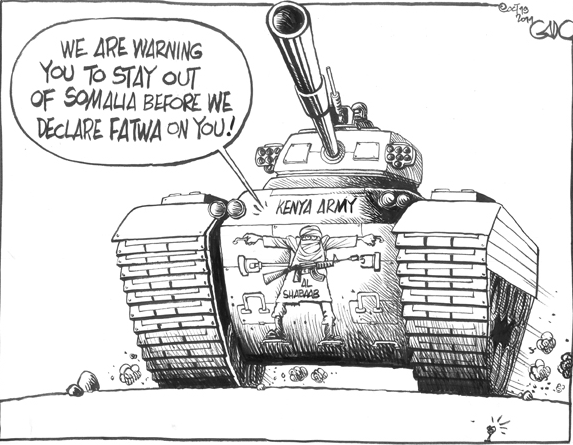
On Sunday the Kenyan armed forces moved into Western/Southern Somalia. The invasion was occasioned by recent kidnappings of tourists and aid workers near the border with Somalia. Al-Shabab, the proscribed terror group in Somalia, is suspected to have been behind the kidnappings, although it denies the charge.

The invasion is a clear signal of the failure of Kenya’s previous policy of strategic containment of the “Somalia problem.”

Source: Gado, Daily Nation

As of Tuesday the Kenyan army had advanced more than 100 miles into Somali territory, although bad weather has significantly slowed the advance. The target town is Al-Shabab’s stronghold port town of Kismayo. The DoD spokesperson Emmanuel Chirchir is reported to have said that “The troops are ready for anything. If it takes us to December they are willing to celebrate Christmas there.”

The invasion comes at a difficult time for the country and will no doubt generate significant economic and political consequences.

Inflation is at over 17%. The Kenyan Shilling is struggling against the US dollar. And the rate of economic growth appears to have slowed from a projected annualized rate of 5.6%. The increase in military expenditure amid high inflation, a severely weakened Shilling and calls for fiscal austerity will surely have a negative impact on future growth prospects. For more on this check out the Business Daily.

On the political side, success in routing al-Shabab will be another feather in retiring President Kibaki’s hat.

Failure might ignite a backlash against the country’s military establishment. It will be interesting to see how the political class deals with failure, since this is the first time that Kenya has ever undertaken a military operation of this scale. My take is that the military, as an institution, will take the fall in case of failure. Because of their ethnicized nature, previous lapses in security in the borders with Ethiopia and Uganda did not create that many problems for the pols in Nairobi. That said, this time might be different because of the nature and scale of the threat.

Of interest will also be how this military operation affects civilian control of the military.

Experience in many less institutionalized countries shows that heightened militarization results in diminished civilian control of the military – with the potential for coups.

I doubt this will be the case in Kenya. However long “Operation Linda Nchi” takes the result will be closer to the Tanzanian invasion of Uganda in the late seventies than to cases where military adventurism resulted in the overthrow of an incumbent (like in Siad Barre’s Somalia). Civilian control of the military in Kenya remains stronger than in most African countries.

Beyond matters of civilian control of the military it is important to consider what the repercussions will be for ordinary Kenyans. Many fear that the al-Shabab might strike Kenya where it hurts most – in Nairobi. This is a real possibility that one hopes the Kenyan government has planned for.

Also, in the event of a protracted war or a major terrorist attack by al-Shabab within Kenya there is the possibility of a backlash against Kenyans of Somali extraction. While this might happen among the masses I doubt that any of the major political figures will actively promote such a misguided reaction. North Eastern Kenya is an important voting bloc that the presidential front-runners in next year’s general election will want on their side (Mr. Odinga, the Kenyan Prime Minister is particular keen on this voting bloc). In this regard the fact that blatant scapegoating of Somalis will have negative political consequences is a source of mild comfort.

The editorial pages of the major newspapers in Kenya have all been solidly behind the invasion. Quoting the Business Daily:

Kenya’s foreign policy has at best been mild and at worst meek.

The nation has been out of the regional combats even when incursions took place in its territory, opting for peaceful resolutions.

This has happened in the Kenya-Ethiopia border during the Oromo wars and during the Ogaden War when Kenya opted for peace parleys rather than battlefield tussles.

But this dud non-aligned policy of the 1960s, exacerbated by the extinguished Cold War, holds no place in the current political order where terrorism and banditry has replaced conventional wars.

There were few options left for Kenya. One, they cannot let the al-Shabaab militia group continue to with their raids oblivious of our military power. Secondly, the sovereignty of our nation, and our pride was undergoing severe test.

The al-Shabab extremism must come to an end.

Drought is an act of nature, famine is man-made

Check out this new campaign video by ONE.org

[youtube.com/watch?feature=player_embedded&v=dzcRSr6PW_o]

You can sign the petition here.

HT HuffPost

Prof. Wangari Maathai passes on

I remember as a kid watching TV and seeing a woman who was the head of the greenbelt movement being chased around by armed policemen. All I knew was that she was fighting to protect Karura forest and freedom corner in Nairobi from land grabbers. This woman was Wangari Maathai, the first woman in eastern Africa to receive a PhD. She would go on to win the Nobel Peace Prize and do all Kenyans proud.

For many Kenyans Prof. Maathai was the face of activism against environmental degradation and misuse of natural resources. Her organization, the Greenbelt Movement has planted more than 20 million trees across Africa.

According to her family Prof. Maathai died “after a long and bravely borne struggle with cancer.”

She will be forever remembered as a key part of Kenya’s Second Liberation.

Hand Relief International

Something for the humanitarian and aid communites to think about, courtesy of Hand Relief International.

Among those in the know, another fact has not remained unnoticed: there is more money flowing in than used to and that, reader, is excellent news.

The shit continues to be real in Nairobi, the dignified hub of any meaningful Somalia project, with necessary field trips to Dadaab, where HRI has quickly  set up cutting-edge infrastructure to ferry high-flyers through, complete with up-to-the minute roster of the photogenic fresh arrivals that can be summoned in an instant with their families for that perfect picture, should the visitor require one for the cover of their all-important trip report or their obligatory article in newspaper of choice back home.

More on this here.

HT Blattman

quick hits on Zambia and beyond

In case you missed it, Zambia is a middle income country – at least according to the Bank. This sort of shows in some parts of Lusaka. But Zambia is also a highly unequal and very poor country. Most people in the countryside have nothing else to do but subsistence farming and burning charcoal. The economy is also heavily dependent on mines and foreign owned consumer goods outlets from South Africa and beyond. Which is sad really, given how much arable land it has.

Does anyone know why Zambians use military time? Forget 4 PM, it is 16 hours in Zambian time. The people I have asked have speculated that it is a legacy of the mining industry. I find it fascinating. Taxi drivers think I am weird every time I bring it up.

Also, why is everyone in Lusaka out to some workshop???? Seriously. This is a big problem here. I have had to cancel about five appointments because the only person at the office was the security guard. When do people have time to do their work?

Moving a bit beyond Zambia, be sure to follow the Kenyan cases at the ICC. I am withholding blogging on the issue until the pre-trial judges make their decision. Whichever way they go it will have important ramifications for Kenyan politics. Next year is a make or break for Kenya.

Be sure to check out the Economist’s piece on South Sudan. The teething problems for the new nation will be epic and will take time to go away.

And lastly, check out Jim Fearon on Libya. HT Platas-Izama, who has a new blog here.

The decline of odious ODA?

The Economist has a piece outlining the paradox of Indian overseas development assistance (to the tune of 11 billion over the next 5-7 years). With figures from the CIA factbook I have calculated that about 300 million indians live below the poverty line. The Economist piece also touts the emergence of middle income donors, especially among the BRICs.

In this world Europeans and Americans no longer dominate aid. China is the biggest source of investment in Africa and the Gates Foundation is as important as many donor governments (and much more innovative). Private capital flows to Africa outstrip aid flows, contradicting an old justification that aid is necessary because investors hold back.

For the poorest, the new donors are more important because Western aid is shrivelling. Congress is proposing to chop American aid by a fifth. Brazil is giving more to the Somali famine than Germany, France and Italy combined. There are exceptions: Britain and Australia promise to boost aid spending. But they seem like a last hurrah of Western generosity.

Adding that:

In this new world the justification for aid and the behaviour of donors must change. For India and others, it is far from clear why the government should send aid abroad when it has so many poor people at home. No doubt, aid will be defended as a boost to global influence. The risk for India is that, just like the West did in the 1960s, it will pour money into grand projects which fail—and encourage bad government.

I disagree with this latter assessment. It is not aid per se that caused the epic governance problems facing most of the low-income countries of the world. Sure it stunted the co-evolution of accountable government and domestic revenue generation. But the biggest failure of aid was what it was spent on.

Aid being highly fungible meant that most of the money wound up in the private accounts of venal leaders and gun-runners.

Things have since changed a bit. For instance, China’s resources-for-infrastructure deals can be a model for Aid 2.0 (this no doubt needs some tweaking too, as this damaging expose on Sino-Angolan oil deals shows). Plus this time the infrastructure investments are different. In an earlier period most of the investments were overtly white elephant projects (like Moi’s infamous hydro-electric dam in Turkwel). Most of the current projects are in roads, telecoms, and to some extent agriculture – investments that will have a much bigger impact because of their broader reach.

You can find a related earlier post here.

Will be blogging sporadically for the next week

Dear readers, I have been away for a bit. Research/work and running the San Francisco half marathon (see images below) have kept me from blogging. I am back but will only be blogging sporadically for the next week or so.

In other news, next Thursday I head home to Kenya for a short vacation. My trip will also include brief visits to Uganda and Tanzania and an extended trip to Zambia (I will be there for the elections) before coming back to the Bay Area for year 3 of (hopefully) 5 of grad school.

Stay tuned.

Here are my marathon pictures.

Mediocre leadership is the biggest crime against humanity

The saying goes that when the tide runs out you get to know who has been skinny dipping. In the same vein, it is when disaster strikes that you get to know who has mediocre leadership.

The ongoing famine in the Horn of Africa, the worst in 60 years, has exposed eastern African leaders for who they are. The Ethiopian and Eritrean governments for a while even refused to acknowledge the humanitarian catastrophe in their hands. The Kenyan government spokesman would not admit that any Kenyan has died from the famine. Kenya, the region’s biggest economy, is a lesson in the dangers of mediocre leadership: Meteorological warnings from two years ago were ignored; Money for food aid ended up in private bank accounts; and The government lacks any coherent agricultural and food security policies.

And because of it all, this is happening [please pardon the famine porn, but we need to see how REALLY bad things are]. 3.5 million Kenyans face starvation. 11 million in the wider region are affected.

In the last two days I have followed news stories on the situation in northern Kenya. I can only imagine how things are in the epicenter of the famine in Somalia and the Ogaden region of Ethiopia.

A lot of blame has been flying around. According to Jeff Sachs:

“The warning is also clear. The Horn of Africa is the world’s most vulnerable region, beset by extreme poverty, hunger and global climate change, notably a drying and warming of the climate during the past quarter century.”

adding that

“The west has contributed to the region’s crisis through global climate change that victimises the lives and livelihoods of the people of the region.”

In my view, however, the blame squarely lies with the region’s leadership. It is the leaders who have consistently refused to plan ahead, opting instead for palliative measures like food relief with lots of opportunity for graft. Blaming western colonialism, neocolonialism, climate change, etc are nothing but distractions. This problem and many other African problems are for the most part just that, African problems.

That millions of shillings in aid money was stolen, thus endangering millions of lives in northern Kenya, is a moral travesty. To add insult to injury, no one has yet been arrested or charged with the crime. It is Kenyan officials who have sat by and in some instances (in the past and now) even contributed to the endangerment of the lives of 3.5 million citizens of Kenya.

The usual perpetrators of crimes against humanity – warlords and their militia – kill with guns. But corrupt and mediocre civilian leadership continues to decimate millions more through both inaction and well calculated mis-allocation of resources.

Because of the famine 800,000 children in the wider region could die from malnutrition.

Food aid is definitely not a long term solution. But here is how you can chip in to help those affected by the famine.

quick hits

Mau Mau veterans allowed to sue the UK government for atrocities committed during Kenya’s independence rebellion. The court might have just opened a pandora’s box for a whole lot of lawsuits.

Kim on the ongoing protests in Malawi. Kenya’s Daily Nation reports that at least 12 people have died in the protests over the last two days.

Pardhan on the limits of the NGO movement in global development.

Some cool graphics showing the cellular connection map of the US.

The US will, after all, be sending humanitarian aid to Al-Shabab controlled areas suffering the ongoing famine in Somalia. I hope this does not turn into a farcical repeat of Ethiopia in the 1980s. Back then food aid was used as a weapon of war by both government and Meles Zenawi’s rebel forces.

Lastly, remember Glencore? The firm that has been involved in not so clean mineral deals in the DRC? Well, they are now in South Sudan. I hope Juba doesn’t go this route. You can’t stay clean while playing with someone covered in mud.

The EAC needs a defense pact

UPDATE: The Government of South Sudan has barred people of Somali origin from entering the country by road for “security reasons.” This wrongheaded move has created an awkward situation since not all people of Somali origin are from Somalia. In Kenya, for instance, a good chunk of the long haul transport sector is run by Kenyans of Somali origin.

********************************************************

The Ugandan government recently went on a $1 billion shopping spree for six fighter jets. The deal, which almost broke the bank, made a significant dent on Uganda’s forex reserves. Many, while acknowledging the risks that might have motivated the purchase, have questioned the wisdom of spending that much money on six jets.

For those not in the know, the key motivation for Museveni’s purchase was a desire to project military power in the region for two key reasons:

Firstly, in order to create a market for Ugandan light industries – cooking oil, soap, etc – Kampala has had to project military power to help in the pacification of pockets of eastern DRC and northern Uganda/South Sudan. These markets are crucial because they create jobs in Uganda, allowing Museveni some room as he continues to preside over Uganda’s decline into a dysfunctional police state.

The second reason was Museveni’s desire for military grandeur in the region. Kigali and Khartoum are not in the best of terms with Kampala. Museveni is probably suspicious of a potential Odinga presidency in Kenya. For these reasons, the Ugandan military establishment – the real rulers of Uganda – might have wanted to ensure that non of their neighbors are in a position to bully them in the near future.

While most of Museveni’s militarism is inspired by a mentality from a bygone era, I find Kampala’s fears against Khartoum as legitimate grounds for a regional defense pact. It is an open secret that Khartoum will try as much as it can to destabilize the new government of South Sudan (and by extension the wider region). And they have a few options:

  • They can foment civil war within South Sudan – there are a lot of disgruntled armed bands within South Sudan who might decide to take their chances with Khartoum; Remember that even Riek Machar, the current vice president of South Sudan, formed a Khartoum-backed splinter group (SPLA-Nasir) that fought Garang’ back in the early 1990s.
  • They can use armed groups in the wider central African region – including Kony’s LRA and the plethora of roving bandits in eastern DRC to engineer insecurity in South Sudan. Khartoum has used the LRA against SPLM in the past.
  • They can invade in an all out war. This option is the riskiest because of its potential to generate international opprobrium. But remember that Ethiopia and its secessionist former province Eritrea fought a bloody war that generated nothing but “stern” warnings from the UN and the wider international community. The US even armed Ethiopia because it needed Addis Ababa to fight its war in Somalia.
  • Lastly, they can use non-conventional tactics. Terrorism is slowly growing in the wider east African region. So far Eritrea has been the biggest state sponsor of terror in the region – mostly aimed at Ethiopia in the Ogaden, Oromo land and Somalia. The involvement of Ugandan and Burundian troops in Somalia has created even more enemies for these groups. There is no reason to believe that Khartoum would not use these same groups to destabilize South Sudan, if for nothing then as a survival tactic for a beleaguered Bashir administration that will forever be blamed for having lost the South’s oil.

Needless to say, an unstable South Sudan is bad for the region. Period.

The proliferation of small arms is already a major problem in the areas bordering the Ilemi triangle and eastern Uganda. That instead of sticks pastoralists have to roam around with AK-47’s says it all. More conflict in South Sudan will only make a really bad situation even worse. The potential for proxy wars within the region would also be an unnecessary drain on limited resources. Because of various interests in Juba, an aggression by Khartoum against South Sudan will definitely be met with reaction in one form or another from Kenya, Ethiopia and Uganda.The conflict will definitely be regionalized. Lastly, Eritrea’s bad habit of supporting terrorists should not be permitted to catch on. Khartoum must know that if it tries this dirty tactic it will be met by more than just resolutions from the AU, IGAD or the UN.

Which is why I think that the EAC should have a robust defense pact. War should have to be a last resort. But that does not mean that the East African Community should not prepare for such an eventuality, if it arise.

That way, no single country will be burdened with the task of buying all the necessary hardware needed to keep Khartoum deterred.

Such a plan would face significant challenges, of course – key among them the fact that the region’s armies are non-professionalized. A functional defense pact would require near total civilian control of the army. Only Kenya and Tanzania come close to this in the EAC. Rwanda, South Sudan and Uganda are dominated by their respective armies. Burundi can’t even win against rebels within its territory and remains a militarized tin pot dictatorship. And Ethiopia, if it were to join, is still dominated by the remnants of the rebellion that ousted Mengistu.

These challenges aside, it might be worth a try. Such a pact might even help professionalize and de-politicize the officer corp in the region’s armed forces.

And the biggest winner if this were to happen is MORE regional trade.

The potato beats Maize, and most other Old World staples

The price of maize in Kenya and the rest of east Africa has hit the roof. The wider Horn of Africa region is currently experiencing its worst drought in 60 years, with thousands of refugees streaming into Kenya from Somalia every week.

10 million people in the wider Horn of Africa region are at risk. Kenya is already planning on opening a third refugee camp (besides Dadaab and Kakuma) to accommodate Somali refugees fleeing the famine.

Africa is the last major world region yet to experience a green revolution. Subsistence agriculture, in my view, is the culprit. Governments in the region must seriously come up with plans to consolidate and commercialize agriculture asap.

Having upwards of 70% of people dependent on subsistence agriculture is simply not sustainable. Period. To paraphrase Adam Smith, specialization determines the extent of the market AND the complexity and size of the economy. [italicized text mine]

As the region mulls over its agriculture and food policy it might help to consult Nunn and Qian’s new paper in the latest QJE. The paper makes the argument that the potato beats most of the Old World staples as far as a balanced supply of nutrients and calories is concerned (p. 604-5).

Maize is unable to rival potatoes in terms of nutrients or calories. It produces significantly fewer calories per acre of land. Moreover, humans are unable to subsist on a diet that is too con- centrated in maize. Significant consumption of maize is associated with pellagra, a disease caused by niacin deficiency. The effects of pellagra include skin, digestion, mental disorders, and, if un- treated, eventual death. The disease was first observed in the 1730s in Italy and even today continues to affect poor populations with diets that rely too heavily on maize. A second adverse effect of a corn-heavy diet is protein deficiency (Messer 2000a).

Sweet potatoes are also nutritious and produce similar amounts of calories per acre of land as potatoes, but they differ from potatoes in two important ways. First, the archaeological evidence suggests that sweet potatoes, transported by Polynes- ians, reached the Old World long before the European discovery of the New World. For many countries in our sample, their impact would have been felt as early as 1000 (Hather and Kirch 1991). Second, a close substitute to the sweet potato, the yam, already existed in the Old World (O’Brien 2000). Yams are broadly simi- lar to sweet potatoes in terms of both nutritional content and the requirements for cultivation. Many regions that were suitable for cultivating sweet potatoes had already cultivated yams when the former were introduced.

The New World staple, cassava, which is also called manioc or yuca, also provides abundant calories. But its deficiency in pro- tein and other important nutrients causes it to be a less “complete” food than potatoes (Cock 1982). In addition, because cassava con- tains toxic cyanogenic glycosides (e.g., cyanide), failure to properly prepare cassava causes konzo, a neurological disease that causes paralysis.

Welcoming Southern Sudan to the EAC

UPDATE: A related article on Uganda’s influence in the soon to be independent South Sudan can be found in the New York Times.

In three days the East African Community will celebrate the independence of its next newest member. Because of SPLM connections in Kenya, among other East African nations, the Southern Sudanese economy will most likely orient itself southwards.

Kenya’s Vision 2030 development plan, for instance, will link Southern Sudan to the Indian Ocean coast via a pipeline and railway line. Oil from South Sudan is currently exported through Port Sudan, 3,000 kilometres away. The planned link to Lamu would reduce that distance to 1,700 kilometres.

For Southern Sudan, economic ties with its southern neighbors will not only grant it access to much needed capital and skilled labor but also implicitly guarantee it security against its menacing neighbor to the north.

I doubt that Kenya, Ethiopia and Uganda will sit on their hands if the north decides to bomb local offices of Equity Bank, Ethiopian Airlines or Ugandan retail outlets in Juba (Remember the “Kenyan” tanks fiasco?). It also helps that IGAD has suddenly woken up to the security challenges posed by proxy wars among its member states. Kenya’s president, and current head of IGAD, recently chastised Eritrea for its ties with militant groups in the region.

IGAD will provide yet another forum for the region to put pressure on Khartoum to honor the CPA and not resort to war.

Several Kenyan companies have already set up shop in Juba. About 70,000 Kenyans live and work in Southern Sudan. According to the Business Daily:

Although several major Kenyan companies like Equity Bank, KCB, UAP Insurance and many small enterprises operate in South Sudan, the independence declaration on July 9 is expected to trigger another wave of corporate movement there.

Bidco Refineries that has a dealership in South Sudan, for example, is expected to consider having a physical presence there, said the company’s CEO Vimal Shah in an earlier interview. Kenyan manufacturers are, however, discouraged by low consumption levels and shortage of power, water and sewerage systems.

Co-operative Bank of Kenya is also expected to start setting up its banking infrastructure with a new venture that will be 30 per cent owned by the Government of South Sudan.

The new bank is expected to benefit from government business as it will process salaries of government employees and enjoy business arising from the government’s shareholding in the venture. The peaceful aftermath of the January 9 referendum that voted for secession from the North has helped to improve the country’s risk profile.

To the Swahili speakers out there

Jaguar’s latest hit Kigeugeu is currently quite popular in the Swahili world. The song highlights the breakdown of trust and probity in Kenyan society – according to jaguar, everyone (his wife, his pastor, doctors, politicians, bureaucrats, etc) is janus-faced (kigeugeu).

Here is the official video of kigeugeu.

No ICC hearings in Kenya

The ICC Pre-Trial Chamber Judge Ekaterina Trendafilova on Wednesday decided that the trial of suspects of the 2007-08 election violence in Kenya will not be held in the country.

Great move.

I am of the view that holding the hearings in Kenya would have created an unnecessary distraction from the important task of implementing Kenya’s new constitution. Already, the bigwigs accused of masterminding the violence that killed 1300 and displaced over 300,000 Kenyans have ethnicized their predicament. Holding the hearings in Kenya would have handed them an opportunity for a circus of ethnicity-charged rallies and demonstrations in Nairobi.

The ICC continues to be a source of debate in Kenya and across Africa. Many have faulted the court’s apparent bias against African leaders. Some have even called it a form of neocolonialism. While admitting that the court could use a little bit more tact [principally by acknowledging that it cannot be apolitical BECAUSE it is an international court SANS a world government] I still think that it is the best hope of ending impunity on the African continent – at least until African leaders internalize the fact that it is not cool to kill your own people.

Among the cases that should have been handled with a sensitivity to political realities include Sudan and Libya [and may be the LRA in Uganda]. Kenya’s Ocampo Six, the DRC’s Jean-Pierre Bemba and Cote d’Ivoire’s Laurent Gbagbo, on the other hand, should not raise questions of national sovereignty. Murderous dictators and their henchmen do not have internal affairs. In any case sovereignty for many an African country means nothing more than sovereignty for the president and his cronies.

Related posts here and here.