I just finished reading John Waterbury’s The Nile Basin: National Determinants of Collective Action. The book offers a concise introduction to the politics of international water basins as well as the various points of contention among the riparian states in the wider Nile Basin.
Here’s an excerpt:
All upstream riparians in the Nile basin, including the Sudan share varying degrees of suspicion towards Egypt and Egyptian motives in seeking cooperative understandings. It seemingly follows that Ethiopia could mobilize these fears and occasional resentments into an alliance of upper basin riparians. The British in fact tried to do just that from 1959 to 1961, as Egypt and the Soviet Union jointly pursued the Aswan High Dam project at the expense of the upper basin (p. 86).
Why would upper basin riparians care about how Egypt uses water that flows up north?
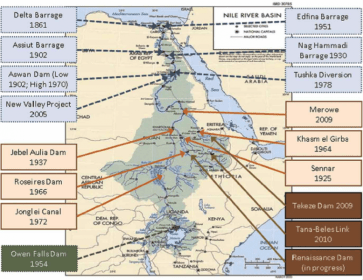
Image credit: Whittington et al. (2014)
As Waterbury explains, this is because of the international norm of Master Principle of appropriation — “whoever uses the water first thereby establishes a claim or right to it” (p. 28). Therefore, Egypt has an incentive to use as much of the Nile waters as possible in order to establish a future right to high volumes of downstream flows. Increasing domestic water consumption makes it easy for Cairo to demonstrate “appreciable harm” if any of the upper riparian states were to divert significant volumes of the Nile’s flows.
This is principle is in direct conflict with the principle of equitable use that also underpins riparian regimes (which are legion, apparently. Read the book). And that is where inter-state power politics come in.
Waterbury accurately predicted the current problem bothering Cairo:
The ultimate nightmare for Egypt would be if Ethiopia and the Sudan overcame their domestic obstacles to development and to examine coolly their shared interests in joint development of their shared watershed in the Blue Nile, Atbara, and Sobat basins. Given Ethiopian and Sudanese regional behavior in the 1990s, Egypt need not lose sleep yet (p. 149).
Well, it is time for Egypt to lose sleep. Big time.
A resurgent Ethiopia is damming the Abbay (Blue Nile) and is likely to divert more of its waters in the future for agricultural projects.
What’s puzzling to me is why Egypt is not interested in cutting a deal right now. Given that Ethiopia is only likely to get economically and militarily stronger with time, why wouldn’t Cairo want to cut a deal under conditions of a favorable balance of power?
An obvious explanation is that Egyptian domestic political concerns make it harder for the government to sign a deal that diminishes claims to the Nile (Sisi doesn’t want to be the one that signed away water rights!) But this problem will only get worse for Egyptian elites, assuming that Egypt will get more democratic with time.
 In the run up to the 2013 election, several members of the commission (then known as IIEC) and its secretariat were implicated in graft (
 One of the goals of Kenya’s new political dispensation following the adoption of a new constitution in 2010 was police reform (majority of the 1,300 killed in the post-election violence of 2007-8 were shot by police). The institution even changed its name from Police Force to Police Service; and an independent police oversight authority was created (to democratize the institution through civilian oversight). But experience since 2013 has shown that these attempts at reform have not yielded any tangible results.
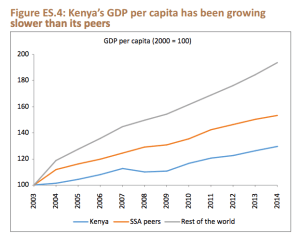 Compared with other fast-growing economies, Kenya invests less and the share of investment financed by foreign savings is higher. The economic literature and post-World War II history illustrate that investment determines how fast an economy can grow. Kenya’s investment, at around 20 percent of GDP, is lower than the 25 percent of GDP benchmark identified by the Commission on Growth and Development (2008). Kenya’s investment rate, as a share of GDP, has also been several percentage points lower than the rate in its peer countries. At the same time, the economy has largely relied on foreign savings as a source for new investment since 2007, while national savings have been declining. National savings—measured as a share of gross national disposable income (GNDI)—has not surpassed the 15 percent mark over the past decade. In contrast, Pakistan’s savings is above 20 percent of GNDI, and Vietnam’s is more than 25 percent. Cambodia had a low savings rate in the 1990s, but it more than doubled the rate in the 2000s.
 kenopalo.com