Why is Barclays exiting its Africa business?

The FT reports:

Firstly, he said it would create “a very simple, clear vision for Barclays” as a bank focused on its two core markets of the UK and US.

Secondly, he explained that Barclays was “structurally challenged” as the majority owner of the African operation. It has all the downsides of owning 100 per cent of the business, but benefits from less than two-thirds of its profits.

……. The African operation produced an attractive 17 per cent return on equity last year in local currency, but this fell to 8.7 per cent at group level, below its 10 per cent target.

In addition, the Wall Street Journal reports that the bank is selling its Asian wealth management fund in order to focus exclusively on the US and UK markets.

According to the Journal:

Cutting the African division “was a very difficult decision,” Mr. Staley said. A U.K. tax on bank balance sheets and the regulatory costs that come with holding the unit outweighed the benefits of keeping it, he added. It is unclear when Barclays will start to sell out of the business.

In short, this data point does not reveal any new information on the state of the African economies in which Barclays is a major player.

Some thoughts on the Okoa Kenya campaign to amend Kenya’s Constitution

I just posted a piece over at ConstitutionNet on the politics of popular constitutional amendment provisions, with Kenya as an illustrative case.

The Kenyan Constitution allows for popular (extra-legislative) amendment initiatives, as long as the petitioner can collect at least one million signatures. The Okoa Kenya campaign is one such initiative, but driven primarily by the main opposition alliance, CORD. In the piece I seek to answer two key questions:

…….. (i) how do constitutional popular amendment provisions impact institutional stability?; And (ii) can such provisions maintain their legitimacy when captured by mainstream political parties already represented in key state institutions?

The answers to the first question speak to the dangers of populism. Democratic stability necessarily requires institutional barriers to regular changes of the basic rules of the game (i.e. constitutions), as well as checks on populism. Therefore, by exposing constitutional changes to “every-day politics”, extra-legislative origination of constitutional amendments (under ordinary circumstances) may pose a risk to the very foundations of democratic stability.

The answers to the second question speak to the original intent of popular amendment provisions. Given their extra-legislative character and the notion that they are supposed to preserve popular sovereignty, it is unclear whether popular amendment provisions maintain their integrity when captured by mainstream political parties that are supposed to operate within the legislature. In other words, the potential exploitation of such provisions to circumvent the outcomes of legislative elections may derogate the electoral process itself. Elections should have consequences for both the ruling and opposition parties.

More on this here.

Why Did Nation Media Group Fire Galava?

Mr Galava, who was suspended on January 6th, 2016, was fired today for “not following due process and endangering the group’s business.”

A significant portion of NMG’s “business” includes ad revenue from the Government of Kenya.

On January 2nd the Daily Nation’s main editorial page ran an uncharacteristically hard-hitting piece highlighting various shortcomings of President Kenyatta and his Administration. It later emerged that Mr. Denis Galava had solely penned the piece. This tells us a lot about the state of newsroom management at NMG. Who else saw the editorial before it ran? Does NMG want us to believe that they never collectively agree on what runs in their main editorial pages? When they say “we” in these pages, who are the “we”?

Of course, a more plausible explanation is that the editorial team at NMG is actually independent, and on January 2nd sought to channel middle class dissatisfaction with the Kenyatta Administration. It’s potentially minuscule political impact notwithstanding, the editorial got significant airplay precisely because its contents resonated with a significant proportion of the Kenyan middle class.

The NMG management then panicked, and in an attempt to protect NMG’s “business” dealt a serious blow to hard-earned media freedom in Kenya.

I can’t rule out the involvement of busybodies at State House in the firing of Mr. Galava. But I also don’t think that this is a decision that came from super high up in government. It was most likely an internal (NMG) foolish reaction to the massive airplay the editorial got (they wanted to protect their “business” and the close relationship between the Aga Khan and the Administration). To this end they may have been nudged by some overeager underlings at State House desperate to show the boss that they’ve got his back.

But was this really necessary?

Uhuru Kenyatta is the President of the Republic of Kenya. He and his Administration should not need to be protected from journalists who are simply doing their job. As the Galava case will soon demonstrate, such acts will only reinforce the perception that Mr. Kenyatta and his Administration are bent on taking Kenya back to the KANU days (I don’t think this is true, see here).

This is a step backwards for media freedom in Kenya. Shame on the NMG management.

Ignore the hype: Kenya’s home solar users have not leapfrogged the grid

A recent article in the New York Times describes how a solar home provider will, “help some of the 1.2 billion people in the world who don’t have electricity to leapfrog the coal-dependent grid straight to renewable energy sources.” Does that mean someone didn’t read my previous attempt to stamp out the phrase “leapfrogging” in the context of distributed solar energy for households in the developing world?!? Alas!

One of the reasons I object to the phrase leapfrogging is that, at least given current technologies, home solar systems do not provide anywhere close to the same level of service as electricity from the grid. By contrast, a mobile phone, the oft-cited analogy in the leapfrogging discussions, has at least one notable advantage over a landline – it’s mobile.

Together with my co-authors Ken Lee and Ted Miguel, I just released a working paper that provides direct evidence that home solar users have not leapfrogged the grid

That’s Catherine Wolfram of Haas at Berkeley. Read the paper.

Regular readers of the blog know of my deep skepticism over the “leapfrogging the grid” talk.

And it’s not just in Kenya. Wolfram reminds readers in the post that:

The Center for Global Development describes recent research that makes a similar point. They found that nearly 90% of households in Tanzania who already had “access to electricity outside of the national grid, such as solar power” still wanted a connection to the national grid. They also link to an article that describes villagers with a solar microgrid in India who still want “real” electricity, by which they mean grid.

On a side note, these findings should inform the marketing strategies of solar power companies that may want to go big on the Continent. The last thing you want to do is “NGO-ize” your product by making it seem like it is exclusively meant for those who cannot afford to be on the “real” grid.

Also, Africa’s grids are actually a lot greener than you might think:

Over 60 percent of the existing generation in Kenya and other parts of sub-Saharan Africa comes from hydro, geothermal and other non-fossil-fuel sources.

So, pushing households to home solar in Sub-Saharan Africa may not save nearly as much fossil fuel as some proponents would have you believe.

Tanzania suspends construction of $10b Bagamoyo port

An agreement for the initial development of the Bagamoyo Port Project was signed in March 2013 during the visit of the Chinese President Xi Jinping as part of the Tsh1.28 trillion infrastructure package deals. The agreement specified that $500 million would be designated for port financing for the year of 2013 to allow the project to start.

Tanzania and Kenya are locked in a competition for the title of gateway to East and Central Africa, and so far Kenya is winning. Transportation costs on the southern corridor are almost 1.5 times those on Kenya’s northern corridor. Bagamoyo was supposed to take the fight to Mombasa (and Lamu). Now Dodoma will focus on upgrading the ports in Dar and Mtwara (and Tanga).

The cancellation of the project is a reasonable policy move. The cost would’ve severely stressed Tanzania’s fiscal position; and the 20m container capacity was a little too ambitious, to say the least.

Also, this development probably increases the probability that Uganda’s oil pipeline to the coast will be routed through Kenya (see here and here).

Do host governments necessarily “do development” better than foreign donors?

A common complaint you hear against donor-driven development projects is that they are typically at variance with local priorities; and make no attempts to work along the grain, or build upon existing systems. It turns out that governments in developing countries aren’t any different.

Take the example of the slum upgrading project in the infamous Kibera slum in Nairobi:

A keen look at the Open Street Map for Kibera and Mathare Valley before the NYS initiative started reveals the existence of services such as education, health, water and sanitation points. In Korogocho, Mukuru, Mathare and Kibera self help groups had emerged even before NYS Initiative start to earn daily income from activities such as urban farming, garbage collection and water delivery services. It is a fact that most toilets are not connected to the main sewer and private clinics are either not registered or managed by quacks, while illegal power connections abound.

The NYS Initiative would have scored big by establishing connections with already existing services providers in poor neighbourhoods by either improving their capacity to offer quality and affordable services to the urban poor or by trying to create an enabling environment for slum entrepreneurs to be part of formal and legal business entities. It is a mistake to assume that  there are no service providers within poor neighborhoods. Poverty and lack of basic services is an urban reality which has motivated the establishment of civil society groups to initiate health, education and income generating activities for women and youths as a supplement to government efforts in meeting its obligations. No government in the world can be able to solve the complex community problems of the poor by itself.

And there is an interesting twist to this story…

Experience from Dar es Salaam in Tanzania and the Urban Poverty and Slum Upgrading Project funded by the World Bank might be instructive. The project has some similarities with the NYS project in terms of targeting poor neighborhoods but was able to achieve more success because it worked more closely with local communities and partnered with Dar es Salaam Municipal Council officials from conception to implementation and monitoring stages, a situation which is totally lacking with the National Youth Service projects. The NYS Initiative seems to be a duplication and competition with the mandate of mandate of Nairobi City County.

I do not know about the veracity of the claims about the Dar slum (and I think the NYS budget is fully domestic — after the initial Chinese boost) but right now it’s hard not to feel like Tanzanians are doing everything right; while Kenyans are perennially running around in circles. The Mara Derby is on.

Read the whole thing here.

Harambee!! When did people stop caring about the optics of political action?

Screen Shot 2016-01-04 at 11.30.36 AM.png

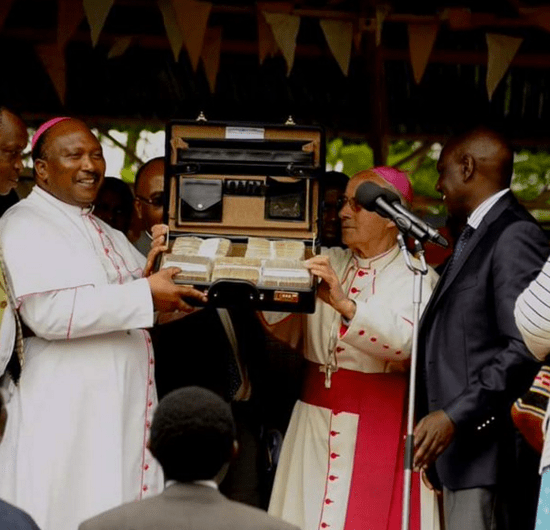
That is the Deputy President, William Ruto, at a Catholic church harambee. Late last year Mr. Ruto donated about Kshs. 17m (USD 170,000) over the span of two months.

May be I have watched too many crime shows. But bundles of cash in a briefcase sounds and looks bad. Even with Catholic bishops in the picture.

Also, Kenya has a pretty sophisticated financial system with a population that is the most banked in Africa. Why not write cheques for these big harambee contributions? Without casting aspersions on the character of the Hon. Deputy President, it might be good for the overall health of the Kenyan financial system if it was possible to keep track of such huge financial transactions. May be Governor Patrick Njoroge can require that any donations above Kshs. 10,000 must be in the form of a cheque. Commercial banks have incentives to lobby hard for this, no?

Of course there is also the possibility that some banks are actually benefitting from this cash-based charitable industry — by dabbling in the business of cleaning up would-be donations. Just a random thought.

Also, does the government of Kenya offer any tax incentives for charitable donations? And how big of an incentive would be needed for generous politicians to start keeping track of all their harambee contributions?

Kenya is at peak Tanzania envy

There’s a veritable reason President John Pombe Magufuli is a Tanzanian, and not a Kenyan. It’s the same reason Chief Justice Willy Mutunga is a product of the University of Dar es Salaam, and not the University of Nairobi. President Magufuli embodies the immutable character forged into the Tanzanian identity by President Julius Kambarage Nyerere, the philosopher-king. It’s a national character of service and selflessness that made Tanzania the anchor of the African liberation movement — the Mecca of all black freedom fighters.

It’s a mchicha [sukumawiki] culture of simplicity that eschews public gluttony, impunity, and vileness. That’s why #WhatWouldMagufuliDo has become a household hashtag. Not since President Nyerere have we seen the likes of Mr Magufuli in Africa. There’s a famous quote, attributed variously to Alexis de Tocqueville or Joseph de Maistre, which speaks of the character of a nation, a people. It says that “In a democracy, people elect the government they deserve.” The keys to the nugget are “democracy” and “elect.” In other words, it speaks of the free expression of the will of the people through an open plebiscite. In Tanzania, the people decided to “elect” Mr Magufuli over the opposition candidate, former PM Edward Lowassa. Even before the election, Mr Magufuli had distinguished himself as the hardest working member of the Kikwete government. Mr Lowassa was wildly popular, but Mr Magufuli beat him hands down. The people spoke.

…… In contrast, faced with a stark choice in Kenya in 2013, my compatriots were said to prefer Jubilee’s Uhuru Kenyatta and William Ruto over CORD’s Raila Odinga and Kalonzo Musyoka. The former faced charges for crimes against humanity at the International Criminal Court. I was one among many who placed obstacles in Mr Kenyatta’s election. I argued that electing an ICC indictee wasn’t in the national interest. But voters were polarised along ethnic blocks and failed to see my logic. Today — three years after the election — Kenyans are more depressed than ever, and every new scandal sinks the country into a deeper funk. Most Kenyans today wish Mr Magufuli was a Kenyan. I hate to say I’ve no sympathy.

That’s SUNY Buffalo law professor Makau Mutua writing in the Standard.

This is among a long line of Kenya-Tanzania comparisons that often serve to highlight the relative moral/ethical deficiencies of the former. Kenyans are corrupt and boorish; Tanzanians are polite and virtuous. Kenyans are rabid tribalists; Tanzanians have a strong national identity crafted around Kiswahili as a national language and the great Mwalimu Julius Nyerere’s vision for the Muungano (full disclosure, like Mutua, I am also intellectually enamored by the Dar es Salaam School).

Like all sweeping narratives there is some truth to these comparisons. And bucket loads of unsubstantiated hype. For example, under both Mkapa and Kikwete Tanzania had its share of mega corruption scandals, not unlike what happens north of the Kilimanjaro. Kenya ranks 145/175 in Transparency International’s perception of corruption rankings. Tanzania is at 119/175, still experiencing widespread corruption. The same slight differences are depicted in Afrobarometer survey results (See above. Tanzania is on the left. Question asks for respondents’ perceived share of government officials involved in corruption).

Also, the income of the average Kenyan is almost 1.5 times that of her Tanzanian counterpart. The infant mortality rates (per 1,000 live births) are 37 and 51 in Kenya and Tanzania, respectively.

Mwalimu once quipped that Kenya is a dog-eat-dog society. To which Kenya’s then Attorney General Charles Njonjo replied that Tanzania is a man-eat-nothing society.

Tanzania’s economy may yet outpace Kenya’s in the near future on account of the former’s solid foundation of nationhood. But for now I think it is fair to say that Kenya’s faux “African Socialism” beat Tanzania’s Ujamaa in delivering the goods, the morality of it all notwithstanding.tanzania

Oh, and what about the tired stereotyping of Kenyans as being more hardworking than Tanzanians? Well, according to Pew survey findings a bigger proportion of Tanzanians (than Kenyans) believe that the best way to get ahead is through hard work.

So there is that.
 

The OAU is dead, long live the AU

On Friday, the African Union approved draft plans to send troops to the conflict-ridden Burundi even without permission from Bujumbura in what could be a historic move to stop the country’s impending implosion.

The move by the AU Peace and Security Council reached on Friday despite initial opposition from the Burundi delegation invoked a rarely-used clause in AU Constitutive Act.

Article 4(h) of the AU Constitutive Act provides for sending of troops to a member country under circumstances of war crime, genocide or crimes against humanity without that country’s permission.

More on the African Union’s 5000 strong force for Burundi here. The actual AU resolution establishing the African Prevention and Protection Mission in Burundi (MAPROBU) is available here. Paul D. Williams, an associate professor of international affairs at George Washington University, parses the text of the AU communique here.

This semester I taught a class on intra-Africa IR, mostly looking at economic and security cooperation from 1963 to the present. One of the issues we wrestled with in the class was whether the AU was any different from the OAU, despite the language of Article 4(h). The OAU was notoriously ineffectual in dealing with conflict in Africa, on account of its many non-interference clauses.

Doubts about the AU and its ability to effectively originate an intervention in the face of intra-state conflicts were reinforced by:

(i) its continued commitment to the “equality” of member states (no regional hegemons — like Nigeria, Ethiopia, or South Africa — were given any formal status of first among equals);

(ii) the the deliberate weakening of the Peace and Security Council (PSC) — which has no permanent membership (5 elected for 3 years, 10 for 2 years);

(iv) the fact that the chairmanship of the PSC rotates monthly (by country name alphabetical order), giving any one chair hardly any time to develop the connections required for effective operations of such a sensitive post in a major IO;

(v) the structure of the regional distribution of seats on the PSC which incentivizes a sub-regional logic of seat allocation, as opposed to actual efficiency of the PSC.

It is therefore interesting that 4(h) was today invoked to justify intervention in Burundi, without the direct consent of Bujumbura (Nkurunziza may yet save face by inviting the AU mission under 4(j)).

Also interesting is the fact that the troops will be under the banner of the East African Standby Force (EASF) and not the AU. This will expose the actual operations of the mission to the same EAC politics that I outlined in an earlier post here (for the two of you out there who care to know, the different (sub)regional standby forces actually have formal relationships with the AU, so they are not totally run by the sub-regional RECs but can be seen as a practical first step in the aspirational goal of a continental standby force, someday).

Who said intra-African IR is boring (or does not exist)?

Also, watch out for a draft paper on the politics of intra-Africa IR soon…

Stanford Biz School Seed Transformation Program is seeking applicants from East Africa

Do you run an SME? Are you interested in training and mentorship? Then apply for Stanford’s STP.

The Stanford Seed Transformation Program addresses the needs of founders/senior leaders in developing economies who lead growing, small to medium sized enterprises.

The STP curriculum is customized to address the needs of founders and senior leaders of small and medium sized companies who are committed to growing their businesses.

Over a period of six months, you will attend four highly interactive sessions—each lasting one week. Sessions cover tools and methodologies that you will use to grow and transform your business.

For example, you will learn about Design Thinking—an innovative problem-solving approach refined by Stanford faculty and its alumni—that is invaluable for identifying new products and services for your customers.

STP topics include leadership training, strategy, organizational design, business model development, operations, accounting, marketing, finance/investing, value chain innovations, governance, business ethics, and product and service innovations. 

You can apply here.

Some Africanist inside baseball

Image

Screen Shot 2015-12-01 at 8.58.24 PM

The Kenyan Army’s Criminal Racket in Somalia

Quoting from a new report from the Journalists for Justice project:

With the death toll from al-Shabaab attacks inside Kenya rising to over 400, Journalists for Justice felt that the task of examining whether Operation Linda Nchi is actually delivering was overdue. This study looks at the conduct of KDF forces in two areas: 1) sugar smuggling and financial enabling of al-Shabaab and, 2) human rights violations.

This report presents the findings of several months of research in Somalia in Kismayo and Dhobley and inside Kenya in Liboi, Dadaab, Garissa and Nairobi. A desktop review, encompassing UN monitoring reports, academic studies, African Mission in Somalia (AMISOM) communication and media reports was followed by one-on-one interviews with over 50 people with intimate knowledge of KDF activities, including serving senior KDF officers, UN officials, western intelligence officials, members of parliament, victims of KDF human rights violations inside Somalia, journalists, doctors, porters at the charcoal stockpiles, drivers on the sugar routes and middlemen in the Dadaab camp.

…. JFJ research suggests that both KDF, the Jubaland administration of Ahmed Madobe and al-Shabaab are all benefitting from shares in a trade that is worth, collectively, between $200 million and $400 million.

More on this here.

For more on the challenges facing Kenya’s security operation in Somalia see here.

How Kshs. 38.5 billion ($385m) of borrowed money “disappeared” from Kenya’s budget

… the June 2013/14 bond issues were moved to the 2014/15 opening balances carried forward from 2013/14 at that time, while the November bond issues were recorded as 2014/15 revenues. If so, we would have a balance of Ksh38.5 billion in the bank, and the full Ksh75 billion (what we had estimated at Ksh67.5 billion) coming onto the budget in 2014/15.

There are no further changes in these numbers in the final fourth quarter COB report for 2014/15, suggesting that by the end of that year, all but Ksh38.5 billion of the Eurobond had come onto the budget and been spent.

The Ksh38.5 billion balance was not brought onto the budget for 2015/16 at the beginning of the year. The August 31 Statement of Actual Revenues shows no budgeted carryover from 2014/15 and an actual balance carried forward of only Ksh204 million. There is a budgeted revenue of Ksh72 billion in further commercial loans for the year, and nothing collected as of August.

So… what happened to the Ksh38.5 billion balance? If it was not spent, it is hard to see why the government wouldn’t be using it now to smooth liquidity during an apparent cash crunch. If it was spent, when did it come onto the budget, for what purpose and why isn’t it visible in public reports? Cabinet Secretary for the Treasury Henry Rotich recently claimed that all of the Eurobond money was spent, but I have not found any official documents showing when the final balance came on budget.

Why should basic facts about billions of shillings require us to sift through vague reports and still come up short?

Lakin’s excellent accounting narrative of budget figures from FY2013/14-FY2015/16 is available here. 

So where did the money really go? Only Treasury Secretary Henry Rotich can tell us what happened, with certainty. In the meantime Kenyans can only speculate. Which is why it is very odd that CS Rotich so far has barely bothered to explain himself.

How tragic would it be if it emerged that someone (or a group of people) stole Kshs. 38.5b ($385m) of borrowed money?

The confusion over the Eurobond cash has elevated public uproar over corruption in the public sector to new levels. The only problem is that blame has been spread thin, with everyone in government being blamed (and no single officer really feeling the pressure, with the possible exception of CS Waiguru).

In my view the two people that should be forced to explain themselves (regardless of whether they are individually corrupt or not) are CS Henry Rotich at Treasury; and the Chairman of the Parliamentary Budget Committee, Hon. Mutava Musyimi. These two men should shoulder any blame arising from any emergent violations of the Public Finance Management Act.

A focus on specific officers and their specific failures will perhaps give the president political cover to get rid of offending public officials. The fundamental challenge of the anti-corruption drive in Kenya at the moment is that it continues to be blind and deaf to political realities. The president is a politician, with an eye on reelection in 2017. The challenge for reformers is therefore to come up with incentive-compatible means (for the president) of dealing with corruption and incompetence in the public sector before then. (The president himself admitted on record that a significant number of public officials are corrupt). Mere calls for public officials, including the president, to act nice will not work. That is the tragedy of politics.

Energy to top the African Development Bank’s agenda

The FT reports:

Akinwumi Adesina, who took over as president of Africa’s lead development lender in September, has said that his flagship project aims to raise $55bn of investment to close the energy deficit in the next decade.

He says the bank will take a leadership role, coordinating with existing multinational initiatives and pushing member states to move faster to privatise and liberalise their energy sectors.

More on this here.

The paper also has a neat report on African economies’ adjustment to China’s slowdown, US pension funds’ move into the PE space in Africa, the grievances that fuel extremism in Africa, among others.

Full report is here (unfortunately, gated).

Africa’s looming debt crises

The 1980s are calling. According to Bloomberg:

Zambia’s kwacha fell the most on record after Moody’s Investors Service cut the credit rating of Africa’s second-biggest copper producer, a move the government rejected and told investors to ignore…..

Zambia’s economy faces “a perfect storm” of plunging prices for the copper it relies on for 70 percent of export earnings at the same time as its worst power shortage, Ronak Gopaldas, a credit risk analyst at Rand Merchant Bank in Johannesburg, said by phone. Growth will slow to 3.4 percent in 2015, missing the government’s revised target of 5 percent, Barclays Plc said in a note last week. That would be the most sluggish pace since 2001.

The looming debt crisis will hit Zambia and other commodity exporters hard. As I noted two years ago, the vast majority of the African countries that have floated dollar-denominated bonds are heavily dependent on commodity exports. Many of them are already experiencing fiscal blues on account of the global commodity slump (see for example Angola, Zambia and Ghana). This will probably get worse. And the double whammy of plummeting currencies and reduced commodity exports will increase the real cost of external debt (on top of fueling domestic inflation). I do not envy African central bankers.

Making sure that the looming debt crises do not result in a disastrous retrenchment of the state in Africa, like happened in the 1980s and 1990s, is perhaps the biggest development challenge of our time. Too bad all the attention within the development community is focused elsewhere.