Talking real development

It is an upper-middle-class, industrialized-country fiction to romanticize life on a small farm. Economic development and food security lie in industrialized agriculture, and this is why I continue being interested in agricultural value chains. My thinking on this has also been reinforced by my recent reading of Jane Jacobs’ The Economy of Cities, in which she posits that agricultural development came as a consequence of urbanization, and not the other way around.

That is Marc on his blog here.

Reading Marc’s post reminded me of my beef with anti-poverty development as it is currently practiced. For instance, the humanitarian instincts behind giving poor slum dwellers loans to start businesses may be noble, but the impact of these projects are ambiguous (Not forgetting the recent trends in Venture Capital firms making money from high interest rates on the poor).

Such projects, for the most part, serve little more than giving the poor comfort in their poverty. Yes, there are a few success stories, but for the vast majority life remains precariously close to abject destitution. Self-employment is a risk that should not be forced on those at the very bottom of the economic ladder in developing countries.

Such palliative measures should never distract from the main task of long-term job creation.

The growing disillusionment with the long-term developmental effects of micro-finance should force development experts to think of creative alternatives.

What could be an alternative?

Well, for starters it might be more beneficial to boost the capacity of banks to give loans to mid-size businesses that have the technical and managerial capacity to scale up their operations and thus create more jobs. Corporate finance in most of the developing world has no “middle class.” Nearly all the players are big firms. Mid-size firms simply cannot keep up with the high interest rates and collateral requirements. Yet these are the firms that have the potential to grow and create more jobs.

This move smells of trickle down economics, but it is not. Poverty alleviation requires massive amounts of job creation. Making the poor self-employed distracts from the bigger problems of non-industrialization and lack of formal-sector jobs.

It is also bad for political development because it provides Hirschman’s exit option for millions of economically disaffected citizens of the developing world.

Check out Blattman’s blog on a related post on NGO activism in the developing world.

selective unconditional convergence and growth

Rodrik has a finding that reinforces the importance of politics and other macro conditions for economic development. He points out the existence of the paradox of unconditional convergence at the industry level but not at the national level. Rodrik stresses the importance of structural change that channels labor into the right industries. To this we should add political change that provides certainty and the requisite legal and physical infrastructure for economic growth.

Industries that thrive in poorly run places – like telecoms, banks and construction firms in Nigeria or Kenya’s retail giants – do so despite their governments. Non-existent roads, underdeveloped railway systems, sporadic and expensive electricity, bad schools, legal uncertainty and massive amounts of political risk all serve to limit the extent to which within-industry gains can be extended to other sectors.

The massive uptake of mobile telephones across Africa suggests that consumerism in SSA is alive and well, just under-exploited. Sectors like textiles, agriculture and construction remain largely untouched because of cheap imports and bad regulation.

Development is a complex enterprise that requires massive amounts of (implicit) coordination. There has to be a link between California’s Silicon Valley, Massachusets’ Route 128 and New York’s Wall Street, in addition to other growth clusters. In this game synergy is King. The provision of the legal, human capital and physical infrastructure to facilitate coordination of this scale is largely dependent on well-functioning governance structures.

Here’s Rodrik.

Poor countries have access to new technologies already developed elsewhere so should grow more rapidly than richer economies. This is one of the implications of standard growth models, as well as of common sense.

But in reality, there is no automatic tendency for economic “convergence” among countries at different levels of income. Convergence depends instead on a number of additional determinants. It is only those developing nations with the “appropriate” preconditions – for example, adequate schooling or physical investment – that manage to absorb new technologies sufficiently rapidly and therefore to catch up. In the language of growth economics, there is conditional convergence, but not unconditional convergence.

When we look at the same question at the level of individual industries rather than countries a surprising finding emerges. Suppose we focus on, say, plastics, furniture, or the auto industry in developing countries. Does productivity in these (and other) industries experience automatic convergence with the technological frontier? Or is convergence once again conditional, depending on a host of country-level variables?

The interesting (and I think new) finding is that productivity convergence appears to be unconditional at the industry level – at least for manufacturing industries and for the period since the 1980s.

Quick hits

Texas in Africa’s review of Fighting for Darfur.

Blattman on economic growth and development.

The long arms of the Rwandan state?

The Zambian elections will be close. Last time round the opposition leader lost by a mere 3% (I will be there for the campaigns this summer).

And lastly, Kenya’s trillion-shilling proposed budget. High on development expenditure but could it crowd out the private sector?


food for thought

UPDATE: Gelman responds with the question: Why are there IRB’s at all?

Ted Miguel and other similarly brilliant economists and political scientists (in the RCT mold) are doing what I consider R&D work that developmental states ought to be doing themselves. Sometimes it takes intensive experimental intervention to find out what works and what doesn’t. The need for such an approach is even higher when you are operating in a low resource environment.

That said, I found the points on this post from monkey cage (by Jim Fearon of my Dept.) to be of great importance:

Why is there nothing like an IRB for development projects?   Is it that aid projects are with the consent of the recipient government, so if the host government is ok with it then that’s all the consent that’s needed?  Maybe, but many aid-recipient governments don’t have the capacity to conduct thorough assessments of likely risks versus benefits for the thousands of development projects going on in their countries.  That’s partly why they have lots of aid projects to begin with.

Or maybe there’s no issue here because the major donors do, in effect, have the equivalent of IRBs in the form of required environmental impact assessments and other sorts of impact assessments.  I don’t know enough about standard operating procedures at major donors like the World Bank, USAID, DFID, etc, to say, really.  But it’s not my impression that there are systematic reviews at these places of what are the potential political and social impacts of dropping large amounts of resources into complicated local political and social situations.

You can find the rest of the blog post here.

Look here for more information on RCTs.

Kenya: The Private Sector Still Has Faith in the system

The Kenyan economy is expected to grow by 4.3% this year. That is a downgrade from 6%, as had been projected by the treasury. Erratic rains, high cost of fuel (Kiraitu Murungi should resign), and general inflation are to blame.

The Shilling has also had a beating in the last few months. While a weak shilling is generally good for exports, it is is terrible for the fuel bill (oil is priced in USD). The Central Bank tried to mop up the excess Shillings in the economy with no avail. Last Saturday when I visited the local Western Union the Shilling was trading at KSHS 80 to the US dollar. Not so long ago the rate was in the low 70s.

The shaky macro-economy aside, the Kenyan private sector is doing OK.

Just the other day mortgage companies announced plans for 100% financing. House prices will definitely go up, at least in the short-run (a.k.a before the bubble bursts due to oversupply). The long-run benefits won’t be trivial. More construction means more jobs, the benefits of the multiplier effects of property, and (crucially and obviously) more houses. The current housing deficit runs in the hundreds of thousands of units per year.

Private sector confidence is also reflected in private sector leveraging. The private sector debt as a fraction of the economy has grown to about 50%. This is the best measure of confidence (in my view). Finance is fickle and thrives on stability. The bosses of Equity (and other banks) will not let the loudmouth tyrants and thieves who parade as democrats adversely affect their bottom line.

Because of its big service sector, future growth in Kenya will be predicated on confidence in the country’s political economy. Remember that Kenya is Africa’s biggest non-mineral economy. South of the Sahara and north of the Limpopo only the oil giants Nigeria and Angola have bigger economies.

For some reason (thereby dis-confirming my fears) the incendiary nature of Kenyan siasa za ukabila (ethnic politics) is not doing that much damage. Two cheers to Kenyan biashara.

the political economy of violence

The Economist reports:

YESTERDAY it was Afghanistan and Congo. Today it is Côte d’Ivoire and Libya. Violence, it seems, is always with us, like poverty. And that might seem all there is to be said: violence is bad, it is worse in poor countries and it makes them poorer.

But this year’s World Development Report, the flagship publication of the World Bank, suggests there is a lot more to say. Violence, the authors argue, is not just one cause of poverty among many: it is becoming the primary cause. Countries that are prey to violence are often trapped in it. Those that are not are escaping poverty. This has profound implications both for poor countries trying to pull themselves together and for rich ones trying to help.

Many think that development is mainly hampered by what is known as a “poverty trap”. Farmers do not buy fertiliser even though they know it will produce a better harvest. If there is no road, they reason, their bumper crop will just rot in the field. The way out of such a trap is to build a road. And if poor countries cannot build it themselves, rich donors should step in.

Yet the World Development Report suggests that the main constraint on development these days may not be a poverty trap but a violence trap. Peaceful countries are managing to escape poverty—which is becoming concentrated in countries riven by civil war, ethnic conflict and organised crime. Violence and bad government prevent them from escaping the trap.

Interesting piece. It is particularly important to note that violence affects everyone’s investment decisions, whether rich or poor.

The thing about poor places is that everyone is poor, elite or not.

No matter that Theodore Obiang’s son is buying the second most expensive boat in the world. If he has to hop on a plane to LA to have fun – instead of say, creating Africa’s Dubai in oil-rich Equatorial Guinea – he and his father remain tin pot dictators. The same applies for Idris Deby of Chad, Biya of Cameroon and many others. These dictators may have property abroad but the fact that they cannot accumulate property at home because of structural insecurity of their property rights (a coup is always a crazy junior officer away) continues to confine their countries to penury.

What do you do when even the dictator does not have stable property rights? How can you develop when no one is secure enough to invest in factories?

Trends on Aid, Growth and Government Spending in Africa

Data from the Penn Tables

The graph shows average growth rates, government expenditure as a fraction of GDP and foreign aid as a fraction of GDP in Sub-Saharan Africa since 1960. Both the growth and aid trends are encouraging. Growth has been positive since the mid-1990s and aid seems to be trending downward in the long-run. It is also apparent that the African growth tragedy was to a large extent confined to the disaster periods that were the “lost decade” of the 1980s (caused by the oil shocks, commodity bursts, debt crises and SAPs) and civil wars era of the early 1990s.

Despite the ongoing crises like this, this and this, the region as a whole appears to be experiencing an economic upswing. In the coming decade, the Economist projects that 7 out of 10 of the fastest growing economies in the world will be African.

institutions, culture and economic development

I am currently taking a class taught by Avner Greif, an economist/economic historian at Stanford in the tradition of New Institutional Economics. The class introduces ideas about economic development from a perspective that does not get much attention from economists, i.e. culture and its impact on long-run institutional development.

In one of the readings Tabellini argues that:

Well functioning legal institutions breed good values, since legal enforcement is particularly relevant between unrelated individuals. …… better informal enforcement sustained by ongoing relations in a closed network may be counterproductive for values.

Thus, the model predicts that clan based societies develop very different value systems compared to modern societies that rely on the abstract rule of law.

That’s in The Scope of Cooperation.

The paper provides a model of the recursive interaction between good institutions and culture. The scope of cooperation and interaction matters for institutional and economic outcomes. Clannishness, whether in Southern Italy or Mogadishu, is bad for economic development.

But you need a functional state system for people to be able to even contemplate abandoning the insurance scheme that is the clan. The model predicts two steady-state equilibria. Institutionally speaking, you are either Botswana or Chad.

A note on economic development

“I think we have gone too far in the pro-poor direction…… we don’t necessarily have trade-offs. Factories are pro-poor.” Chris Blattman, Yale University

I am on record as not being too enthusiastic about “pro-poor growth” as it is currently practiced. Loans to the poor and other approaches that completely bypass those with a higher probability of succeeding at creating big business – the educated and middle class – will at best only keep the poor afloat and at worst divert resources from much needed long-term investment. I am not saying that the educated have a monopoly on entrepreneurship. All I am saying is that what we want is to create sustainable jobs. This requires scale. And scale comes with big business and industry.

Blattman neatly summarizes this point:

The difference between a country with $1,500 and $15,000 of income a head a head is simple: industry. All the microfinance and microenterprise programs in the world are not going to build large firms and import technology and provide most people with what they really want: a stable job, regular wages, and a decent work environment.

More on this here.

exactly when did the rain start beating africa?

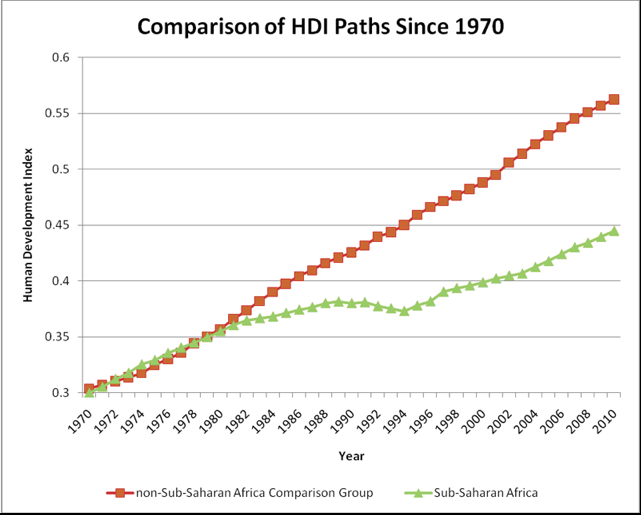
HDI divergence

The new HDI rankings are out. Some in the blogosphere have beef with the new geometric (as opposed to additive) method of calculating final scores. I don’t.

Aid Watch’s beef is that:

The biggest change in method was that the new HDI is a geometric average rather than a normal (additive) average. Geometric average means you multiply the separate indices (each ranging between 0 and 1) for income, life expectancy, and education together and then take the cube root (I know your pulse starts to race here…)

Now, students, please notice the following: if one of these indices is zero, then the new HDI will be zero, regardless of how great the other indices are. The same mostly applies if one of the indices is close to zero. The new HDI has a “you’re only as strong as your weakest link” property, and in practice the weakest link turns out to be very low income (and guess which region has very low income).

My two cents on this discussion is that the Continent looks bad irrespective of how we arrive at its HDI scores. It’s best performers are tiny Botswana and Mauritius. It’s biggest countries and potential engines for growth are the DRC, Ethiopia and Nigeria, need I say more? And per capita income has not changed in most places in half a century.

I rarely disagree with Easterly but on this count I do. Let’s not shift posts for Africa. The idea of “African Standards” is condescending and demeaning to Africans. Norway and Chad look like they are eons apart. If the numbers reflect that fact so be it.

I hope this year’s report embarrasses the African ruling elite enough to wake them up from their stupor (come on, I am allowed one wishful thought per post).

More on this here and here. For a summary of this see Blattman.

emerging africa

I have read the book, met the author and will be writing a review soon. In the book Steven Radelet makes the important point that African countries are not born equal. About half of sub-Saharan African countries have, since the mid 1990s, have shown signs of preconditions for take off. The stars in the book are the usual suspects, Ghana, Mauritius, Botswana. The suckers are mostly Sahelian and central African.

An abbreviated version of the book appears in the Journal of Democracy.

africa in the news

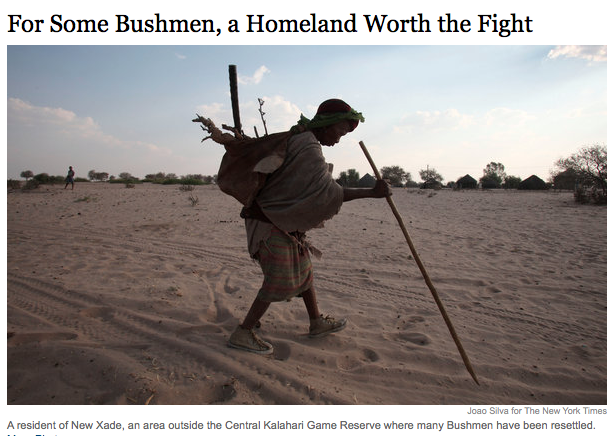
Forget about the elections in Tanzania or the Ivory Coast. What matters for the American audience as far as news from Africa go are human interest stories such as this one which made it to the front page of the New York Times.

I echo the point of the Times piece. It really sucks being a hunter-gatherer in Botswana. And by extension, it really sucks being a citizen of Chad, Niger, Uganda or any one of the 40 other countries that make up sub-Saharan Africa. Despite the “good news” (see earlier post below) things are really bad on the Continent.

Africa deserves all the bad press it gets. Period. The only problem is that Africans have not been able to participate effectively in the discourse on their continent or attempted to contextualize the bad press. The continent long lost the game of framing the narrative.

kenya: a model of conservative revolution?

An ambitious project is in the works to build a new city from scratch in Kenya, a sign that things are indeed changing in the economic engine of the wider eastern African region. The stock market voted for the new constitution with a bullish run on the eve of the ratification of the document. Investments in property – the property class has outdone most asset classes in the last two years – serve as a sure marker that Kenyans are confident in government’s commitment to protection of property rights. I am one of those who remain optimistic that Kenya is on the verge of take-off. And here is why.

Not long ago the idea of a cabinet minister resigning in Kenya was a pipe dream. Even more improbable was the idea of parliament defying the president. But these days ministers resign and the Kenyan parliament routinely defies State House. More importantly, the august house has continued its march towards independence from the executive – both functionally and financially. By controlling their own budget and calendar and building a functioning committee system, members of The House have acquired enough muscle to expose lapses in the management of public affairs – including the present scandals involving the Kenyan foreign ministry and the Nairobi City Council.

The biggest question, however, is whether the reforms embodied in the new constitution will last. My answer is yes they will, for two reasons. Firstly, the reforms are not as radical as some commentators think they are. The Kenyan establishment still stands to gain the most from the institutional reforms embodied in the new constitution. Land ownership, taxation, regulation of business, among other topics of interest to the elite are still firmly in the hands of the conservative centre and their provincial allies. Secondly, the emerging culture of bargaining, as opposed to Nyayo era “wapende wasipende (like or not) politics,” provides opportunities for amicable settlement of disputes resulting in self-reinforcing deals. No single political grouping can force its will on Kenyans. Mr. Kenyatta needed to only convince the Kiambu mafia for his policies to fly. Moi only needed a small group of collaborators. The new dispensation, however, requires that a significant number of elites, with varied political interests, buy into an idea before it can fly. This is progress. It is stable and sustainable progress.

Kenya’s dark hour in early 2008 was an eye-opener to the political and economic elite. The more than 1300 deaths will forever be a reminder of the evils of strongman rule. The broader legacy of the 2007 election will however be positive. The elections showed the core conservative establishment that they cannot run the country on their own, and that the peripheral elites also have significant de facto political power. By forcing the elite into agreeing to a self-enforcing arrangement, the regrettable events of 2007-08 facilitated elite compromises culminating in their new Kenyan constitution. The yet to be established supreme court will provide the final piece of the foundation needed for sustained institutional development in a predictable environment. Paradoxically, the biggest plus of Kenya’s new constitution is its conservative bent. And for that reason it will endure beyond the current teething phase. A more radical document would have been eviscerated just as the Kenyatta and Mboya amendments decimated Kenya’s independence constitution.

osama bin laden on development

Via Chris Blattman

frustrations of the african intellectual

William Easterly on Aid Watch captures the frustrations of African intellectuals and their continued neglect by both the aid industry and their home governments.

African intellectuals continue to be on the periphery of the discourse on African socio-economic development. The independence leaders jailed, killed or exiled many of them, leading to fifty years of disastrous misrule and general mediocrity from Dakar to Mogadishu, Khartoum to Jo’burg. The current crop of autocrats and pretend-democrats did not learn a thing from the last half-century and continue to opt for career poverty-voyeurs development experts from donor countries instead of their own people who may have greater incentives to see their homeland match the achievements of the newly emerging states of Brazil, India and China.