Population trends and the potential for a demographic dividend in Africa

Bloom, Kuhn, and Prettner write:

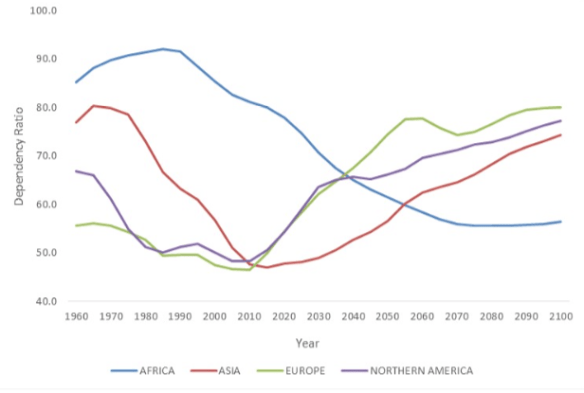
We assess Africa’s prospects for enjoying a demographic dividend. While fertility rates and dependency ratios in Africa remain high, they have started to decline. According to UN projections, they will fall further in the coming decades such that by the mid-21st century the ratio of the working-age to dependent population will be greater than in Asia, Europe, and Northern America. This projection suggests Africa has considerable potential to enjoy a demographic dividend. Whether and when it actually materializes, and also its magnitude, hinges on policies and institutions in key realms that include macroeconomic management, human capital, trade, governance, and labor and capital markets. Given strong complementarities among these areas, coordinated policies will likely be most effective in generating the momentum needed to pull Africa’s economies out of a development trap.

screen-shot-2016-09-07-at-7-23-46-pm

Dependence Ratios Across Different Regions


Do you need a reason to visit Kenya?

Kenya’s economy is growing at 5.9%. It is a frontier economy of 46 million with lots of opportunities for investment in sectors as diverse as tech, infrastructure, agribusiness, and light manufacturing. Kenya is also a gateway to the wider Eastern Africa region, with a market of about 120 million.

But if you are not a potential investor and just want to visit, here are some pictures to help you along…

Facebook founder Mark Zuckerberg visited Nairobi this week for business. He also found time to visit Lake Naivasha, a quick two hour “safari lite” destination to the northwest of Nairobi. The best thing about Nairobi is that it is the only city in the world with a national park (not a zoo) within city limits. Zuckerberg could have gone for a game drive in Nairobi, if he wanted to. The pictures were posted on Zuckerberg’s Facebook account.

Now go ahead and book those tickets.

The Secret to Autocratic Success (The Example of China)

This is from The Economist:

Even so, Mr Xi’s authority remains hemmed in. True, his position at the highest level looks secure. But among the next layer of the elite, he has surprisingly few backers. Victor Shih of the University of California, San Diego, has tracked the various job-related and personal connections between the 205 full members of the party’s Central Committee, which embodies the broader elite. The body rubber-stamps Mr Xi’s decisions (there have been no recent rumours of open dissent within it). But the president needs enthusiastic support, as well as just a show of hands, to get his policies—such as badly needed economic reforms—implemented. According to Mr Shih, the president’s faction accounts for just 6% of the group. That does not help.

Admittedly, this number should not be taken too literally: it is difficult to assign affiliations to many of the committee’s members. Doubtless, too, many members who are not in Mr Xi’s network support the president out of ambition or fear. Still, Mr Xi can rely on remarkably few loyal supporters in the Central Committee because he did not choose its members. They were selected at the same time he was chosen as party leader in 2012, a process overseen by the dominant figures of that period, Mr Hu and the long-retired Mr Jiang.

Most people who laud China’s autocratic success conveniently choose to ignore two important facts:

  1. That China’s rulers, at least since the late 1970s, have not been totally unaccountable. The country is a dictatorship by committee. And a large committee at that. It is not a personalist one man show.
  2. The the Chinese party-state works tirelessly to reduce the cost of compliance among its citizens — through conscious state building, coercion, and public services.

What this means is that in order to replicate China’s autocratic success, would be little Chinas must invest in both state capacity and intra-elite accountability (perhaps by building strong, institutionalized parties).

Absent this, what you are likely to get are mediocre petty tyrants running disorganized non-states with infant mortality rates straight out of the 16th century.

Why are Africans getting shorter?

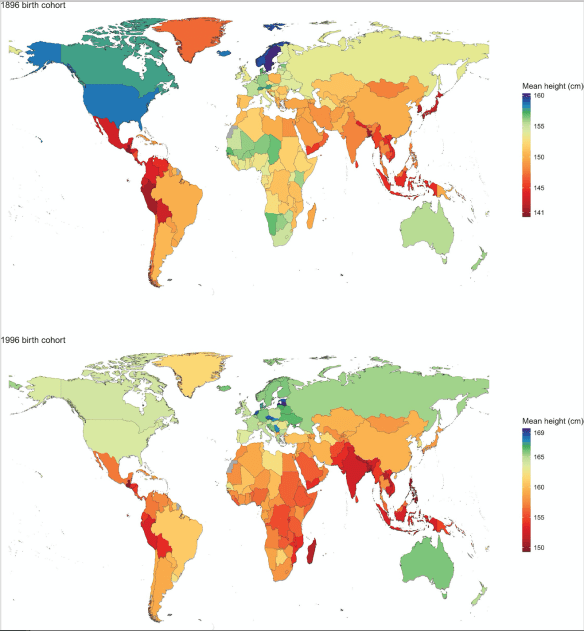
South Asia still posts the lowest average height for adults in the world (see image below). But a remarkable finding of a recent study is that adult Africans (among other low income regions of the world) have gotten shorter, on average, since the 1970s.

Being taller is associated with enhanced longevity, and higher education and earnings. We reanalysed 1472 population-based studies, with measurement of height on more than 18.6 million participants to estimate mean height for people born between 1896 and 1996 in 200 countries. The largest gain in adult height over the past century has occurred in South Korean women and Iranian men, who became 20.2 cm (95% credible interval 17.5–22.7) and 16.5 cm (13.3–19.7) taller, respectively. In contrast, there was little change in adult height in some sub-Saharan African countries and in South Asia over the century of analysis. The tallest people over these 100 years are men born in the Netherlands in the last quarter of 20th century, whose average heights surpassed 182.5 cm, and the shortest were women born in Guatemala in 1896 (140.3 cm; 135.8–144.8). The height differential between the tallest and shortest populations was 19-20 cm a century ago, and has remained the same for women and increased for men a century later despite substantial changes in the ranking of countries.

Screen Shot 2016-07-28 at 8.38.48 PM

What explains deceleration in average adult heights on the Continent?

One obvious explanation is a decline in nutrition amid rising populations and declining agricultural productivity (Africa barely registered a green revolution). Another major culprit is the economic disaster that visited the Continent from the late 1970s to the early 1990s — which resulted in poor nutrition and an unchecked disease burden. Lastly, there is the issue of water and sanitation, especially in the context of a rapidly urbanizing population, which has direct implications for the realized disease burden.

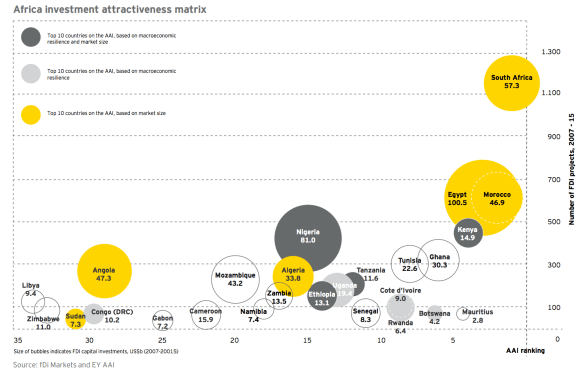
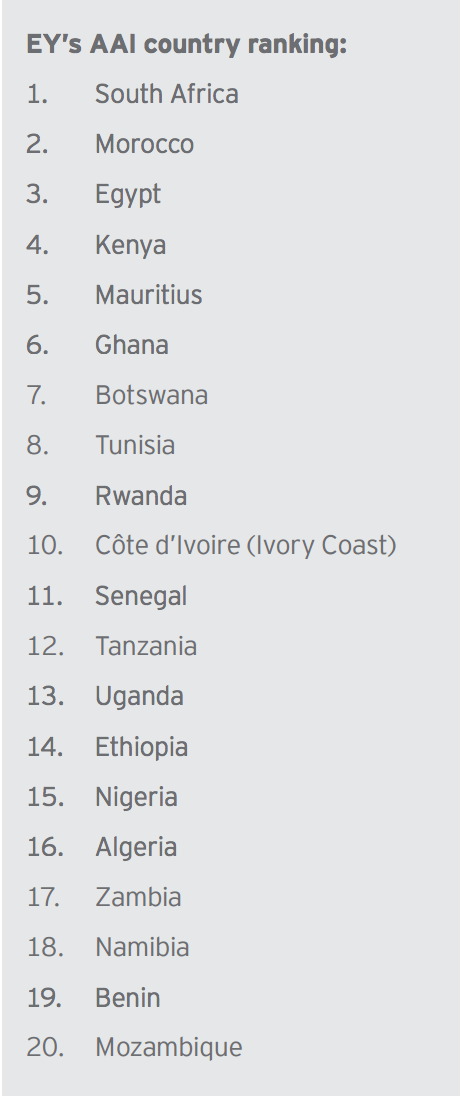
The top 20 best countries to invest your money in Africa

This is according to the latest Ernst & Young’s Africa Attractiveness Report (2016). Kenya is ranked 4th. Ahead of Tunisia, Mauritius, and Botswana. You just need to spend a few hours in Nairobi, or the other 46 county headquarters, to understand why. While economic inequality remains to be a huge (political) challenge, it’s hard to argue against the structural transformations underway in the Kenyan economy.

Screen Shot 2016-07-26 at 11.41.28 AM.png

Screen Shot 2016-07-26 at 11.36.26 AM

More on this year.

Human Capital and Economic Development in Britain, 1750-1930

B. Zorina Khan writes:

Many argue that the nature of early British industrialization supports the thesis that economic advances depend on specialized scientific training, the acquisition of costly human capital, and the role of elites. This paper examines the contributions of different types of knowledge to British industrialization, by assessing the backgrounds, education and inventive activity of the major contributors to technological advances in Britain during the crucial period between 1750 and 1930. The results indicate that scientists, engineers or technicians were not well-represented among the British great inventors, and their contributions remained unspecialized until very late in the nineteenth century. For developing countries today, the implications are that costly investments in specialized human capital resources might be less important than incentives for creativity, flexibility, and the ability to make incremental adjustments that can transform existing technologies into inventions that are appropriate for prevailing domestic conditions.

…….. The patent records also enable us to examine whether a science background increased productivity at invention. Again, the patterns are consistent with the notion that at least until 1870 a background in science did not add a great deal to inventive productivity. If scientific knowledge gave inventors a marked advantage, it might be expected that they would demonstrate greater creativity at an earlier age than those without such human capital. Inventor scientists were marginally younger than nonscientists, but both classes of inventors were primarily close to middle age by the time they obtained their first invention (and note that this variable tracks inventions rather than patents). Productivity in terms of average patents filed and career length are also similar among all great inventors irrespective of their scientific orientation. Thus, the kind of knowledge and ideas that produced significant technological contributions during British industrialization seem to have been rather general and available to all creative individuals, regardless of their scientific training.

The whole paper is definitely worth reading and is available here.

Barack Obama on Uhuru Kenyatta

This is from Jeffrey Goldberg in the Atlantic:

Obama’s relationship with Kenyatta is complicated. A careful reading of Obama’s memoir, Dreams From My Father, suggests that he holds Kenyatta’s father, Jomo Kenyatta, the liberator of Kenya, indirectly responsible for his own father’s premature demise. (The elder Kenyatta, a member of the Kikuyu tribe, froze out Obama’s father, a Luo, from government service after the elder Obama complained too insistently about corruption.) And the younger Kenyatta’s association with human-rights violators has placed a question mark over his head. But Obama also believes that Kenyatta is at least intermittently committed to battling tribalism and corruption, and aides tell me that Obama will devote a part of his post-presidential years to the issue of African governance.

Instead of focusing on “African Governance,” I’d suggest President Obama spends part of his post-presidential years as Africa’s economic ambassador to the United States and beyond.

“Good governance” and “good institutions” are great. But the notion that African states have to reach zero corruption and zero rigged elections before any factories can be built is a misguided fantasy. Institutions and positive economic performance co-evolve. Good politics is not always good economics; and good economics is not always good politics. Africa, despite everyone’s apparent belief in the region’s exceptionalism, is not unique in this regard.

Elite Political Stability and Development: The Case of Europe

Alex Lee of Rochester and Avi Acharya of Stanford write:

During the Middle Ages, most European polities operated under a norm that gave only the close male relatives of a deceased monarch a clear place in the line of succession. When no such heirs were available, succession disputes were more likely, with more distant relatives and female(-line) heirs laying competing claims to the throne. These disputes often produced violent conflicts that destroyed existing state institutions and harmed subsequent economic development. Given these facts, we hypothesize that a shortage of male heirs to a European monarchy in the Middle Ages has a deleterious effect on levels of development across contemporary European regions ruled by that monarchy. We confirm this hypothesis by showing that regions that were more likely to have a shortage of such heirs are today poorer than other regions. This finding highlights the importance of the medieval period in European development, and shows how a sequence of small shocks can work in combination with both institutions and norms in shaping long-run development trajectories.

……. Our main empirical finding demonstrates the path dependent effects of the uneven nature of state development in medieval Europe arising due to the availability of male heirs. We show that regions of Europe that were ruled by medieval monarchs who had an abundance of male heirs are today richer than other regions. We are also able to trace our effects over time by showing that urban density in each century between 1300 and 1800 was higher in regions that had an abundance of male heirs. In addition, we show that an abundance of male heirs also decreased the frequency of internal wars and coups during the Late Middle Ages, and we find that contemporary economic development is negatively correlated with the frequency of these medieval wars and coups.

Forget the sweeping comparisons between England and the rest (esp France) that is common in works about economic development in Europe. This paper offers lots of great insights about the mechanics of statebuilding (and institution building) and the impact on economic development.

The linking of medieval European political realities to economics outcomes in 2007-2009 still requires a tighter justification. But the general insights in the paper about elite-level conflict and institution-building are spot on.

The paper is a reminder that our obsession with vertical accountability (mostly elections) as a means for institution-building is patently misguided. Much of the action takes place at the elite-level, hence the need to focus on horizontal accountability (as yours truly does….)

As they say, the paper is self-recommending.

H/T Andy Hall.

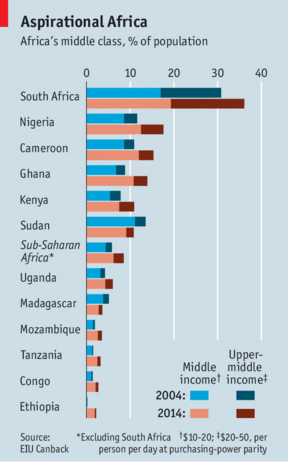
The vanishingly small African middle class

The Economist reports:

Screen Shot 2015-10-23 at 12.50.11 PMGood data on the exact size of the middle class are hard to come by, but it remains small across most parts of the continent. The Pew Research Centre, an American outfit, reckons that just 6% of Africans qualify as middle class, which it defines as those earning $10-$20 a day. On this measure the number of middle-income earners in Africa barely changed in the decade to 2011.

…… Unlike Asia, Africa has failed to develop industries that generate lots of employment and pay good wages. Only a few countries manufacture very much, largely because national markets are small and barriers to trading within Africa are huge. Most people who leave the countryside move into labour-intensive but not very productive jobs such as trading in markets. John Page, also of Brookings, reckons that such jobs are on average only about twice as productive as the ones that many left behind.

Angus Deaton wins the Economics Nobel Prize

Angus Deaton of Princeton University has won the Nobel Prize in Economics. Tyler Cowen over at MR summarized Angus Deaton’s immense contribution to the study of consumption, human welfare, and development:

A brilliant selection.  Deaton works closely with numbers, and his preferred topics are consumption, poverty, and welfare.  “Understanding what economic progress really means” I would describe as his core contribution, and analyzing development from the starting point of consumption rather than income is part of his vision.  That includes looking at calories, life expectancy, health, and education as part of living standards in a fundamental way.  I think of this as a prize about empirics, the importance of economic development, and indirectly a prize about economic history.

Think of Deaton as an economist who looks more closely at what poor households consume to get a better sense of their living standards and possible paths for economic development.  He truly, deeply understands the implications of economic growth, the benefits of modernity, and political economy.  Here is a very good non-technical account of his work on measuring poverty (pdf), one of the best introductions to his thought.

More on this here.

Deaton’s book, The Great Escape: Health, Wealth, and the Origins of Inequality is a must read for those interested in development.

Some readers of the blog may recall Deaton’s summer square off with Rwanda’s Health Minister Agnes Binagwaho over his comments on the Boston Review blog.

Deaton’s selection is a timely nod to the study of BIG PICTURE development.

A Commentary on Research Priorities in Development Economics

Over at the Bank’s Future Development blog, Princeton Economist Jeffrey Hammer writes:

The Chief Minister posed serious questions that have traditionally been the bread and butter of the economics profession. Unfortunately, we are not even trying to answer them any more. The specific question was “Should I put more money into transport? Infrastructure (power, roads, water)? Law and order? Social services? Or what? And where am I going to get the money?” What questions could be more solidly part of the core of economics than these? Unfortunately none of these were even remotely the focus of the “evidence-based” policy making discussed.

Almost all of the cases analyzed were  single, simple policy “tweaks” that were, first of all, isolated from the broader market context in which they occurred and, second, had no conception of opportunity cost – what we would have to give up to pursue these things? We had an answer to “how to improve a public food distribution system” but even with a precise answer (to whether a tweak would work) we had no idea whether the substantial amount of money funding such a system is a good idea. Maybe the Chief Minister would be better off improving education or road networks or police or rural electricity. Some of these alternative policies could have more impact on food consumption than food distribution if we thought about how the world worked. Getting food to market securely (roads, better cold storage, trustworthy police and safe roads – this is Pakistan, which no one seemed to notice) may increase food availability much more than any tunnel-visioned food program Or not – maybe the food distribution system is better. We just don’t know. And none of us “experts” are trying to find out.

When someone says “we should have more “X” because we have evidence that it works”, the response should be “compared to what?” What should we cut in order to promote your particular interest? My hobby horse these days is more sanitation in South Asia. I should have to defend it against (at least) a few alternatives.

What’s your justification for your latest hobby horse?

My take on the gap highlighted by Hammer is that what is good for reviewers is seldom useful to policymakers. The incentive for academics is to publish. And this will always be reflected in the design and implementation of interventions headed by academics. This is not necessarily a bad thing [For obvious reasons we should firewall academic research from the actual process of policymaking. The latter should be the political process that it is, albeit informed by the former]. I think the widespread acceptance of rigorous evidence-based policymaking has been a net benefit for the developing world. What it means though, is that the “public sector” development research community — i.e. the IMF, the World Bank, & host country research institutes — should do more to ensure that funding for hyper-targeted interventions do not detract from broader macro research (like, when and why did the rain start beating Ghana?)

However, in the long run, developing countries will be better served by having more and more of their own/country-based politically relevant macroeconomists.

This is because answering the types of questions posed by Hammer requires one to also take a political stand (on account of a lack of consensus among economists). Economists who can’t do this will invariably resort to “technical” solutions that can be perceived as “apolitical” by both host governments and the sponsoring foreign development agencies. Again not necessarily a bad thing, just a reflection of the politics of knowledge production.

H/T William Easterly.

Is evidence-based institutional analysis a possibility?

Chris Blattman writes:

But Acemoglu is right that institutional and political change are more important and the evidence-based crowd have done very little here. Most of that evidence is about anti-corruption or election monitoring or other things that I doubt change politics very much.

Meanwhile all the good political economy research (like Acemoglu’s) has no clear implication for social and political change in the world. There is a big disconnect. These scholars have mostly ignored this gap either because… I don’t know why. Maybe it’s too treacherous or hard, or they don’t find it interesting enough, or they are cynical about policy change. I don’t know. Someone explain it to me.

Blattman is spot on.

I think that students of institutions and institutional development have not joined the evidence-based crowd for two main reasons:

  • Politics I: Much of the evidence-based research out there eschews politics, instead focusing on the technical aspects of problems. Works that explicitly deal with political scenarios exist, but are rare. Part of the reason this is the case is that agencies that finance impact evaluations and other kinds of evidence-based policy research agendas have incentives to remain as apolitical as they can (you need host country government permission to do research in the first place …..)
  • Politics II: The other reason is that it is almost impossible to engage in politically relevant big-picture-development research while remaining apolitical. You see this in splits among macroeconomists in the United States (Macro questions make it really hard for researchers to shed off their normative priors). In the same vein, the best placed people to carry out evidence-based studies of institutions and how to change them are often professors in universities in the developing world — the problem is they do not do enough research due to a lack of resources and/or the relevant skill sets; and their own governments often neglect them. Regardless of their nationality, the most visible development economists in universities in the North Atlantic often lack the political connections or the bandwidth to engage in host-country politics; and are thus limited in the extent to which they can effectively study the most vexing policy questions out there.

These reasons are not due to anyone’s fault, just how research is currently financed and structured.

A possible way to get around these problems could be MBA-style case studies of reform programs from across the globe that can then be retooled by Comparativist country specialists — incoming Stanford CDDRL director Frank Fukuyama has very exciting ongoing work on this front.

On a tangentially-related point, I think that works that combine technical brilliance and deep local knowledge (think Bates’ lesser-read books on the Zambian Copperbelt) are about to come in vogue again. It used to be that only a few grad school programs (at least in political science) emphasized technical competence out of econ envy to match the economists. This is getting more commonplace, thereby establishing a new baseline (the data revolution is also helping a great deal by increasing the scope of country-specific studies of macro questions). And once a critical mass is achieved then the comparative advantage will favor those who are both technically competent and can also speak intelligently about how policy dovetails with local politics. The title “country-specialist” will soon no longer be synonymous with “qualitative research”; and more students will be primed to value good qualitative research.

Chapter 9 of The Gospel of Aid: The Aid Prayer

In Chapter 9 of the Gospel of Aid, the Nigerian author and satirist Elnathan John writes:

CHAPTER 9: The Aid Prayer

  1. You must pray then this way: Our donors, who art abroad, hallowed be thy purse. Thy aid come in dollars and pounds.
  2. Thy will be done in our countries, as promoted by Bono
  3. Give us this day, our yearly funding
  4. And lead us not into self-reliance
  5. But deliver us from our selves
  6. For thine are dollars, the pounds and the euros, forever and ever. Amen

The rest of the “Gospel” in all its hilarity is here.

Have a blessed Tuesday.

Review: Why Economists Miss the Point on Economic Growth in Africa

Africa continues to be a fertile ground for economic research. A significant number of economists in the development economics subfield have made careers explaining the “Africa” dummy variable in cross-national growth regressions — that is, explaining Africa’s “growth tragedy.”

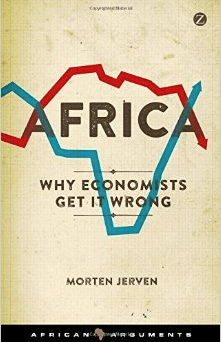
In his latest book, Africa: Why Economists Get it WrongMorten Jerven argues that this is a misguided approach. Instead of explaining African exceptionalism (why is Africa poorer than the rest of the world?), Jerven argues that scholarly inquiry ought to focus on explaining fluctuations in African growth, and intra-Africa variation in general economic performance. Jerven persuasively argues that explaining African poverty and trying to find ways to fix it have distracted researchers and policymakers alike from the more useful endeavor of understanding how economic growth (and decline) happens in Africa. The former approach accepts as a stylized fact the lack of meaningful growth in Africa’s economic history; while the latter more realistic approach acknowledges that African economic history has been characterized by periods of both growth and decline.
Screen Shot 2015-06-24 at 4.52.42 PMJerven is an economic historian, and it shows (see also here). He begins by reminding readers that African economic history did not begin in 1960, the time around which aggregate national economic data became available for a large number of African countries. Jerven then shows that economic growth in Africa has been cyclical, characterized by periods of both growth and decline. At the same time, periods of growth in Africa have not necessarily coincided with the implementation of “good” policies as the literature suggests. The “lost decades” of the late 70s and much of the 80s (due to oil and commodity shocks and associated debt problems) were a period of decline that also coincided with the “good” policies implemented under structural adjustment programs (SAPs). Without getting into the details of the specific policies in question, Jerven makes the point that African states’ experiences in the 70s and 80s are not representative of the full history of economic growth and development in the region.

Yet, according to Jerven, it is the growth record from these two decades that has become accepted as the “stylized fact” of Africa’s growth experience. The idea of an African growth tragedy has been so sticky that most economists (with a few exceptions) did not notice the uptick in growth in the region over the last decade and a half. A quick survey of syllabuses on African political economy will reveal this fact.

Why is Africa poor?” is a question common on course descriptions in many American political science and economics departments, giving the impression that the region has always had a growth deficit to be explained.

Second, Jerven takes on the quality of data that have historically been used to study African economies (remember Poor Numbers?). In this part of the book he pokes holes through major papers in the economic growth literature. The data he looks at range from widely used stats on African economies from sources like the Bank, the IMF, country statistical departments, and other academic sources. He also questions the validity of outcome variables (such as institutional quality, property rights protection, et cetera) that are often found on the left hand side in cross-national growth regressions. Jerven does not seek to provide a review of the development economics literature. Instead, his focus is on the substantive implications of statistical models widely employed by economists to explain relative growth between different regions of the world. In doing so he challenges social scientists to think more careful about issues of measurement and the substantive meanings of regional dummies.

Jerven’s critique of what he calls the “Wikipedia With Regressions” style of academic research is welcome, and hopefully will inspire more students of economics and politics (not just in Africa) to invest in acquiring useful knowledge on the specific countries they study. The basic point here is that the cocksure certainty of findings in scholarly studies on the determinants of growth is unwarranted, given the shaky (data) foundations on which many of them stand. Jerven drives the point home by citing Durlauf, Johnson, and Temple who in their review of the growth literature found 145 different regressors that were found to be statistically significant determinants of economic growth.

Lastly, Jerven takes head on the claim that institutions and good governance cause economic growth. His core argument in this section is that “good” institutions are typically the result of, rather than the cause of economic growth. He gives examples of countries that have experienced sustained economic growth without having the typical bundle of institutions that scholars attribute to be the fundamental cause of long-run growth. I am partially persuaded by this argument, especially after having read Working With the Grain (see review here).

This latter section is the least strong part of the book, and may be the result of trying to do too much in one short text. As a student of institutions I am keenly aware of the importance of elite political stability and institutions that lock in intra-elite commitments for sustainable economic growth. It is not enough to claim that the view that institutions cause growth is misguided because some economies elsewhere have achieved growth without the hypothesized good institutions. I would argue, for instance, that a key difference between the “Asian Tigers” and their African counterparts (some of which we are often reminded were relatively richer in 1960) was the level of stateness (i.e. institutionalization of centralized rule) on account of a much longer experience with statehood. Jerven would have helped his argument by providing alternative explanations for Africa’s economic collapse in the late 1970s and much of the 1980s.

What kinds of institutions matter in “late” economic development? Why did African states almost uniformly fail to contain the oil and commodity shocks and the resultant debt problems that visited them during this period? Has there been institutional variation within Africa over time, and can it explain intra-Africa variation in growth?

Overall, Africa: Why Economists Get it Wrong is a fantastic quick read for anyone (whether in the academy or not) interested in understanding economic growth in Africa. Besides being a brilliant economic historian, Jerven is also an engaging writer with an ability to make even the most technical arguments accessible to the reader. I did not have the book on my original summer reading list but couldn’t stop once I started reading it.

In my view this book is the economics companion to Thandika Mkandawire’s excellent critique of scholarship on African politics. It also raises several very interesting questions that will inspire or reinforce a few dissertations in the field of development economics.
Traditional birth attendants and antenatal care in western Kenya

This paper examines the extent to which locally informed intermediaries can be exploited and provided with incentives to change the health-seeking behavior of pregnant women in rural Kenya. Despite Kenya being the largest and most advanced economy of East Africa, maternal and infant health outcomes are typical for those of other sub-Saharan countries, which lag significantly behind the developed world. There is evidence that antenatal care (ANC) is associated with improved maternal health outcomes, yet the majority of women in rural Kenya fail to meet recommendations for ANC timing and use, despite the availability of government subsidized healthcare. I examine whether a local intermediary, whose own incentives might oppose those of the government, can be co-opted to assist the government’s objective of increasing women’s ANC utilization.

I use a randomized controlled trial (RCT) to evaluate a program, which provides financial incentives for TBAs to encourage pregnant women to seek ANC at a formal medical facility. Competition between the TBAs and the formal clinics makes the effect of the program an empirical question, as there is no guarantee that the TBAs will respond to the incentive.

I find that living in a TBA treatment village increases the likelihood of attending the recommended number of visits by 20.7%. Women living in TBA treatment villages are 4.4 percentage points more likely to attend the recommended number of visits than women living in control villages, who attend the recommended number of visits 21.3% of the time. The results of this experiment, the first to study the extent to which TBAs can be motivated to encourage women to attend the prenatal clinic, could have important policy implications. The program’s success suggests that despite having a risk of losing clients, TBAs can be utilized as intermediaries of health facilities. Furthermore, finding that TBAs can induce pregnant women to attend ANC visits indicates that cultural norms, which discourage women going to ANC visits, can be overcome with relatively small financial incentives. By increasing the demand for formal maternal healthcare, TBAs’ encouragement of ANC attendance by women may help achieve improved maternal and child health outcomes.

That’s Georgetown’s Nisha Rai, in an excellent paper on the possibilities of integrating the use of traditional birth attendants with the formal healthcare system in Kenya (and developing countries in general). You can find a summary of the paper at the Bank’s Development Impact blog here.

If you know a policymaker in the health ministry of a developing country, please have them read this paper.