Graphical Illustration of China’s global reach

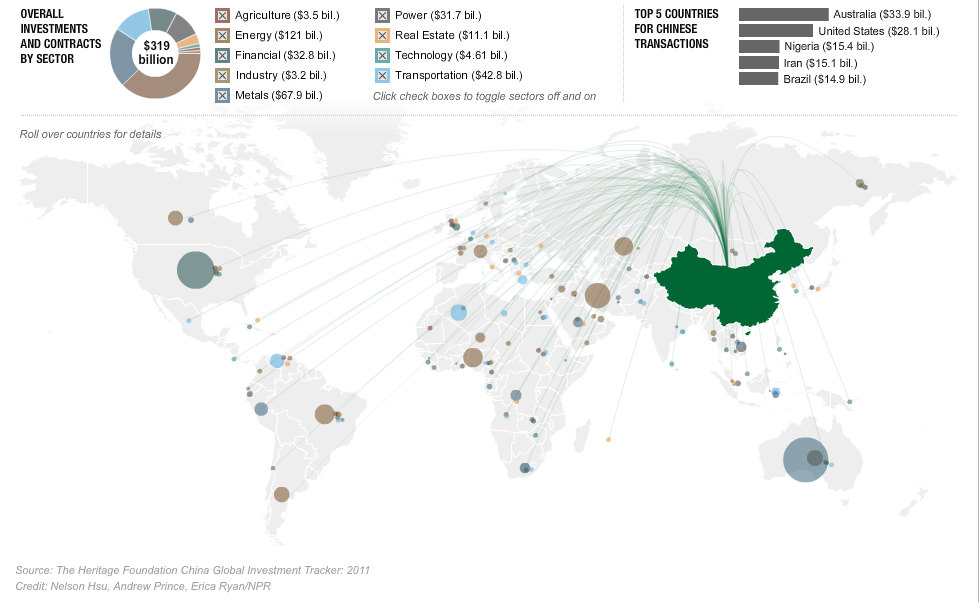
NPR has this cool graphic on China’s global investments [click on image to enlarge].

Notice that Nigeria is among the top destinations of Chinese investments.

In my alternate universe Abuja (the undisputed regional hegemon) is stable and uses this, and the fact that it is also among the most important sources of US-bound crude oil, as leverage to nudge the two biggest global powers in the direction of a more stable and coherent Africa policy.

More on this here.

Failed states index out, the usual suspects top the list

FP has the annual list of failed states. The Continent has a heavy presence on the list, with the usual suspects like Somalia, Sudan, Chad, Niger and Central African Republic, among the top failures. Also on the list are otherwise stable places like Uganda, Nigeria, Kenya, Ethiopia, among others.

The list is, in some sense, a reminder that several states out there are in dire straits. Insecurity and poverty continue to be a daily experience of far too many people. But it also raises methodological questions regarding the rankings. Some of the rankings certainly do not make any substantive sense and merely feed into alarmist stereotypes we already have of certain countries or regions of the world.

Methodological issues aside, the list is yet another reminder that despite the recent surge in Afro-optimism, a lot still needs to be done in order to improve the human condition in Africa, among other regions of the world.

selective unconditional convergence and growth

Rodrik has a finding that reinforces the importance of politics and other macro conditions for economic development. He points out the existence of the paradox of unconditional convergence at the industry level but not at the national level. Rodrik stresses the importance of structural change that channels labor into the right industries. To this we should add political change that provides certainty and the requisite legal and physical infrastructure for economic growth.

Industries that thrive in poorly run places – like telecoms, banks and construction firms in Nigeria or Kenya’s retail giants – do so despite their governments. Non-existent roads, underdeveloped railway systems, sporadic and expensive electricity, bad schools, legal uncertainty and massive amounts of political risk all serve to limit the extent to which within-industry gains can be extended to other sectors.

The massive uptake of mobile telephones across Africa suggests that consumerism in SSA is alive and well, just under-exploited. Sectors like textiles, agriculture and construction remain largely untouched because of cheap imports and bad regulation.

Development is a complex enterprise that requires massive amounts of (implicit) coordination. There has to be a link between California’s Silicon Valley, Massachusets’ Route 128 and New York’s Wall Street, in addition to other growth clusters. In this game synergy is King. The provision of the legal, human capital and physical infrastructure to facilitate coordination of this scale is largely dependent on well-functioning governance structures.

Here’s Rodrik.

Poor countries have access to new technologies already developed elsewhere so should grow more rapidly than richer economies. This is one of the implications of standard growth models, as well as of common sense.

But in reality, there is no automatic tendency for economic “convergence” among countries at different levels of income. Convergence depends instead on a number of additional determinants. It is only those developing nations with the “appropriate” preconditions – for example, adequate schooling or physical investment – that manage to absorb new technologies sufficiently rapidly and therefore to catch up. In the language of growth economics, there is conditional convergence, but not unconditional convergence.

When we look at the same question at the level of individual industries rather than countries a surprising finding emerges. Suppose we focus on, say, plastics, furniture, or the auto industry in developing countries. Does productivity in these (and other) industries experience automatic convergence with the technological frontier? Or is convergence once again conditional, depending on a host of country-level variables?

The interesting (and I think new) finding is that productivity convergence appears to be unconditional at the industry level – at least for manufacturing industries and for the period since the 1980s.
All politics is local, and more

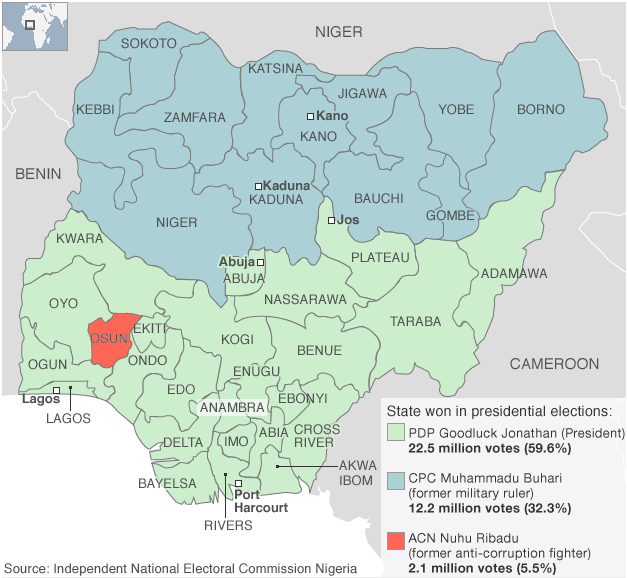
Many have seen the BBC map below of the outcome of the just-concluded Nigerian presidential elections. The south voted for incumbent Jonathan while the north went for Buhari.

The state elections were a different kettle of fish. In these elections the president’s party – the PDP – held its own in the north. Available results show that PDP candidates won in Bauchi, Kaduna, Niger, Gombe, Kebbi, Jigawa, Kano and Buhari’s home state Katsina – in total eight out of the 12 states shaded blue in the picture above.

How is this possible, given the clear north-south divide in the presidential vote?

The answer to this question is threefold (and is here).

First, all politics is local. Given that both the PDP and CPC rode on personality politics with little ideological differentiation, once the presidential race was settled the game reverted back to local personality politics. PDP bigwigs could therefore hold their own in most of these states based on their own local connections.

Second, it could be due to the sequencing of Nigerian elections. In Nigeria, the gubernatorial elections take place weeks after the presidential election. Because patronage politics is the only real game in town, the rational thing for voters to do is pick the president’s man for governorship. This way one can increase the probability that pork will flow to one’s state when President Jonathan sets out to reward those who voted for him and the PDP.

Third, Jonathan might have panicked about having lost the north in the presidential election and therefore put extra effort into winning as many gubernatorial races as he could in the north in order to guarantee his administration a sense of national legitimacy.

In a sense the gubernatorial results are encouraging. It is calming to know that there are powerful local elites in northern Nigeria who are willing and able to work with Jonathan to help Nigeria realize its potential.

goodluck jonathan poised to win nigeria’s election

The Daily Nation reports:

Nigerian President Goodluck Jonathan has taken a wide lead in elections in Africa’s most populous nation, results showed today, putting him on a possible course for a first-round victory.

Millions of voters turned out for Saturday’s election as Africa’s most populous country bid to put years of rigging and badly flawed ballots behind it and hold the cleanest polls for head of state in nearly two decades.

Observers gave the polls an initial thumbs up, but concerns were raised over regional divisions, a scenario many analysts had hoped to avoid in a country as fractious as Nigeria, roughly split between Christians and Muslims.

Results from 30 states showed Jonathan had won 20, while ex-military ruler Muhammadu Buhari had nine and the former head of the anti-graft agency, Nuhu Ribadu, had one state.

Mr. Jonathan’s cross-national victories are a good omen for Nigerian unity moving forward. Now the big question is how Mr. Jonathan and the PDP will govern. Top on the agenda will be Nigeria’s energy problems. Sub Saharan Africa’s largest oil producer also happens to be one of its biggest importers of refined oil products. No new refineries have been built in the country in ages. The country also suffers frequent power outages despite the fact that millions of cubic metres of gas get flared in its oil fields daily. About 23 billion cubic metres get flared annually in Nigeria (second only to Russia).

That is 23 billion cubic metres of gas that can be harnessed for power production or LPG.

nigeria holds first transparent election since 1993

The last time Nigeria had a transparent election was in 1993. Then, opposition leader Moshood Abiola won the election only to be denied the chance to lead Nigeria by strongman Ibrahim Babangida. Mr. Abiola died in jail in 1998. Nigerians had to wait until May of 1999 to see the end of kleptocratic military rule. Mr. Olesegun Obasanjo, a former military ruler, was Nigeria’s first elected president since the early 1980s. His party (Mr. Obasanjo’s) the People’s Democratic Party (PDP) has since then won two elections under questionable circumstances, to put it mildly.

The latest election appears to be different.

Initial results show that PDP is set for a thumping in the legislative and governorship races, although its presidential candidate (Goodluck Jonathan) is still the front-runner with 62% approval rating.

Credit goes to Attahiru Jega, a professor of Political Science and head of the Independent National Electoral Commission (INEC), for ensuring that the Nigerian elections have credibility both at home and abroad.

Watch this space for the results of the gubernatorial and presidential elections in the coming weeks.


Africa needs zuma (to have a coherent foreign policy)

This week the Economist rightly called out South African president Jacob Zuma on his country’s lack of a coherent foreign policy. South Africa was reborn in 1994 with the moral authority and international goodwill to be Africa’s shining light in the world. Instead, under Mbeki and now Zuma, the country has squandered all that away.

Mbeki did it with his intransigence against reason on the issue of HIV/AIDS and support of Robert Mugabe in Zimbabwe. Mr. Zuma is doing the same with his support for Mugabe and equivocal pronouncements against other murderous tyrants on the Continent. Since his election he has not spoken strongly against any injustices or electoral fraud on the Continent; this task has been left to Ian Khama, president of tiny but relatively prosperous Botswana.

Sub-Saharan Africa is desperately in need of a regional hegemon to help it chart a coherent path in global politics. Latin America has Brazil. South Asia has India. East Asia has China. Even Europe has Germany. In Africa, Nigeria (pop. 150+m), South Africa (~40m, biggest economy), Ethiopia (85m) and the Democratic Republic of Congo (~70m) – all potential regional leaders – have woefully underperformed.

Nigeria is Nigeria. Ethiopia is dirt poor and needs to clean its own mess, Somalia’s and Eritrea’s, before it can venture further afield. The DRC is struggling to keep itself afloat. South Africa, by far, has the capacity and the requisite soft power to take up the job of regional guiding light. The country is slated to become a BRIC country soon, making the BRICS (Brazil, Russia, India, China and South Africa).

It is a shame that Mr. Zuma has chosen to abdicate his role as the Continental leader. He alone, among the members of the Continent’s club of kleptocratic autocrats (a.k.a AU), has the clout to stand up to the evils we continue to see in Cote d’Ivoire, Darfur, Zimbabwe and elsewhere.

Achebe’s take on the trouble with nigeria

Chinua Achebe has an editorial piece in the NY Times on the prospects for economic and political development in Nigeria. Below is an excerpt that I think applies to most of Sub-Saharan Africa.

During the colonial period, struggles were fought, exhaustingly, on so many fronts — for equality, for justice, for freedom — by politicians, intellectuals and common folk alike. At the end of the day, when the liberty was won, we found that we had not sufficiently reckoned with one incredibly important fact: If you take someone who has not really been in charge of himself for 300 years and tell him, “O.K., you are now free,” he will not know where to begin.

This is how I see the chaos in Africa today and the absence of logic in what we’re doing. Africa’s postcolonial disposition is the result of a people who have lost the habit of ruling themselves, forgotten their traditional way of thinking, embracing and engaging the world without sufficient preparation. We have also had difficulty running the systems foisted upon us at the dawn of independence by our colonial masters. We are like the man in the Igbo proverb who does not know where the rain began to beat him and so cannot say where he dried his body.

HT Erin.


Goodluck Jonathan wins pdp nomination

Nigerian president Goodluck Jonathan has won his party’s primary nomination. The BBC reports:

Correspondents say the margin of his victory was a huge surprise, with several central and northern states backing Mr Jonathan, a southerner.

“The People’s Democratic Party has spoken with one strong voice,” Mr Jonathan said in his acceptance speech, wearing a trademark fedora hat and black traditional robe.

The African behemoth (population > 150 million) holds elections in April. Mr. Jonathan is favored to win.


ushering in the new year

Happy new year to all readers.

2011 will be a crucial year for a few countries on the Continent. On January 9th Southern Sudan will vote for secession, creating the newest state in the world. The aftermath of that might be all out war with North Sudan (over borders and oil) and/or civil war in the south (ethnically motivated warfare over control of the new state). That is what most analysts predict. I think there is a glimmer of hope for peace due to heavy Kenyan investment in the south and the desire to build, link and orient the new nation towards the East African Community. Watch this space as it all unfolds.

Uganda will hold elections on February 18th. Yoweri Museveni will win big and dig in even more now that Uganda has oil in the west of the country. Also bolstering Mr. Museveni’s hold on power will be the LRA’s delusional insurgency in the north of the country and the continuing war on terror in the horn of Africa – Uganda’s troops form the core of the African Union (AU) forces in Somalia. Mr. Museveni has been in power since 1986.

The other major election will be in Nigeria, the continental behemoth in the west. President Goodluck Jonathan is favored to win, but his victory will most certainly be tainted with chaos and irregularities.

Other countries holding elections in the new year are Central African Republic, Benin, Madagascar, Cape Verde, Chad, Djibouti, Niger and Liberia.

Electoralism remains largely dysfunctional and inconsequential in Africa because of a myriad of structural impediments (poverty, weak institutions, monarchical presidentialism, etc). In the recent past events in Kenya, Zimbabwe and Cote d’Ivoire have shown how far the Continent is from being a liberal democratic paradise (may be democracy is not for everyone at all times?). 2011’s elections will no doubt fail to buck the trend.

The Gambia, Iran, Nigeria and the confusion over arms

Remember the story about the mysterious cache of arms found in Lagos Port, Nigeria? Well, turns out the story goes beyond Nigeria. FP reports that there is reason to believe that the arms from Iran were destined for The Gambia. Authorities in Banjul expelled the Iranian officials in the country, increasing speculation that the arms were meant for rebel groups linked to last year’s coup attempt against President Yahya Jammeh who by the way, cures AIDS on Thursdays.

Just as Libya is retreating from its bad habit of financing and arming rebellions all over the Continent Tehran appears poised to assume this role, especially in Muslim sub-Saharan Africa. There is not a clear strategic reason for this kind of involvement by Iran in The Gambia, although theories abound out there. To add to these, I think it might be that someone within the Iranian government is involved in the global drugs trade and wanted to use The Gambia as a transit to Europe. On November 19th Nigeria discovered US$ 10 million worth of heroine shipped from Iran.

West Africa plays a major role in the global drugs trade. Barely afloat West Africa states, particularly Guinea and Guinea-Bissau, are key transit points for drug shipments from Latin America and Asia into Europe.

goodluck jonathan announces his candidacy on facebook

Nigerian President Goodluck Jonathan has announced that he shall be running for president in next year’s general election, according to a post on his facebook page. Apparently the good sir takes social media seriously:

While some observers were surprised that Mr Jonathan had used Facebook to announce his candidacy, he said in July that comments on his page had influenced him in overturning his ban on the national football team . . . . . . . . . “People may scoff, but we take the interactions seriously, we track the [Facebook] feedback,” a presidential adviser told the Reuters news agency.

It will be interesting to see how the rank and file of the PDP reacts to this announcement. Under the party’s implicit North-South agreement the next president has to come from the North. Mr. Jonathan is a southerner.

a very nigerian affair

The BBC reports that the Nigerian state owned oil company (NNPC) is insolvent, with a US $ 5 billion debt. Most of the money ($ 3b) is owed to the Federation Account a lootable cash cow that distributes money to different levels of government within the Nigerian state. The country is divided into 36 states (and one federal capital territory, Abuja) and 774 local governments, all of which have legally guaranteed claims to oil revenues.

The report also notes that: Despite Nigeria being a major crude oil producer, it must buy almost all the oil it uses on the international market because its own refineries are insufficient and dilapidated.

Recently the Nigerian government signed a deal with the Chinese that hopefully will result in the construction of an $ 8 billion refinery in Lagos to ease the country’s dependence on imported petroleum products. 80% of the cash will come from the Chinese and 20% from the Nigerians.

No prizes for guessing why on earth A LEADING INTERNATIONAL OIL EXPORTER should import almost all of its petroleum products or why it took so long for the Nigerian leadership to start thinking of expanding Nigeria’s refinery capacity…

Achebe’s assessment of the Nigerian condition in the early 1980s still rings true: “The trouble with Nigeria is simply and squarely a failure of leadership.

Yar’Adua passes on

Nigerian President Umaru Yar’Adua died today. According to the Nigerian constitution Goodluck Jonathan who has been acting president will formerly assume office as president of the federal republic. Mr. Yar’Adua had had problems with his kidneys going back to his days as governor of Katsina state. May he rest in peace.

Wole Soyinka, the Nigerian Nobel laureate had this to say about Mr. Yar’Adua’s passing on:

“What passes for the Nigerian nation is nothing more than a tragic arena, and Yar‘Adua is only the latest tragic figure. The vampires, including those within his own family, turned him into a mere inert resource for their diabolical schemes. They have a reckoning with their conscience, assuming they know what the word means. One can only hope that, while mouthing sanctimonious platitudes such as ‘Power belongs to God,’ they have now learnt that the politics of Do-or-Die cannot guarantee who does and who dies. They must stop playing God. I pray for the repose of the soul of their latest, much abused innocent victim.”

abuja is sleeping on the job

The Nigerian government has failed its people in so many respects that we have come to not expect the men and women in Abuja to deliver much. That said, this is too much. At the risk of sounding religiously intolerant, I am gonna go out on a limb and say that this should be considered cruel and unusual punishment.