Southern Africa has an ambitious plan to eliminate malaria by 2030. According to the FT:
Under the Elimination8 plan, the idea is to end malaria by 2020 in four so-called frontline states where transmission levels are already low — below 10 per 1,000. These are Botswana, Namibia, South Africa and Swaziland. Four higher-transmission, “second line” countries — Angola, Mozambique, Zambia and Zimbabwe, where transmission rates can climb as high as 400 per thousand — have until 2030 to get the job done.
Kenya presents a less sanguine but still somewhat positive story. The country reported 8.3 million cases of malaria in 2018, a decline of 12% from 2012. And out of these cases, 16,000 fatalities were reported. Contrast this with China which in 2017 reported a grand total of 2,672 malaria cases, all of which were due to infections while abroad. China’s population is 1.4 billion. Kenya’s population is 49 million. 40 years ago China reported more than 24 million malaria cases annually.
So how did China do it?
 Through a combination of vector control, human behavioral change (including use of treated bed nets), and treatment. All three approaches are important. For instance, while the malaria mortality rate of 0.09% in Kenya is not super high (thanks to treatment), it still means that each year millions of work hours are lost due to illness. It is also a significant drain on the healthcare system. In addition, while treated bed nets have been shown to save lots of lives, we should still work towards complete elimination of the disease.
And that will require an aggressive form of vector control, something that is glaringly missing from most malaria programs on the Continent.
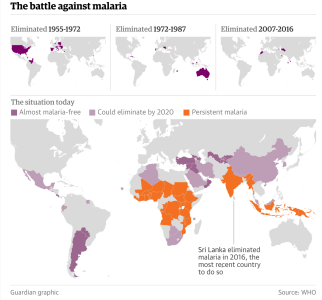
Interestingly, the international community used to take vector control seriously, which resulted in some significant results (see map):
In 1955, the UN committed to ending the scourge of malaria. It was optimistic because it thought there were effective tools. The pesticide DDT had been found to kill the mosquitoes that were spreading the disease in US army camps in the Pacific during the second world war. Widespread use of DDT and the drug chloroquine drove malaria out of many countries in the Americas, Europe and parts of Asia.
But it all fell apart. There was no real attempt to tackle malaria in sub-Saharan Africa because it was thought to be too difficult. Elsewhere, elimination fell foul of the problem that has bedevilled all malaria control efforts: resistance of the malaria parasite to drugs and of the mosquitoes to pesticides. Then in 1962, Rachel Carson’s blockbuster Silent Spring was published, alerting the world to the environmental devastation wreaked by DDT. The UN’s malaria eradication plan was officially scrapped in 1969.
The over-correction arising from Carson’s paradigm-shifting findings meant that much of the world was willing to sit on their hands as more than 400,000 people died each year of malaria. The WHO only dabbles in vector control through treated bed nets. Sadly, resistance to its choice of insecticides stood at 81% in 2016.
That translates to over 200 million people infected each year, over 400,000 of whom die.
Even Bill Gates agrees that complete eradication of malaria is the most sustainable solution:
“Eradication is the only sustainable solution to malaria,” Bill Gates said on the release of the report his foundation produced with the UN last September. “The alternative would be endless investment in the development of new drugs and insecticides just to stay one step ahead of resistance. The world can’t afford that approach.”
Is anyone out there investing in research on environmentally-safe insecticides?


 Among those targeted by Moi in 1988 was Kenneth Matiba, a wealthy former Civil Servant, executive at East African Breweries, and M.P. for Mbiri (later renamed Kiharu) Constituency in Murang’a District since 1979. In order to defend his seat, Matiba went
  Matiba then joined forces with intellectuals, church leaders, and politicians who were calling for a return to multiparty politics. For his efforts he was detained on July 4 1990 as he and other opposition leaders prepared for the first Saba Saba (July 7th) rally at Kamukunji grounds in Nairobi.
 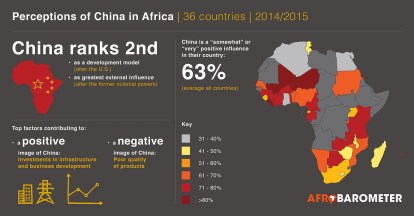 Enter the Chinese. Their model is to pay for resources both in cash and in kind. African leaders still get cash that they can stash abroad. But they also get roads, railways, stadia, hospitals, water works, among other infrastructure investments. And more recently Chinese firms have begun to invest in actual factories — most notably in Ethiopia.

 They also suggest that the militants learned from mistakes the United States made in 2003 after it invaded Iraq, including the decision to purge members of Saddam Hussein’s ruling party from their positions and bar them from future employment. That
  The extraordinary life you led is an example of resilient fortitude and inextinguishable passion that is a source of inspiration to us all of how to courageously confront challenges with unwavering strength and determination.
 kenopalo.com