Fascinating case of failed Coasian bargaining

How much would you pay in order not to listen to loud street music while working in your office?

The Washington Post (our new hometown paper) has an interesting story on this:

The band’s brassy riffs at 15th Street and New York Avenue NW always delight the hordes of tourists heading toward the White House. But the very spot that’s proved so profitable for Spread Love to pull in tips has also earned it the enmity of employees at two major Washington institutions: the Treasury Department and the law firm of Skadden, Arps, Slate, Meagher & Flom.

Apparently, the economists in charge of our nation’s financial stability and the attorneys who represent many of our country’s corporate high-rollers and white-collar criminal defendants are struggling to focus inside their offices because the band is so loud. They are hearing Spread Love spreading its love too much.

So the office workers offered to pay the band $200 a week. The band members declined, saying that they typically make that amount in an hour (unverified) from tourists.

The band’s director insists that they can sell the office workers a little quiet, if the price is right (just how much do the office workers value a little quiet while working? And what’s the band members’ opportunity cost of not spreading love?)

Apparently the band’s act is totally legal, as DC’s noise regulations are subordinate to individuals’ first amendment rights.

Also, notice how in certain instances government policies can create value for specific subsets of citizens by simply allocating “property” rights.

On the failure of constitutional engineering in Burundi

Burundi’s post-conflict constitution provides a robust array of formal checks to personal rule. Article 164 mandates a 60-40 Hutu-Tutsi split in National Assembly and 50-50 split in the Senate in order to ensure that the majority Hutu (85%) do not violate the rights of the minority Tutsi (14%). The Batwa (1%) are also guaranteed representation in Parliament through special nomination. Burundi also has a proportional representation (PR) system with a closed list that requires political parties to nominate no more than two thirds of candidates from the same ethnic group. Article 257 of the constitution reinforces the principle of ethnic balance by mandating a 50-50 split in the military. Furthermore, according to Article 300 any amendment to the constitution requires an 80% super-majority in the National Assembly and two thirds of the Senate (this is why Nkurunziza failed in an attempt to amend the constitution in early 2014).

So how did Nkurunziza manage to overcome all these formal institutional checks on his power and engineer a technical third term in office? For answers see here.

Hint: elite consensus on acceptable bounds of political behavior matters a great deal. Looking back, the framers of the Burundian constitution probably should have focused on intra-Hutu balance of power as much as they did on the Hutu-Tutsi balance. Nkurunziza succeeded because not enough Hutu elites (within his own divided party) were willing to punish his blatant contravention of term limits on a questionable technicality. Perhaps they will stand up to him if he tries again in 2020.

The Obama Visit to Kenya: Four Key Issues Deserving Special Attention

This weekend Kenya is hosting the 2015 Global Entrepreneurship Summit. The chief guest at the summit is U.S. president Barack Obama. Mr. Obama is scheduled to hold bilateral talks with his host President Uhuru Kenyatta; and will also give two public speeches on the sidelines of the summit — one at Kenyatta University and another at the Moi International Sports Centre in Kasarani. Here are the things I hope Obama and his team will focus on while in Kenya:

  • Infrastructure Development and FDI: Kenya is currently in the middle of an epic infrastructure investment drive (power generation and transmission, roads, railway lines, ports, and water systems). The most impactful thing the U.S. president can do for Kenyans is to facilitate a more robust involvement by the U.S. private sector in these projects – either through private investment or PPPs (Public-Private Partnerships). And perhaps the most natural place for U.S. companies to put in even more money is Kenya’s buzzing tech scene. IBM, Intel, Google, Microsoft, and GE have led the way. More need to follow.
  • A New Approach to Civil Society Support: The Kenyan government still has a lot to do in terms of governance reforms. But the way partners like the U.S. and the EU approach the challenge needs to change. The 2010 Constitution devolved and, by a large measure, professionalized government in Kenya. Unfortunately, the Kenyan Civil Society appears to not have caught up. The same can be said about political affairs officers in various embassies in Nairobi. The new institutional game is different and favors Think Tanks with deep research benches as opposed to multipurpose activists. Support for the Kenyan Civil Society therefore needs to catch up to this reality. Project cycles need to be elongated. Also, if I were a donor with a large pot of money I would focus a lot of energy in getting governance right in a few of Kenya’s 47 counties as an example to the rest. These subnational units have substantial financial and political resources that make them ideal testing grounds for public policies. They are also sources of future national politicians.
  • Taking Security Seriously: Kenya continues to be mired in the conflict in Somalia as part of the AMISOM mission. The involvement has exposed Kenya to terror attacks by al-Shabaab – the most bloody of which was the Garissa University College attack that left 148 people dead. The U.S. has been a key partner of AMISOM, providing equipment, funds, intelligence, and air support. Given its leverage, America could do more in making sure that Kenya’s involvement in Somalia does not lead to an erosion of KDF’s professionalism. Credible reports have linked KDF officers to the smuggling of charcoal and sugar, activities that line the coffers of al-Shabaab. There is also evidence that the Generals are the ones driving Kenya’s Somalia policy, instead of elected civilians. U.S. support should be predicated on civilian control, a healthy reverence of military professionalism, and an appreciation of the local and regional consequences of American actions in Somalia. America also needs to realize that Kenya is still a young democracy struggling to consolidate rule of law. Unlawful arrests, disappearances, and executions of suspected terrorists who are Kenyan nationals must stop. The fight against al-Shabaab must not be allowed to erode hard fought gains in the quest for rule of law.
  • A Constructive Political Engagement About Reforms: The U.S. can help Kenya clean up its public sector through reforms founded on political reality. For example, presently corruption appears to be worsening in the country. This is both a function of media exposure and dispersal of power. More people in government now have access to state coffers – mainly throught the tender process (as a result tenderpreneurs abound). Corruption is also political. The president is ultimately a politician who wants to be reelected. the same applies to MPs and Governors and Senators. Many of them engage in corruption as a means of campaign finance (Harambees are expensive). Tackling corruption therefore requires more than mere moralizing about its ills on society. All involved must be willing to address the hard and uncomfortable truths about the political economy of the vice. This would mean, for instance, coming up with a way to allow politicians access to campaign money in a legal and transparent manner. It may also entail some form of amnesty for past offenders (you can’t jail the entire public service). Corruption in Kenya is not a simple law enforcement problem. The same logic applies to other reform initiatives. They are likely to succeed if grounded on political realities, instead of some notion of a moral failing among Kenyan politicians.

Here are some pieces I liked about Obama’s trip to Africa:

– Charles Kenny on why Obama is selling Africa short

– Todd Moss on Obama’s missed opportunity in Africa 

– The challenges facing power Africa in Nigeria

Presidential Salaries in Africa

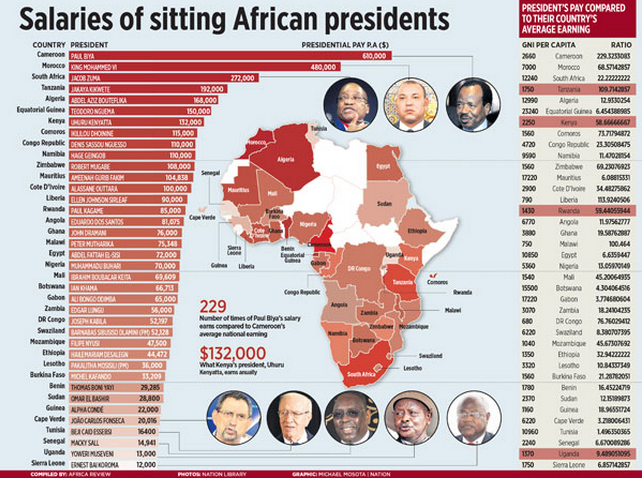
Paul Biya of Cameroon earns $610,000 per annum, 229 times the earnings of the average Cameroonian.* Screen Shot 2015-07-22 at 10.31.57 PM

Think about it for a second: Paul Biya earns $210,000 more than Barack Obama.

Notice that these figures do not include all manner of allowances.

Source: Daily Nation

*Note that the interns at the Daily Nation mixed up Mauritania and Mauritius. The CNN bug is contagious.

The politics of unemployment numbers

I just discovered the website Africa Check. It’s a fantastic resource dedicated to “sorting fact from fiction.” Three posts caught my eye, on unemployment numbers in Nigeria, Zimbabwe, and South Africa.

In Zimbabwe:

Zimbabwe’s unemployment rate is 4%, 60%, or 95% depending on who you ask. The ruling ZANU-PF, in a campaign manifesto, admitted that the rate was 60%! You know things are really bad when a ruling party (in an election year!) says that this big a proportion of the working-age population is unemployed. The World Bank apparently claims that the rate is closer to 5.4%.

In Nigeria:

The state stats agency controversially claimed that the unemployment rate is only 7.5% (for the last quarter of Goodluck Jonathan’s presidency). Tolu Ogunlesi then offered this explainer on how the government arrived at the number. The numbers suggest that the actual figure varies from 7.5 to 24.2 depending on the choice of cut-off for what it means to be employed. 

And in South Africa:

ANC claims that the unemployment rate at the end of 2013 was 21.9% but skeptics insist that the actual figure closer to 24.1%. 

World Bank Recruitment Drive for African Nationals

Are you a national of an African country? Do you have a Masters’ degree and are interested in working for the World Bank Group? Then be sure to apply here before AUGUST 31, 2015. The positions (covering 22 different issue areas) may be based either in DC or in country offices.

“Qualifications for the entry level is a Master’s degree plus 5 years of relevant professional experience. For mid-career professionals, the requirements are a Master’s degree plus 8 years of relevant professional experience. Ideal candidates for these positions must have a demonstrated capacity for strategic thinking, the ability to conduct dialogue on relevant development policies and priorities, and be fluent in English with very good writing and communication skills.

All applications must be received by August 31, 2015. Applications received after the closing date will not be considered.”

More on this here.

H/T Teresa

Is evidence-based institutional analysis a possibility?

Chris Blattman writes:

But Acemoglu is right that institutional and political change are more important and the evidence-based crowd have done very little here. Most of that evidence is about anti-corruption or election monitoring or other things that I doubt change politics very much.

Meanwhile all the good political economy research (like Acemoglu’s) has no clear implication for social and political change in the world. There is a big disconnect. These scholars have mostly ignored this gap either because… I don’t know why. Maybe it’s too treacherous or hard, or they don’t find it interesting enough, or they are cynical about policy change. I don’t know. Someone explain it to me.

Blattman is spot on.

I think that students of institutions and institutional development have not joined the evidence-based crowd for two main reasons:

  • Politics I: Much of the evidence-based research out there eschews politics, instead focusing on the technical aspects of problems. Works that explicitly deal with political scenarios exist, but are rare. Part of the reason this is the case is that agencies that finance impact evaluations and other kinds of evidence-based policy research agendas have incentives to remain as apolitical as they can (you need host country government permission to do research in the first place …..)
  • Politics II: The other reason is that it is almost impossible to engage in politically relevant big-picture-development research while remaining apolitical. You see this in splits among macroeconomists in the United States (Macro questions make it really hard for researchers to shed off their normative priors). In the same vein, the best placed people to carry out evidence-based studies of institutions and how to change them are often professors in universities in the developing world — the problem is they do not do enough research due to a lack of resources and/or the relevant skill sets; and their own governments often neglect them. Regardless of their nationality, the most visible development economists in universities in the North Atlantic often lack the political connections or the bandwidth to engage in host-country politics; and are thus limited in the extent to which they can effectively study the most vexing policy questions out there.

These reasons are not due to anyone’s fault, just how research is currently financed and structured.

A possible way to get around these problems could be MBA-style case studies of reform programs from across the globe that can then be retooled by Comparativist country specialists — incoming Stanford CDDRL director Frank Fukuyama has very exciting ongoing work on this front.

On a tangentially-related point, I think that works that combine technical brilliance and deep local knowledge (think Bates’ lesser-read books on the Zambian Copperbelt) are about to come in vogue again. It used to be that only a few grad school programs (at least in political science) emphasized technical competence out of econ envy to match the economists. This is getting more commonplace, thereby establishing a new baseline (the data revolution is also helping a great deal by increasing the scope of country-specific studies of macro questions). And once a critical mass is achieved then the comparative advantage will favor those who are both technically competent and can also speak intelligently about how policy dovetails with local politics. The title “country-specialist” will soon no longer be synonymous with “qualitative research”; and more students will be primed to value good qualitative research.

Key Issues That President Kenyatta Will Raise During Obama’s Visit

This week for the first time a serving American leader will visit Kenya. Such a high profile visit has been long coming. It was eight years ago that the North American country witnessed only the 43rd peaceful handover of power following a free and fair democratic election.

Many analysts had expected that then Kenyan president, Mwai Kibaki, would extend a courtesy invitation to president Barack Obama in order to signal Kenya’s commitment to the process of democratic consolidation in the United States. President Kibaki’s decision to avoid being associated with Obama was perhaps emblematic of the concerns many in the Kenyan government still have regarding the American leadership’s commitment to reforms, including in areas such as police brutality, income inequality, ethnic and racial tensions, and overall respect for human rights.

For example, America has only 5% of the world’s population but 25% of its prisoners. Many of those languishing in crowded jails are people of color serving long sentences in large part due to racially-biased laws and police departments.

obamaAware of this blot on America’s record, Obama sought to assuage Kenyan officials by visiting a federal prison in the region of Oklahoma as well as publicly declaring his commitment to reforming the justice system in America. As a gesture of goodwill the American leader also released several prisoners ahead of his visit. The Kenyan Ambassador in Washington, Robinson Githae, welcomed this move by the U.S. government, but reiterated the need for structural reforms. Mr. Githae also emphasized Kenya’s commitment to supporting governance reforms in the United States and the Americas in general.

The Kenyan Ambassador also listed a number of issues that President Kenyatta hopes to raise with the American leader during his two-day visit in Nairobi. These include:

  • Regional and global security: The United States is the most militarized nation in the world. As such, it has had a hand in nearly every single geopolitical hotspot on the globe. President Kenyatta will remind the American leader of the need to respect international law and the sovereignty of other nations, even as his country pursues its interests abroad. For example, in a statement last week Mr. Kenyatta commended the American negotiating team for reaching a deal with Iran just in time for the visit. He also lauded the American leader’s decision to by-pass the country’s sophomoric parliament and first seek the deal’s approval at the United Nations. Eager to please Kenyan officials, America this week began the process of normalizing relations with Cuba. The government of Kenya hopes that these gestures will endure beyond the current administration and signal a new American commitment to engaging other nations of the world with mutual respect.
  • Ethnic and racial violence: Having lived in the Americas during his college years, Mr. Kenyatta is well aware of the evils of racial discrimination in that part of the world. The president will particularly focus on the utterances by some candidates in next year’s U.S. election who suggested that all immigrants from neighboring countries are violent criminals. Mr. Kenyatta will emphasize the need for ethnic and racial tolerance ahead of the election in order to avoid ethnic violence or a souring of relations with America’s neighbors. The Americas hold the dubious title of being the murder capital of the world, in addition to being a leading source of drugs such as cocaine. Kenya is keen to ensure that the volatile region remains reasonably contained since it is a vital supplier of movies and soap operas to the global market.
  • Respect for human rights: Despite its impressive rebound from the stolen election of 2000, the United States continues to experience several challenges with regard to human rights. It’s police routinely brutalize men, women, and children in front of cameras, and get away with it. Just this year almost 400 people have been killed by the police or died under mysterious circumstances while in the custody of police. The U.S. government also continues to spy on its own citizens, in many instances in direct violation of its own constitution. Mr. Kenyatta will press the American leader on these issues, and remind him that his country lags other nations that share its level of political and economic development.
  • Bilateral Trade: Trade ties between Kenya and the United States are weak. In 2013 the total volume of trade between the two countries was a mere 2 percent of Kenya’s GDP. America’s economic insignificance to Kenya is signaled by the fact that the latter is the former’s 96th largest trading partner. President Kenyatta will press the American leader on the need to maintain the American EXIM Bank (whose authority has lapsed) as a financier of bilateral trade. The president will also remind the throngs of businesspeople and cronies that will be part of the Obama delegation that they need to stop the habit of hiding behind “political risk”  and warped ideas about Kenya as excuses for not investing in the country.

An often under-appreciated aspect of this visit is that the American leader’s father was Kenyan (indeed, America’s leading TV station has speculated that Obama himself was born in Kenya). It is unclear what, if any, President Kenyatta has planned for the American leader to mark this historic visit to his father’s home country.

How did Nkurunziza manage to stay in power even after a coup?

Ronald Rugero offers an insightful take on the dynamics of intra-elite politics in Burundi:

…… the attempted coup pitted two ideological factions against each other within the ruling party. On one side are the “progressives” represented by Niyombare, the leader of the coup and first Hutu chief of staff in the history of the country. Backed by the West, the progressives blame the current crisis on Nkurunziza’s wanting to seek a third term at all costs, contrary to the Peace Accord of Arusha and the Burundian constitution.

On the other side, the “conservatives” rally behind Nshimirimana, for whom the current crisis goes far beyond a simple difference in the reading of the constitution. A central concern of this faction is the progressives’ close ties with Rwanda, which indirectly accuses Nkurunziza’s government of preparing a genocide similar to that of 1994, utilizing the Democratic Forces for the Liberation of Rwanda (FDLR) and the Imbonerakure (the youth wing of the CNDD-FDD). The conservatives, and Nkurunziza, are supported by Russia and China.

Many analysts make the mistake of thinking that the departures of CNDD-FDD personalities like the second vice president Gervais Rufyikiri or the President of the National Assembly Pie Ntavohanyuma (both supported by the “progressive” wing) affect the party. As long as the majority of the military establishment, most of whom are unknown to the media, are behind Nkurunziza, the whole party and the Burundian military will support him. In light of nascent rebellions like the one declared last week on the Burundi-Rwanda border, it is unrealistic to imagine that a swift attack could remove the power of Bujumbura and drive out Nkurunziza.

You can read the whole piece here.

Angus Deaton and Rwanda’s Health Minister, Agnes Binagwaho, square off

Angus Deaton wrote a critique of Effective Altruism, in which he offered up Paul Kagame’s dictatorship as an example (read the whole thing, he makes some good points):

In today’s Rwanda, President Paul Kagame has discovered how to use Singer’s utilitarian calculus against his own people. By providing health care for Rwandan mothers and children, he has become one of the darlings of the industry and a favorite recipient of aid. Essentially, he is “farming” Rwandan children, allowing more of them to live in exchange for support for his undemocratic and oppressive rule. Large aid flows to Africa sometimes help the intended beneficiaries, but they also help create dictators and provide them with the means to insulate themselves from the needs and wishes of their people.

The industry does not ignore the evidence; indeed the World Bank, the U.S. Agency for International Development, and its European counterparts use the same evidence GiveWell does, and they help to create more. They are also infinitely better organized and funded than the NGOs, so if it were possible to use this sort of evidence to eliminate global poverty, they would be better placed to do so than a handful of wealthy individuals working through NGOs. Yet these official aid agencies cannot solve the political conundrum and must bear some of the burden of responsibility for the oppressive dictatorships that fester in Africa.

Rwanda’s Minister of Health, Dr. Agnes Binagwaho then wrote this response:

Deaton believes that we ‘provide health care for Rwandan mothers and children’ in order to ‘insulate ourselves from the needs and wishes of our people’. I can’t tell if he means that Rwandans don’t wish for good health, or that our country would be more democratic if we neglected basic needs.

…..  The issue is moral, and it concerns all of us. Deaton’s theory rests on the assumption that Africans don’t feel love for their children. It follows that President Kagame, being an African, sees children as a commodity, like copper or sweet potatoes, to be sold to people in the West who value their lives more highly. Rwandans have a proverb for such impertinence – Urusha nyina w’umwana imbabazi aba ashaka kumurya: “Whoever shows more compassion for a child than its own mother only wants to exploit it.”

Angus Deaton doesn’t know Paul Kagame from Kunta Kinte. The president is just a cartoon character he uses to argue against foreign aid. Deaton isn’t referring to the real Paul Kagame or the real Rwanda, but to a generic ‘other’ whose moral inferiority is so self-evident that it requires no elaboration.

To which Angus Deaton replied:

Dr. Agnes Binagwaho, firing off in all directions, misses her target. I am not a racist, and that she would stoop to such libel only highlights the weakness of her case, indeed the absence of any argument at all. And her fury has blinded her to the logic of my argument.

My target is not the Rwandan people, nor even Paul Kagame; I have no doubt that Rwandan parents love their children, and that the improvements in health and healthcare in Rwanda are a good thing. Dr. Binagwaho can be justifiably proud of her part in this. I did not argue that Rwandans do not want good health, nor that Rwanda would be more democratic if it neglected its basic needs. No one in their right mind would ever make such claims, certainly not I. The attack on Kagame is general, not personal: autocrats without accountability to their citizens face no constraints to behave well and have no structural incentives to do good things for their people.

The merits of either respective arguments aside, this exchange raises serious questions about how academics and practitioners working in development should approach or write about regimes like those in Rwanda and Ethiopia.

Here are some (tortured) quick general thoughts:

  • There is a strong positive relationship between strong state institutions and economic growth.
  • The jury is still out on the causal relationship between democracy and economic growth. And since institutional development takes time, simply democratizing doesn’t guarantee the emergence of good institutions. What seems to be necessary is freedom for the relevant economic actors. England on the eve of the industrial revolution provided freedom for the relevant actors, even as loads of men and women could not vote.
  • Dictatorships also have institutions that aren’t mere window-dressing. So we shouldn’t think of Kagame or Mugabe as unhinged omnipotent ghouls who can do whatever they can dream of. Lifetime presidents like Museveni and Mugabe are hostage to subsets of elites in their countries, just as much as the same elites are being held hostage by their rulers.
  • Most “good” institutions (like strong legislatures, for example) often have autocratic foundations. In other words, if Rwanda ever democratizes, its democratic institutions will be built upon the developments that have taken place going back to 1994 and beyond. This means that reformers are probably likely to succeed if they work along the grain, rather than against it.
  • The approach to governments like those in Rwanda and Ethiopia (unlike in Syria or Pol Pot’s Cambodia) should therefore not be one of everything sucks right now, lets get rid of them and start afresh. Instead, efforts to right the wrongs in these countries should focus on how to build on what has been achieved so far. Anyone who tells you that the governments of Rwanda and Ethiopia are 100% bad is lying to you. A couple of years ago an Ethiopian opposition leader who was visiting Stanford as a fellow told me that “you can’t argue against power lines and roads.” She had a point. The reductions in infant mortality in Rwanda are real. Those lives matter. And I don’t think Kagame’s regime worked to save those lives in order to use them as a bargaining chip.
  • The world should be united in its moral outrage in light of the jailing and killing of democracy activists in both Rwanda and Ethiopia.  Pressure should be applied on Kagame and the EPRDF to improve on their human rights record. But at the same time we should not fall into the temptation of singling out these regimes as particularly weird dictatorships like the world has never seen before. This is the line, I think, that Deaton crossed with his “farming children” argument.
  • Political change for the better is hard. Just look at the unimaginable injustices that take place in the United States, a robust democracy, with politicians and all manner of well-wishers unable to do anything meaningful about it. Just imagine for a second that until recently African-Americans in Charleston still lived under state-sanctioned humiliation in the name of the confederate battle flag. All reasonable people hated the fact. But they also acknowledged the political complexities involved. And appreciated the complexity of the actors involved. In the same vein, several governors in the United States currently deny their citizens healthcare benefits for purely political reasons. Why do commentators acknowledge the political complexities of these red states but somehow imagine politics elsewhere to be simpler? Why do we believe that countries like Rwanda and Ethiopia can be put on the right track with quick fixes? Why do we always simplify these places?
  • I have no idea of how to quickly get rid of Kagame or the EPRDF without going through a revolution, a reign of terror, and a restoration of dictatorship. So all I can do is criticize these regimes, but all the while acknowledging that they are complex systems composed of human beings with interests and who respond to incentives.
Can you train people to be financially competent?

Margaret Miller and co-authors try to answer this question in a new paper in the World Bank Research Observer. The paper does a meta-analysis of 188 studies conducted in Africa, Asia, Latin America, the United States and Europe.

Are there approaches to teaching financial skills or modifying financial behaviors through educational programs, training, or other outreach activities that have reliable, positive results? The objective of this paper is to analyze the evidence of impact for financial literacy and capability interventions through a systematic review of the evidence. The review includes the use of meta analysis, a statistical technique that pools data from different studies to test for significance in the enlarged sample of observations this creates. This paper is different from most previous narrative reviews in that it focuses exclusively on research that analyzes the impact of financial education interventions. Key characteristics of 188 papers are coded to create a rich data set with the characteristics of the interventions, as well as statistical information on the impact of programs on outcome variables such as general savings, retirement savings, and credit performance. This data set is then used for a descriptive analysis of the literature and for empirical tests using meta-analysis.

…. we find that financial education can affect financial outcomes such as savings and improved record keeping, but does less well in preventing negative outcomes such as loan defaults. These results suggest a role for financial education in improving behaviors where individuals have the ability to exert greater control. Arguably, loan default is imposed by external agencies (banks or other financial providers), and hence can only be avoided secondarily or over the long term if financial education leads to more prudent borrowing decisions. Savings and record-keeping, in contrast, are immediate and primary decisions that can be acted upon by targeted consumers.

More on this here.

European logging firms are financing rebels in CAR

According to Global Witness:

CAR’s trade in timber – the country’s number one official export – has assisted the war effort. Logging companies have paid millions of euros to armed groups to ensure that they can continue operating. Under the cover of conflict they have also been stripping out CAR’s rainforests.

Throughout this period, European companies have continued to offer CAR timber for sale on EU markets, which Global Witness believes violates the EU’s flagship timber law, the EU Timber Regulation.  China is another major market for CAR wood, but has no regulations in place that could help halt the import of illegal or conflict timber.

[youtube.com/watch?v=QAVhfaX78g4]

At some point in the video an officer in one of the French firms involved says:

“But it’s Africa. It’s so common we don’t pay attention. It’s not really a concern. It’s not a war where they attack white people. It’s not a war we have to avoid.”

This honest assessment of the situation in CAR highlights one of the reasons why wars in places like CAR or Liberia and Sierra Leone in an earlier time tend to be so intractable.

Source: Wikipedia

Source: Wikipedia

Research shows that sources of finance determine the industrial organization of rebel groups and their propensity to commit atrocities against civilians (see also here). The ready availability of shady firms like Tropica-Bois and Société d’Exploitation Forestière Centrafricaine (SEFCA) make it possible for rebel leaders to raise funds for their war effort in the international commodity market. This in turn makes it possible for them to buy arms and recruit locally, but without maintaining strong ties with the very communities in whose name they raise arms (call it the rebel’s resource curse). The resultant incentive system is one in which CAR warlords can obtain material benefit from the rents on illicit trade without capturing Bangui, as long as their maintain access to the global market of timber.

The Global Witness report adds to complaints about French intervention in the ongoing CAR conflict. In April news broke that more than a dozen French soldiers abused children in Bangui in exchange for food. The six children who came forward with the complaints were aged between eight and 15 and at the time lived in a center for displaced people in Bangui. The centre was under the care of French peacekeepers.

Tropica-Bois must be paying a lot of taxes to the French treasury, or oiling the electoral machines of key French politicians.

According to the UN Comtrade database  in 2013 wood comprised 40% of all commodity exports from CAR, second only to diamonds (45.8%).

The case for well-planned infrastructure mega-projects

No one likes white elephants. But some mega-projects are simply unbeatable. One example is India’s Golden Quadrilateral highway project, constructed between 2001-2012. In a new paper, Ghani, Goswami and Kerr write:

Golden_Quadrilateral

Source: Wikipedia

We exploit a large-scale highway construction and improvement project in India, the Golden Quadrilateral (GQ) project. The analysis compares districts located 0-10 km from the GQ network to districts 10-50 km away, and we utilize time series variation in the sequence in which districts were upgraded and differences in the characteristics of industries and regions that were affected. Our study employs establishment-level data that provide new insights into the sources of growth and their efficiency improvements.

The GQ upgrades stimulated significant growth in organized manufacturing (formal sector) in the districts along the highway network, even after excluding the four major cities that form the nodal points of the quadrangle. Long-differenced estimations suggest output levels in these districts grew by 49% over the decade after the construction began. This growth is not present in districts 10-50 km from the GQ network nor in districts adjacent to another major Indian highway system that was scheduled for a contemporaneous upgrade but subsequently delayed. We further confirm this growth effect in a variety of robustness checks, including dynamic analyses and straight-line instrumental variables (IV) based upon minimal distances between nodal cities. As the 0-10 km districts contained a third of India’s initial manufacturing base, this output growth represented a substantial increase in activity that would have easily covered the costs of the upgrades.

Decomposing these aggregate effects, districts along the highway system experienced a significant boost in the rate of new output formation by young firms, roughly doubling pre-period levels. These entrants were drawn from industries intensive in land and buildings, suggesting the GQ upgrades facilitated sharper industrial sorting between the major nodal cities and the districts along the highway. Despite a substantial increase in entrant counts, the induced entrants maintained comparable size and productivity to control groups. The young cohorts, moreover, demonstrated a post-entry scaling in size that is rare for India and accounted for an important part of the output growth.

Of course these findings should not come as a surprise to anyone who has seen the rapid growth along the $360m Thika Superhighway in Nairobi and Kiambu counties in Kenya — the African Development Bank (a key financier) estimated the project to have an internal economic rate of return of 30%. Which is precisely why Harambee House ought to consider fast-tracking the construction of a dual carriageway linking Mombasa to Busia and Malaba.

On effective altruism

Peter Singer has an essay on effective altruism in the Boston Review, with responses from several authors and academics. One of the more interesting responses came from Jennifer Rubenstein.

She writes:

A central strength of the effective altruism movement is that it urges donors to make empirically informed decisions that focus on effects rather than good intentions, “warm glow” feelings, or the intrinsic value of actions. In this respect, it is far superior to charity appeals based on identifiable victims, charismatic megafauna (e.g., polar bears), charismatic mega-stars (e.g. Bono), oversimplified villains (e.g., Joseph Kony), and dramatic images of disaster.

….  The effective altruism movement retains members by directing their emotional energies and commitments toward each other, not the people they aim to assist. Singer thus profiles effective altruists for his readers to emulate; he does not depict poor people using assistance to exit poverty. Likewise, organizations such as Giving What We Can encourage their members to make commitments to, and engage in community-building with, each other—not poor people. These strategies rightly avoid using pity as a motivational tool, but they also preclude more promising forms of connection, such as political solidarity.

By excluding poor people and encouraging a savior complex and insularity among its members, the effective altruism movement fails to meet normative criteria of democracy and equality. A supporter of this movement might respond that democracy and equality are less important than improving individual welfare. Yet in the medium-to-long term, the movement will likely fall short in this regard as well. As the low-hanging fruit of basic health programs and cash transfers are exhausted, saving lives and alleviating suffering will require more complicated political action, such as reforming global institutions. Undertaking this action will require outsiders to work with, and follow the lead of, activists in poor countries. Yet the effective altruism movement as Singer describes it does not cultivate the expectations, attitudes, or relationships necessary for this kind of work.

The whole exchange is here.

It’s hard to argue against public health interventions or direct cash transfers that save lives and marginally improve living conditions for the world’s poorest.

But at the same time, you’ve got to wonder why well-to-do people in rich countries would be into uncritically subsidizing the bad habits of their counterparts in poorer countries (through “technical” targeted interventions that sidestep political processes). Why should Obiang’s son have the luxury of buying a private jet rather than building clinics for his country’s poor?

A slightly different story on administrative unit proliferation

The emerging stylized story about administrative unit proliferation in the developing world is that it is often a result of political machinations by national and local elites intent on creating new units for marginalized groups and for the ruler to buy votes; and that such proliferation only serves to re-centralize actual power — see for example these really cool papers by Grossman and Lewis (on the specific case of Uganda), Mai Hasssan (on the use of new districts to buy votes in Kenya) and Kimuli Kasara (also on how heightened electoral competition after 1992 accelerated the process of administrative unit proliferation in Kenya).

But there is also a slightly different, and in some ways complementary, story.

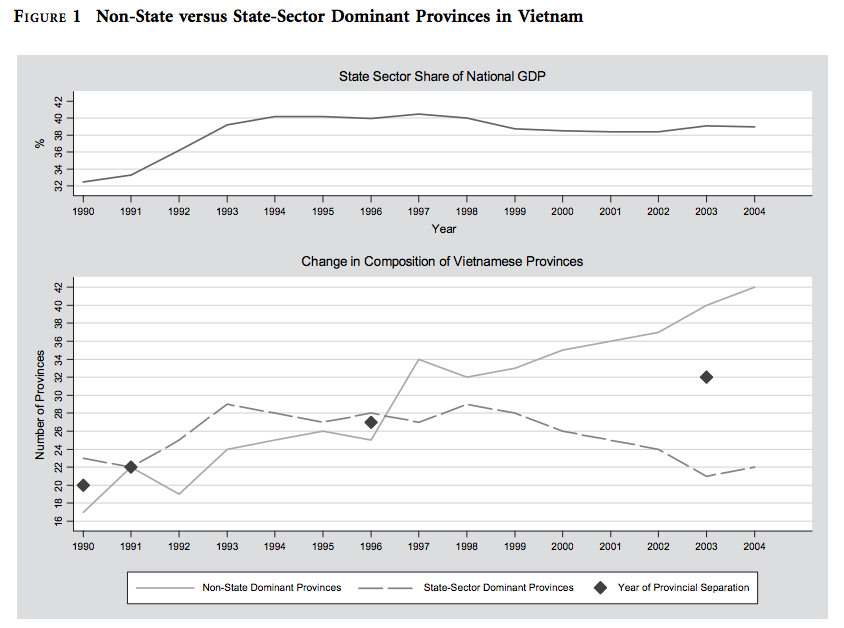
Regarding the creation of new provinces in Vietnam, Edmund Malesky notes:Screen Shot 2015-07-09 at 12.30.20 PM

The timing of provincial separations after Party Congresses, the dominance of Non-state Provinces despite little change in national output, and the decisive political outcome of this dominance at the 2001 Party Congress bolster the argument that reformers had an explicit electoral strategy in calling for the splitting of provinces in 1996. By creating new Non-state Provinces, modernizers believed they could influence the outcomes of future CCOM debates about
grand strategies and smaller NA debates about implementation of these new policies. While rhetorically it was easier to argue for new provinces based on efficiency, it would seem they were studying maps of
district economic composition and creating new reform-oriented
provinces out of SOE-dominated areas.

The key difference between administrative unit proliferation in Vietnam and Uganda (and Kenya before 2010) is the electoral connection (an aspect that, in my view, is missing in the current literature). Because the provinces had votes (in party congresses and plenums), the creation of new Vietnamese provinces had significant implications for the de facto distribution of power in both Hanoi and the periphery (and in Malesky’s story, made reforms possible). Provincial splits in Vietman were therefore not just about patronage and marginalized groups, but also about securing a win for the reformist bloc at the centre.

This might not be the case in countries where new units can be created without altering the balance of power in the party congress or parliament — either because such action does not create new electoral districts; or the president gets to nominate or can credibly influence the election of the representatives of the new districts. For this reason, I would predict that Kenya, Nigeria, and South Africa (whose subnational units are electorally significant and have a fair amount of fiscal autonomy) are unlikely to create new primary subnational units willy-nilly.