We find that in countries with a high degree of bureaucratic capacity (i.e. ability to tax the rich), the wealthy turn out at higher rates than the poor. Consistent with our theory, we find that the turnout of the poor is largely unaffected by bureaucratic capacity. This finding is robust to a variety of measures of state capacity. We also provide evidence for an additional implication of our theory. If turnout rates amongst the wealthy are driven by their potential tax exposure, it ought to be the case that where redistributive politics on a tax-and-transfer dimension are salient, the rich turn out to vote at higher rates than the poor. We show that where the rich and the poor support different political parties, the rich turn out to vote at higher rates. We also provide evidence that likely confounds, reverse causation, and social desirability bias in reported turnout cannot account for the patterns we find in the data.
That is Kimuli Kasara and Pavithra Suryanarayan of Columbia [h/t monkeycage] in a paper explaining global variation in turnout rates by income. In a roundabout way the paper speaks to the factors that enhance democratic stability. Low state capacity (in this case with regard to tax collection) is bad for democratic stability because, among other things, it denies young democracies the stabilizing effect of the middle and upper classes in the democratic process thereby making them continue to behave like autocracies (Did you know that autocracies in Latin America redistributed land more than democracies?) It also takes away the taxation-based implicit contract between the voter and the state, thereby giving politicians a free hand to do as they wish with public resources.
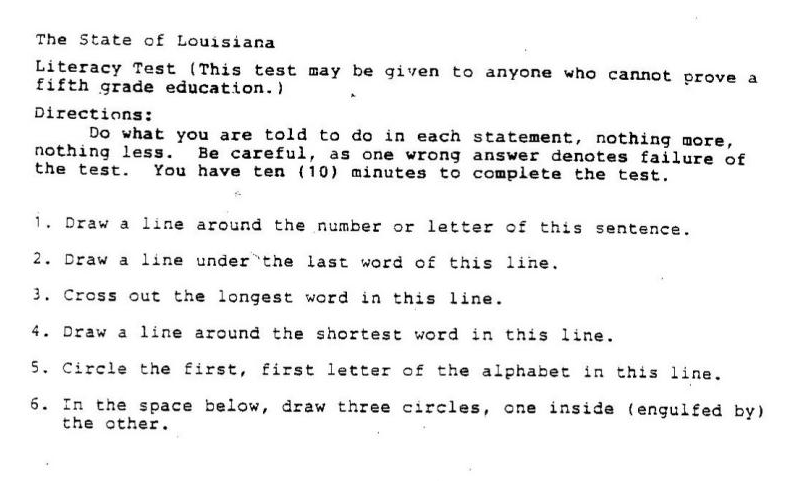
In related news, following the US Supreme Court decision on the Voting Rights Act Rebecca Onion at Slate posted a nice piece on the original literacy tests in Louisiana that were designed to keep minorities away from the polling stations. Interesting stuff. I wonder what the average score would be if the tests covered all voting age Americans…
 kenopalo.com