Mastermind of 1998 bombings in Nairobi and Dar killed in Mogadishu

The man behind the US embassy bombings in Nairobi and Dar es Salaam has been killed by Somali government forces at a roadblock in Mogadishu.

The Saturday Nation reports:

The mastermind of the 1998 twin bombings in Nairobi and Dar es Salaam Fazul Abdullah has been killed by Somalia government forces in Mogadishu.

Mr Abdullah, who holds a Kenyan passport, was wanted for the fatal bombing of US Embassies in Kenya and Tanzania that left at least 250 people dead and many injured.

He was reportedly killed by the Transitional Federal Government (TFG) forces on Wednesday at a roadblock.

The run-away terrorist, who was on the Federal Bureau of Investigations (FBI) watchlist of most wanted terrorists, is believed to have taken over the leadership of al Qaeda’s branch in Somalia, al-Shabaab from where he directed world attacks and African terror operations.

Confirming the reports, Kenya’s Police Commissioner Mathew Iteere said he was working with security officers in Somalia to get a comprehensive report.

PhD comics movie

Isn’t it time we had a real show about graduate student life? (The big bang theory does not count, although it gets close. And I love it).

Here is the PhD Movie trailer:

I hope this will get hollywood writers and producers going (or not).

If you haven’t yet, check out PhD Comics.

More on economic development

Brookings has two pieces worth reading on the state of Africa’s economies.

The main takeaways are that: 1) there are many Africa’s; some states are doing well while others continue to run around in circles 2) Governance, Governance, Governance. You cannot have a thriving business sector amidst high levels of unpredictability and 3) Trade, both intra-continental and to other regions of the world, is the key to African development.

You can find the reports here and here.

selective unconditional convergence and growth

Rodrik has a finding that reinforces the importance of politics and other macro conditions for economic development. He points out the existence of the paradox of unconditional convergence at the industry level but not at the national level. Rodrik stresses the importance of structural change that channels labor into the right industries. To this we should add political change that provides certainty and the requisite legal and physical infrastructure for economic growth.

Industries that thrive in poorly run places – like telecoms, banks and construction firms in Nigeria or Kenya’s retail giants – do so despite their governments. Non-existent roads, underdeveloped railway systems, sporadic and expensive electricity, bad schools, legal uncertainty and massive amounts of political risk all serve to limit the extent to which within-industry gains can be extended to other sectors.

The massive uptake of mobile telephones across Africa suggests that consumerism in SSA is alive and well, just under-exploited. Sectors like textiles, agriculture and construction remain largely untouched because of cheap imports and bad regulation.

Development is a complex enterprise that requires massive amounts of (implicit) coordination. There has to be a link between California’s Silicon Valley, Massachusets’ Route 128 and New York’s Wall Street, in addition to other growth clusters. In this game synergy is King. The provision of the legal, human capital and physical infrastructure to facilitate coordination of this scale is largely dependent on well-functioning governance structures.

Here’s Rodrik.

Poor countries have access to new technologies already developed elsewhere so should grow more rapidly than richer economies. This is one of the implications of standard growth models, as well as of common sense.

But in reality, there is no automatic tendency for economic “convergence” among countries at different levels of income. Convergence depends instead on a number of additional determinants. It is only those developing nations with the “appropriate” preconditions – for example, adequate schooling or physical investment – that manage to absorb new technologies sufficiently rapidly and therefore to catch up. In the language of growth economics, there is conditional convergence, but not unconditional convergence.

When we look at the same question at the level of individual industries rather than countries a surprising finding emerges. Suppose we focus on, say, plastics, furniture, or the auto industry in developing countries. Does productivity in these (and other) industries experience automatic convergence with the technological frontier? Or is convergence once again conditional, depending on a host of country-level variables?

The interesting (and I think new) finding is that productivity convergence appears to be unconditional at the industry level – at least for manufacturing industries and for the period since the 1980s.

Quick hits

Texas in Africa’s review of Fighting for Darfur.

Blattman on economic growth and development.

The long arms of the Rwandan state?

The Zambian elections will be close. Last time round the opposition leader lost by a mere 3% (I will be there for the campaigns this summer).

And lastly, Kenya’s trillion-shilling proposed budget. High on development expenditure but could it crowd out the private sector?


Africa’s budding narco-states?

UPDATE:

The Kenyan Prime Minister just admitted to the presence of drug money in Kenyan politics. Huge. Also, check the UNODC’s drug trafficking patterns for East Africa.

Also, does anyone out there have a copy of the report on drug trafficking in Kenya? Care to share?

****************************************

I have written before about the growing problem of drug-trafficking that is creating new problems for already fragile African states.

Of note is the fact that the problem is not just limited to the usual suspects – weak or failing states – but also extends to countries that most would consider to have it together, like Ghana, South Africa and Kenya.

According to Reuters, “cocaine moves through West Africa” while “heroin transits through the eastern part of the continent.”

The most alarming thing about this new trend is that in most of these African countries drug-trafficking happens with the consent of those in government.

For instance, in Guinea the son of former president Conte was for a long time a leading drug kingpin. In Guinea-Bissau President Vieira’s and Gen. Na Waie’s deaths in March of last year were a result of drug-related feuds. In Ghana President Atta Mills has lamented that the drug lords are too powerful to rein in. In Kenya, a woman (rumored to be) close to the president and other elites have been linked to the drug trade. Indeed on June 1st President Obama listed a sitting Kenyan Member of Parliament (Harun Mwau) as a global drug kingpin.

In South Africa former Chief of Police, Jackie Selebi, was jailed for 10 years in 2010 on drug charges. More recently the wife of the South African Intelligence Minister (Sheryl Cwele) was found guilty of having connections to the illicit trade. In 2009 a Boeing 727 crashed and was later set ablaze by suspected drug traffickers in Mali. The plane is believed to have been a drug cargo plane from Latin America destined for Europe. Other African states whose drug connections have also come to light include The Gambia (where rumors abound that President Jammeh is himself involved in the trade in drugs and arms in collusion with the Bissauian army) and Mozambique (H/T kmmonroe). You can find related news stories here and here.

Clearly, this is a real problem that if not nipped in the bud has the potential of growing to Mexican proportions, especially considering the already low levels of state capacity in most of Africa.

The Global Commission on Drug Policy also addresses this issue in their newly released report:

In just a few years, West Africa has become a major transit and re-packaging hub for cocaine following a strategic shift of Latin American drug syndicates toward the European market. Profiting from weak governance, endemic poverty, instability and ill-equipped police and judicial institutions, and bolstered by the enormous value of the drug trade, criminal networks have infiltrated governments, state institutions and the military. Corruption and money laundering, driven by the drug trade, pervert local politics and skew local economies.

A dangerous scenario is emerging as narco-traffic threatens to metastasize into broader political and security challenges. Initial international responses to support regional and national action have not been able to reverse this trend. New evidence suggests that criminal networks are expanding operations and strengthening their positions through new alliances, notably with armed groups. Current responses need to be urgently scaled up and coordinated under West African leadership, with international financial and technical support. Responses should integrate
law enforcement and judicial approaches with social, development and conflict prevention policies – and they should involve governments and civil society alike.
Call for papers

The Black Atlantic: Colonial and Contemporary Exchanges
2011 Annual Meeting of the Stanford Forum for African Studies
Stanford University, California
October 28-29, 2011

The Stanford Forum for African Studies (SFAS) invites proposals for papers by graduate students, scholars, and faculty on the topics of slavery, migration and the African Diaspora, and how each of these affect social, economic, and political development in Africa in the past and present. Interested participants should submit abstracts by email to stanfordfas@gmail.com. Please also include your name, affiliation and contact details. DEADLINE: June 10, 2011 (extended from June 1st)

This interdisciplinary conference aims to examine the vestiges of the slave trade, along with the resulting economic and cultural exchanges, both within and from Africa. Scholars and activists have traditionally addressed matters relating to economic inequality, hierarchical racial segregation and ideology, and the transfer of cultural realities presented in art, music, and rituals, to mention a few major topics. Consistent with the theme of exploring the triangular interaction (involving Europe, Africa and the Americas) of the Black Atlantic, the symposium seeks to shed light on the effect of forced and voluntary migration on identity and culture, on social, economic, and political development in Africa and in the African Diaspora. We are soliciting proposals that combine insights, methods, and research from both the social sciences and the humanities, including the fields of anthropology, art history, economics, history, literature, political science, and psychology among others.

Topics of interest include, but are not limited to:
· Identity formation in the Diaspora
· The spread and influence of African culture, art, and music
· The role of technology in connecting migrants to their home countries
· Regional integration and the economic effects of migration within Africa
· Brain drain out of Africa
· Migration and its relation to political and economic development in Africa
· Europe and its acknowledgment of the slave trade
· The role of remittances in modern day Africa
· The slave trade present in literature and/or music

Here is our website.

All politics is local, and more

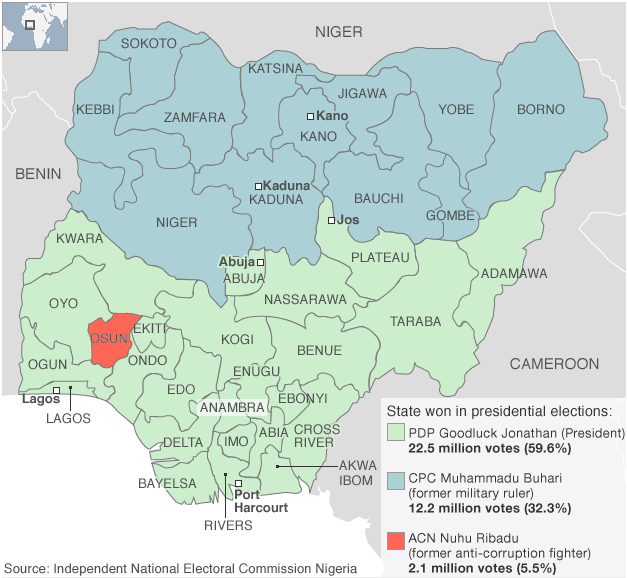
Many have seen the BBC map below of the outcome of the just-concluded Nigerian presidential elections. The south voted for incumbent Jonathan while the north went for Buhari.

The state elections were a different kettle of fish. In these elections the president’s party – the PDP – held its own in the north. Available results show that PDP candidates won in Bauchi, Kaduna, Niger, Gombe, Kebbi, Jigawa, Kano and Buhari’s home state Katsina – in total eight out of the 12 states shaded blue in the picture above.

How is this possible, given the clear north-south divide in the presidential vote?

The answer to this question is threefold (and is here).

First, all politics is local. Given that both the PDP and CPC rode on personality politics with little ideological differentiation, once the presidential race was settled the game reverted back to local personality politics. PDP bigwigs could therefore hold their own in most of these states based on their own local connections.

Second, it could be due to the sequencing of Nigerian elections. In Nigeria, the gubernatorial elections take place weeks after the presidential election. Because patronage politics is the only real game in town, the rational thing for voters to do is pick the president’s man for governorship. This way one can increase the probability that pork will flow to one’s state when President Jonathan sets out to reward those who voted for him and the PDP.

Third, Jonathan might have panicked about having lost the north in the presidential election and therefore put extra effort into winning as many gubernatorial races as he could in the north in order to guarantee his administration a sense of national legitimacy.

In a sense the gubernatorial results are encouraging. It is calming to know that there are powerful local elites in northern Nigeria who are willing and able to work with Jonathan to help Nigeria realize its potential.

Can the fight against aids be won?

There is hope that the fight against AIDS can be won.

Over the last 30 years the disease has killed millions and created millions of orphans.

It’s lasting impact persists in lost human capital and reduced labor productivity (see paper on this here). But if the optimism of the Economist (and they are not known for their love of the bright side of things) is anything to go by, things might be changing for the better.

The 30th anniversary of the disease’s discovery has been taken by many as an occasion for hand-wringing. Yet the war on AIDS is going far better than anyone dared hope. A decade ago, half of the people in several southern African countries were expected to die of AIDS. Now, the death rate is dropping. In 2005 the disease killed 2.1m people. In 2009, the most recent year for which data are available, the number was 1.8m. Some 5m lives have already been saved by drug treatment. In 33 of the worst-affected countries the rate of new infections is down by 25% or more from its peak.

Even more hopeful is a recent study which suggests that the drugs used to treat AIDS may also stop its transmission (see article). If that proves true, the drugs could achieve much of what a vaccine would. The question for the world will no longer be whether it can wipe out the plague, but whether it is prepared to pay the price.

More on this here.

Cleaning up the filth in FIFA

You know things are bad when even American academics who are not into football get all worked up about the sport and its governing body FIFA.

Here’s FP’s Drezner (have you read his zombie book yet?):

A few thoughts.  First, what kind of election process is it when the scandal-beseiged incumbent is the only friggin’ candidate?  Bear in mind this is the same Sepp Blatter who declared that FIFA was much more transparent than the IOC — which is kinda like Frederick’s of Hollywood claiming that they’re classier than Victoria’s Secret.

Second, widening the vote to all members won’t necessarily stop corruption — if the International Whaling Commission is any guide, it will simply expand the number of actors who could be bribed.

Third, any anti-corruption campaign depends on Blatter…. If only Blatter had been caught groping a chambermaid — then there would be some real reform!

Like many out there I hoped that Blatter would step down after the corruption scandals that happened on his watch came to light. His hanging on reflects badly on the Great Sport.

I am a little bit surprised though by the uproar generated by the bribery allegations within FIFA. It’s like everyone had no idea what was going on in FIFA and its member FAs. The organization’s member FAs – from Italy to Nigeria to Thailand – routinely get caught in all sorts of corruption allegations (remember Italian match fixing?).

FIFA is only as good as its national member FAs and the regional confederations. I hope that when the cleanup begins it will not end in Zurich but will extend to national FAs and confederations as well.