The Presidential Race in Kenya’s 4th of March 2013 Election

The race to succeed President Kibaki promises to be an interesting one. All the pointers indicate that it will be a close race between the Raila-Kalonzo-Wetangula and co. faction vs. the Uhuru-Ruto-Mudavadi and co. faction. Prime Minister Raila is expected to be at the top of the ticket under an umbrella special purpose vehicle called CORD (Coalition for Reforms and Democracy). Deputy Prime Minister Uhuru Kenyatta leads his own SPV called the Jubilee Alliance. Below I give a little background information before delving into the state of the race.

Institutions Matter:

The 2011 Kenyan constitution mandates that the winning presidential candidate garner 50% + 1 of the votes cast and at least 25% of the votes in at least half of Kenya’s 47 counties. In addition, presidential candidates and their veep candidates must run on a joint ticket. Previously, the presidential candidate could promise the veep slot to any number of ethnic chiefs. The constitution also limits the president’s ability to buy support by limiting the number of cabinet slots to 22 (necessitating the creation of minimum winning coalitions).

This situation has forced Kenya’s politicians to form alliances that cross ethnic lines, a change from the past when nearly all the major ethnic groups produced their own presidential candidates. The logic of minimum winning coalitions has set in, with two main camps forming ahead of the polls – Mr. Odinga has insisted all year on the stump that this is a two horse race between him and a straw man non-reformer, and that any other candidates are mere donkeys.

In this cycle the big five (Kikuyu, Luhya, Luo, Kamba and Kalenjin, together making over 70%) are all in either CORD or the Jubilee Alliance. Continuing the Luo-Kikuyu feud that has characterized Kenya’s political history since 1966, this election will pit the son of Kenya’s first president (Kenyatta) vs. that of the first vice president (Odinga). CORD’s formateur is Odinga (a Luo) who leads the Orange Democratic Movement (ODM). Jubilee’s is Kenyatta (a Kikuyu) who is leader of The National Alliance (TNA).

It is likely that CORD will field Odinga as the presidential candidate and Vice President Kalonzo Musyoka (a Kamba) as his running mate. Jubilee is likely to field Kenyatta as the the presidential candidate and William Ruto (a Kalenjin) as his running mate. This would leave the Luhya as a big five swing group. Such a scenario favors Odinga, who is already widely popular in Western Province (Luhya-land) and sections of Rift Valley Province (Kalenjin-land). This scenario is likely, but not set in stone.

The ICC Question:

Mr. Kenyatta and Mr. Ruto are facing charges at the ICC over the post election violence that rocked Kenya in 2007-08. Back then they were in opposing parties – Mr. Ruto with Odinga in ODM and Mr. Kenyatta with Kibaki in PNU. They are both suspected to have funded gangs of rival ethnic groups (Kalenjin and Kikuyu) that committed heinous crimes including murder, rape, and arson. The international community has sent a strong signal – through Kofi Annan’s statements, threats of sanctions and the EU’s travel ban on the duo – that the two should not run for office.

The Kikuyu business elite (including cash crop farmers and horticulturalists who would be hardest hit by international sanctions) have thus been trying to prevail on Mr. Kenyatta to forgo his presidential run in favor of Mr. Musalia Mudavadi (a Luhya) – evidence suggests that this was the carrot that Uhuru and Ruto used to lure Mr. Mudavadi into their coalition. If Uhuru steps down for Mudavadi then a good chunk of the Luhya vote would depart CORD for Jubilee. But it may create room for the lesser presidential candidates from Kenyatta’s region – Martha Karua and Peter Kenneth – to get a sizable chunk of the Kikuyu vote. Plus it is unclear if Mudavadi can weather the accusations of being Kenyatta’s project on top of campaigning against the formidable Mr. Odinga. Kenyatta’s last presidential bid faltered partly because he was seen as Moi’s project.

The State of the Race:

Ipsos Synovate, a local polling company, just released a poll of adults 18+ on their preferred candidates for president. Mr. Odinga leads the pack with 34% of the respondents saying he is their preferred candidate. Mr. Kenyatta is second with 27%. Mudavadi, the other likely Jubilee candidate polls at 5%. Musyoka and Ruto poll at 3% and 2% respectively. It is important to note that it is only Mr. Odinga and Mr. Kenyatta who are presently outperforming their ethnic group size in the polls (by 21% and 2% respectively). 22% of Kenyans remain undecided. Notice that the number of undecideds is highest in provinces that lack a presidential front-runner, i.e. all except Central (Kenyatta) and Nyanza (Odinga).

click on image to enlarge.
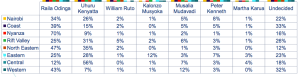
opinion polls

If Odinga eventually faces off with Kenyatta the key swing region that will determine the outcome of the election will be the Rift Valley Province. Mr. Odinga will have Nyanza, North Eastern, Western, Coast and half of Nairobi in the bag. Mr. Kenyatta will have Central, (possibly) the Rift Valley and half of Nairobi locked in. In this scenario (let’s call it scenario 1), for Mr. Kenyatta to win he would have to run the numbers in both the Mt. Kenya region (which as a whole has about 24% of voters, according to the 2009 census) and the Rift Valley Province (with 25% of voters) and get a good showing in Nairobi.  For Mr. Odinga to stop him he would need to have a respectable showing in the Rift Valley – something that he can given the fact that he has managed to keep key leaders from the region in his party, ODM. In Scenario 1 Odinga will be the favorite to win.

If Jubilee nominates Mudavadi to face Odinga, then things will get interesting (It would also potentially make for a de-ethnicized presidenital race). Key questions will be:

  1. Whether the Kikuyu would vote for Mudavadi, given that the ticket would not have a Kikuyu (with Ruto as running mate). Would they opt for other Kikuyu presidential aspirants in Martha Karua and Peter Kenneth?
  2. Whether Mudavadi would manage to unite the Luhya bloc behind him. Luhya leaders have traditionally had a hard time uniting the region to vote as a bloc. Can Mudavadi overcome the sub-ethnic divisions of the Luhya?
  3. Whether Mudavadi will be able to effectively fight the inevitable portrayal of his candidacy by the opposition as Uhuru Kenyatta’s (or Kibaki’s) project. Can Mudavadi be his own man?

If the Rift Valley, Mt. Kenya (Central and sections of Eastern) and Western vote go to Mudavadi en masse, it is hard to see how Odinga can make it to State House. In this scenario, turnout would be key. Jubilee would win by a landslide. But while this situation is likely, it’ll still be a huge gamble for Jubilee to nominate Mudavadi.

Mr. Odinga has more national appeal than his former ODM assistant Mudavadi. The latter lacks a strong political base in his home region of Western Province. Add to that the fact that he will leave the gates with the imprint of “project” on his forehead, not to mention the uncertainty over how Mt. Kenya region would vote and the election becomes a real tossup ex ante. Nominating Mudavadi to head the Jubilee ticket would be a high risk gamble for Uhuru and Ruto that would either pay off big come March 4th or hand Odinga victory on a silver platter.

The Jubilee Alliance will nominate its candidate (either Uhuru or Mudavadi) next week. CORD will name its presidential candidate (very likely to be Mr. Odinga) on the 22nd. I expect minor defections and realignments that will have a non-trivial impact on the race before then. All in all right now Odinga is a slight favorite to become the fourth president of Kenya.
 

State of the Presidential Race in Kenya’s 2013 Elections

UPDATE:

Since this post went up Musalia Mudavadi joined the UhuRuto coalition. This sets the stage for a real two horse race for the presidency between Raila Odinga and either Mudavadi or Uhuru Kenyatta. It is very likely that Mudavadi will run as a compromise candidate due to the charges Uhuru is facing at the ICC. This development, considering Kenya’s ethnic arithmetic, essentially gives the Uhuru camp a head start ahead of the March 2013 presidential elections. Whatever happens, this promises to be a very interesting and close presidential election.

***************************************

The presidential race in Kenya’s 2013 elections is beginning to take shape. Yesterday Uhuru Kenyatta and William Ruto unveiled a political pact that will see them run on a joint ticket, with Mr. Kenyatta at the top of the ticket. Messrs Uhuru and Kenyatta both have pending cases at the ICC on charges that they were behind the post-election violence that rocked Kenya in 2007; leaving 1300 death and more than 300,000 displaced. This has led some to dub their joint platform the “ICC ticket,”  since many see the union of the two as solely driven by their joint desire to earn immunity from prosecution by the ICC once they secure the presidency.

uhuru

Uhuru Kenyatta

The second big coalition will see former allies turned foes and then allies – Raila Odinga and Kalonzo Musyoka – come together. Mr. Musyoka is the sitting Vice President while Mr. Odinga is the Prime Minister. The latter is believed by many to have been the winner of the disputed 2007 presidential election. The electoral commission at the time said it did not know who won the election and declared President Kibaki reelected, sparking two months of violence across the country.

The third potential political grouping might gravitate around Odinga’s former deputy, Mr. Musalia Mudavadi. Mr. Mudavadi has been rumored to be in talks with several smaller parties, including those of Peter Kenneth, Raphael Tuju, among others.

Raila Odinga

Raila Odinga

The latest developments will make for an interesting race moving forward. The ethnic arithmetic involved – Kenyans vote largely along ethnic lines – will make for a very close race (More on this soon). Messrs Odinga and Kenyatta are the clear front-runners, with the former having a slight lead in the most recent opinion polls. The constitution requires the president elect to win 50 percent plus one votes, making it very likely that there will be a runoff between the top two contenders after the first round. The ethnic calculations makes Odinga, a Luo, the likely winner in case of a runoff (Uhuru, a Kikuyu, is the son of Kenya’s first president. The current president, Mwai Kibaki, is also a Kikuyu.) But Mr. Kenyatta might still win in the first round.

The biggest uncertainty moving forward will be the candidature of both Uhuru and Ruto. Following the opening of their cases at the ICC they had to resign as cabinet ministers. Already there is a petition in court seeking to bar them from running in the upcoming elections on grounds that their integrity is questionable. The constitution requires only individuals of the highest integrity to be eligible to run for office (It is hard to see how any Kenyan politician will avoid having at least one strike against their candidature).

The supreme court may eventually bar Uhuru and Kenyatta from running – the talk in the street is that if they are unfit to be mere cabinet ministers then they should also not occupy the two highest offices in the country. Their supporters obviously disagree. In their rallies “UhuRuto” have played the nationalist card, insisting that not foreigners (read the ICC) but Kenyans will decide who will be their next president. It is still unclear what course of action they and their supporters would take were they to be barred from running.

More on this soon.

ICC Kenya case ruling and its consequences

That the ICC’s website crashed an hour before the ruling was given underscores the importance of today’s ICC ruling.

In the end it emerged that charges against Deputy Prime Minister Uhuru Kenyatta, Head of Civil Service Francis Muthaura, MP William Ruto and radio Presenter Joshua Sang were confirmed. Former police commissioner Husein Ali and MP Henry Kosgey will walk, at least for now.

The political implications of the decision will be huge.

Firstly, President Kibaki must decide whether or not to retain two of his most trusted lieutenants in the government (Messrs Kenyatta and Muthaura) even as they face charges with regard to the death of 1300 Kenyans and the displacement of hundreds of thousands. Should the president decide to stand with them I suspect that soon the courts will have to decide whether these two are fit to hold public office.

Remember that Kenya has a resurgent judiciary eager to stamp its authority as an independent institution. There will be intense political pressure from Civil Society groups to see the two step aside.

Equally interesting will be whether the Independent Electoral and Boundaries Commission will allow Ruto and Kenyatta to run for president in light of these developments. Again, the case might go all the way to the Supreme Court. The Kenyan constitution has a clause banning those accused of certain crimes from holding public office. The vagueness of the wording in the constitution will give the courts discretion in reaching a verdict. I suspect some activism here was well.

Secondly, Ruto and Kenyatta will find it hard to sell their candidacy to Kenyans ahead of the general elections later this year. As the process continues, it will be hard for both (whether guilty or not) to hide from the gruesome crimes that were committed in 2007-08. I therefore doubt the viability of either one running for president at the top of a ticket. If they want to be on a winning team in this year’s election they must be part of a coalition.

But coalition building will be hard. For one, cracks are already appearing in either camp. Ruto recently got kicked out of a party he tried to commandeer after defecting from ODM. Mr. Kenyatta is also facing a simmering insurgency within his Central Kenya camp. The other thing is that the Kenyan economic and political upper class has revealed a willingness to throw the two under the bus if they become too much of a baggage. It is telling that a group of Central Kenyan tycoons have started warming up to Prime Minister Raila Odinga, the man to beat in this year’s general election.

I expect a flurry of press conferences to follow shortly. But I must go to bed for now. It is 3:15 AM…

Justice, the ICC and Kenyan Politics

A panel of judges at the ICC will issue their ruling tomorrow afternoon on whether or not six accused Kenyans will stand trial. The six include two declared presidential candidates. Either way the ruling will have a non-trivial impact on the pursuit of justice for the victims of the 2007-08 post-election violence (PEV). It will also significantly shape the politics of coalition building in this year’s general elections.

Because of the ICC process, the Kenyan justice system has put on ice its own process of holding the perpetrators of the PEV to account. A non-confirmation of the charges against at least some of the six co-accused will add the 2007-08 PEV to the long list of crimes against Kenyans, many of which have been committed by the high and mighty, that have gone unpunished.

Justice is political. Therefore, there is no doubt that if the process of prosecuting the crimes committed in the PEV returns to Kenya none of the big fish will be held accountable. That is the sad truth.

This is why despite the noisy political environment, a majority of the PEV victims (and other Kenyans) still back the ICC process. At the very minimum they want justice to appear to be served.

At the moment the problem of justice remains a worry largely monopolized by the 300,000 or so Kenyans in IDP camps and the relatives of the over 1,300 who were killed. [The media and the political class are squarely to blame for this shameful situation.] For the rest of the country, focus has shifted to the politics of the general elections due later this year. To this we now turn.

Two of the accused, William Ruto and Uhuru Kenyatta have declared their interest in the presidency. Mr. Kenyatta is currently the second most preferred presidential candidate after Prime Minister Raila Odinga. Mr. Ruto, while not as popular nationally, still commands a sizeable chunk of the votes in the country’s most populous province – the Rift Valley. The Rift Valley has also been the hotbed of political violence in country’s history, most of it over land.

A confirmation of the charges will seriously dent the presidential ambitions of Messrs Ruto and Kenyatta. It will make it harder for either of them to sell their candidacy outside of their immediate ethnic constituency. It will also give their opponents (and there are plenty) an opportunity to hold themselves as the clean candidates that ought to succeed Kibaki. Needless to say, a non-confirmation would bolster the duo’s campaigns. What will this mean for the general election?

It is common knowledge that the man to beat in the 2012 election will be Mr. Odinga. The two scenarios above will impact the outcome of the election mainly through their influence on the coalition building abilities of the anti-Odinga crowd.

More on this tomorrow in reaction to the ICC ruling.

Kenyan Court Orders Bashir Arrest, Sudan Expels Kenyan Ambassador

UPDATE:

The BBC reports:

Sudan ordered the expulsion of the Kenyan ambassador after a Kenyan judge issued an arrest warrant for Sudan’s President Omar al-Bashir, Sudan’s foreign ministry has said.

Mr Bashir is wanted by the International Criminal Court (ICC) for alleged war crimes in Darfur.

Sudan has ordered the Kenyan ambassador to leave the country within 72 hours.

It has also ordered the Sudanese ambassador in Kenya to return to Khartoum.

*************************************************************

A Kenyan court has issued an arrest warrant for Sudan’s President Omar al-Bashir over alleged war crimes in Darfur.

The ruling came after Kenya allowed Mr Bashir to visit in August in defiance of an International Criminal Court (ICC) warrant for his arrest.

The judge said he should be arrested if he “ever set foot in Kenya” again, the AFP news agency reports.

Kenya is a signatory to the treaty which established the ICC in 2002.

The new Kenyan constitution requires that the government implements its international treaty obligations. The ruling, though without much bite – I doubt Bashir will need to be in Kenya any time soon, has immense symbolism in the region.

It also matters for Kenyan domestic politics. Presently, a few high ranking Kenyan politicians – including the Finance minister, two former ministers and former police boss – are on trial at the ICC for crimes against humanity. The accused await judgment on the admissibility of their cases later this year or early next. The Bashir ruling means that if the charges against the “Ocampo Six” are confirmed but the government drags its feet in implementing an arrest warrant then the courts will step in.

More on the Bashir case here and here.

In other news, Uganda and Tanzania have rejected Khartoum’s petition to join the East African Community, citing “several issues like their democracy, the way they treat women and their religious politics.” Yeah right.

Judges reject kenya’s bid to stop icc case

The government of Kenya has lost in its bid to convince the ICC that it has the political will and capacity to try key perpetrators of the 2007-08 post-election violence (PEV). Kenya had asked for six months to get its justice system in order and convince the ICC that it could bring to book those who planned and carried out the murder of over 1300 people and the displacement of hundreds of thousands in 2007-08. More on this here.

The Kenyan political elite find themselves in a pickle. Less than two years ago parliament thought that they could punt on addressing the PEV by deferring the cases to the ICC. It turns out Ocampo and the court were actually serious. Realizing this, they (the Kenyan gov.) attempted to hurriedly create a local process with the hope of persuading the court to stop the proceedings at the Hague.

But even a blind sheep could see through the government’s insincere attempts to clean up the judiciary or “investigate” the key suspects.

The Kenyan civil society remains adamant that the government has neither the capacity nor political will to prosecute the crimes committed in relation to the 2007 general elections.

Now the clock is ticking. With parliament and the Kenyan legal epistemic community largely in charge of naming the new judges that will staff the supreme court (and the wider judiciary) the accused and their political godfathers are in a panic. They must try and clean up shop under the current system or they will lose big, soon. Realizing the gravity of the situation, the same ethnic chiefs demigods politicians who were running around screaming “sovereignty” and “neo-colonialism” have since gone silent.

The Kenyan case has also generated a lot of heat with regard to the geopolitics of the ICC.

Many in Kenya and across Africa have (sometimes rightfully) criticized the ICC. But in my view it remains to be a necessary institution in the fight against impunity and murderous dictatorship on the Continent. (Pardon the phrase) We cannot throw out the baby with the bath water.

Let’s not kid ourselves. Without the ICC the families of those women and children that were burnt alive in a Church in Kiamba, Eldoret or those killed in retaliatory attacks in Naivasha will never get justice. That is the reality.

Remember, more Kenyans were killed in the months before the elections of 1992 and 1997 than in 2007-08 and yet the Kenyan political class merely pushed the unbearable truth under the rug. Also of note is the fact that the present anti-ICC crusade comprises those suspected to have financed opposite sides of the PEV.

The situation is a grim reminder of the Swahili proverb that says when the elephants fight it is the grass that suffers.

To those who talk of the ICC’s infringement on African nations’ sovereignty I’d like to pose a question: Who’s sovereignty is being violated? Is it al-Bashir’s or the Darfuris?; is it the Central Africans’ or Jean Pierre Bemba’s?; is it the Kenyans’ across the Rift Valley or the sovereignty of the Ocampo six?

Kenyan politician loses $10 million at airport

UPDATE: The blogosphere is already abuzz with the potential absurdity of the Standard story. Apparently $ 10 million in $100 notes weighs 100kg. It is hard to see if someone could carry that much weight around with them, much less be allowed onto a plane. There is vital information missing somewhere. The Standard editorial staff might have been asleep on the job,  again.

The East African Standard reports that a high flying Kenyan politician (either Uhuru or Ruto) lost $ 10 million at the Jomo Kenyatta  airport in Nairobi.

Police are investigating the case. It is believed the said politician had carried the money to the Hague in case he needed cash bail? [whatever happened to wire transfers??? This guy should fire the troupe of yes men around him, and his hapless bodyguards]

The incident raises the question of the legality of carrying such large sums of money in and out of the country. Did the Kenyan authorities know about this? How about the Dutch authorities?

The Kenyan blogosphere is already generating rumors about money laundering and what not. I say the CID should get their noses into this mess.

In unrelated news, parliament will, in a week’s time, be told the names of suspected gold smugglers from the DRC. A few weeks ago the president of the DRC, Joseph Kabila, flew into Nairobi to lodge a complaint with his Kenyan counterpart Mwai Kibaki. Mr. Kabila believes that a Kenyan cartel is smuggling minerals out of the Congo and denying his useless government of vital tax revenue.

what if ruto and uhuru were jailed by the icc?

Kenyan politics is currently in flux. Two key presidential candidates, Uhuru Kenyatta and William Ruto may be barred from running for public office next year on constitutional grounds. The key beneficiaries of such an eventuality will most probably be Raila Odinga and Kalonzo Musyoka, the Premier and Vice President respectively.

But what would such an eventuality mean for Kenya?

I’d say not much.

Over the last few weeks Uhuru and Ruto have been crisscrossing the country and holding chest-thumping rallies to prove to someone – either the ICC or the Kenyan political and economic elite – that they have the support of the grassroots. They have also issued thinly veiled threats that violence may erupt in the country if they are whisked to the Hague and barred from running for president in next year’s general election. Why does Uhuru and Ruto feel the need to do this?

In my view, and according to the rules of power politics, a tiger need not shout about its tigritude [I believe it is the great son of Nigeria, Wole Soyinka who coined this phrase].

That Ruto and Uhuru have felt compelled to shout about their support-base and issue threats tells me that they are feeling the heat. The fact of the matter is that the key backers of the duo are the ones who would lose the most in case of a resurgence of violence – think of Kenyan retail, banking, insurance, media and transport barons. These are the people that will lose the most when the Mombasa-Kampala Highway is impassable and Equity Bank closes everywhere. They know this and Uhuru and Ruto also know this. Furthermore, igniting further violence would most certainly attract sterner reaction from international watchdogs like the ICC and the UN Security Council.

There is also the [small] matter that now ordinary Kenyans will also know where exactly the violence is coming from.

Violence is therefore not an option. Not for Ruto and Uhuru. Not for their backers. And most certainly not for the rest of Kenya.

I suggest that the rest of Kenya call their (Uhuru and Ruto’s) bluff about violence next year.

Their battles with justice should not derail the much needed institutional reforms that will take the country out of the miasma of mediocrity that continues to engulf most of the Continent.

In the final analysis, the words of former VP George Saitoti will ring true: There comes a time when Kenya gets bigger than any single individual. Ruto, Uhuru and the wider political class are about to be schooled on this maxim the harsh way.

kenya’s ocampo six at the hague; kenyan politics will never be the same

The denouement of the saga is still uncertain. Two Kenyan political supremos, Uhuru Kenyatta and William Ruto, are appearing at the ICC in the Hague to answer to charges of crimes against humanity. The two are among six Kenyans accused by Moreno Ocampo for being the brains behind the violence in 2007-08 in Kenya that killed over 1300 and displaced close to half a million people.

The ICC trial of the six is likely to bring to light the hypocrisy of Kenya’s ruling class. For far too long the political elite have used violence as a political tool. Former president Moi perfected the craft and got away with it in 1992 and 1997 (more people died then than in 2007-08). If all goes well, it appears that this time around things will be different.

My hope is that the six accused will bring all to light so that Kenyans can know their leaders for who they really are.

There is no doubt that ethnicity will continue to cloud Kenyan politics. But it is also true that Kenyans will, from now on, know what is at stake when their leaders incite them to violence. They will know that this crop of people do not give a rat’s behind about their (the people’s) plight. They will fully understand why the government of Kenya can spend millions of dollars in defense of a few men while hundreds of thousands of ordinary citizens (and victims of crimes committed by the very few men) continue to subsist in limbo. They will understand why millions get spent every year to build offices, buy expensive cars and pay for the lavish lives of the ruling elite while ordinary Kenyans starve.

They will know that their tribal leaders do not have their interests at heart.

Whatever the outcome of the ICC trial, the mystic around Kenya’s ethnic leaders is gone. These little venal and inept men and women who like parading around as gods will no longer have the final word on everything.

ethnicity and public employment in kenya

The Daily Nation reports:

The survey undertaken by the National Cohesion and Integration Commission (NCIC) gave shocking details of how political patronage and personality-based leadership had reduced the civil service into an exclusive club of the big communities at the expense of the so called small communities.

According to the survey, members of the Kikuyu, Kalenjin, Luhya, Kamba and Luo communities occupy 70 per cent of all jobs in the civil service.

Keep in mind that Kenya has about 42 ethnic groups.

I personally did not find this very shocking. The report indicates that the two ethnic groups that have occupied the Kenyan presidency since independence, the Kikuyu and Kalenjin, together make up 40% of the civil service.

My hope is that this report will initiate debate over merit in public employment. It is about time we had standardized and transparent ways of hiring public servants and not leave all the discretion in the hands of venal pols.

what next for the kenyan political class?

The truth of the matter is that the whole political class in Kenya is implicated in the murder of 1300 people and the displacement of hundreds of thousands following the post-election violence of 2007-08. Their continued contempt of the ordinary mwananchi is evident in the fact that three years on the displaced still live in IDP camps littered across the country. The lack of widespread moral outrage at this fact speaks boatloads about Kenyans’ moral character.

The ICC appears to be closing on the “Ocampo six” – individuals identified by the ICC prosecutor Moreno Ocampo as most culpable at the highest level for the violence that rocked parts of the Rift Valley in early 2008. An ICC pre-trial chamber ruled yesterday that there is evidence to suggest that six prominent Kenyans are criminally responsible for crimes against humanity committed in 2007-08. The six include Finance Minister Uhuru Kenyatta, Cabinet Secretary Francis Muthaura, former Commissioner of Police Hussein Ali, former ministers Henry Kosgei and William Ruto and radio personality Peter Sang.

After the 2007 general elections Kalenjin speaking supporters of Raila Odinga attempted to drive out members of the “Kikuyu diaspora” in the Rift Valley Province, the “ethnic homeland” of the Kalenjin. Raila’s opponent in elections, President Kibaki, is a Kikuyu. It is suspected that local ethnic leaders, including William Ruto, Henry Kosgei and Peter Sang, were in charge of directing these attacks. In the most gruesome episode in Kenya’s darkest hour mobs locked ethnic Kikuyu women and children in an Eldoret church and set it on fire. More than 30 perished. Kikuyu elites, allegedly lead by Finance Minister Uhuru Kenyatta and Cabinet Secretary Francis Muthaura, retaliated by mobilizing the proscribed Mungiki gang to carry out reprisal attacks. It is also alleged that the former Police Commissioner, Hussein Ali, conspired to keep the police off Mungiku’s back. Hundreds of ethnic Kalenjins and Luos, among other supporters of Raila Odinga, were killed or uprooted from their homes in Nakuru and Naivasha.

Ever since the announcement by the ICC prosecutor that he would go after the six a radically political realignment has taken place in the country. William Ruto and Henry Kosgei ditched the party led by Raila Odinga and joined alliances with Uhuru Kenyatta to oppose the ICC indictment. President Kibaki, who at the beginning appeared to be willing to throw Uhuru under the bus, also became wary of the ICC after his chief lieutenant Muthaura was named as a key suspect. Presently, Vice President Kalonzo Musyoka has embarked on a “shuttle diplomacy” mission to convince African leaders and the P5 of the UN security council to lean on the ICC to defer the charges against the Ocampo six. Many African leaders, given their own records at home, have supported the initiative. But the mission at the security council hit a snag yesterday when US representatives indicated that they will veto any attempts at deferral.

What then for Kenyan politics? Any analysis must focus on the Kibaki succession. President Kibaki is term-limited and must step down in 2012. Two members of the Ocampo six – Uhuru and Ruto – are key players in the succession game. If the two are convicted Raila Odinga stands to gain the most. But it all depends on what alliances ensue following such an eventuality. Uhuru and Ruto might remotely throw their weight behind Vice President Musyoka to enable the latter to capture State House. Indeed, the three have publicly declared to be members of the (unfortunately named) KKK alliance (the three are from Kikuyu, Kalenjin and Kamba ethnic groups, respectively). The more likely scenario, however, is that the Kikuyu and Kalenjin communities will experience internal fractures once their key ethnic chiefs are out of the game. Uhuru is already facing an insurgency led by the fire-breathing former Justice Minister Martha Karua. Ruto has maintained a facade of unity in his ethnic bloc but money can do wonders in Kenyan politics, and his potential detractors among the Kalenjin – including a son of former President Moi – have wheelbarrows of it.

In short, everything is in flux right now. The substantive reaction of the political class – beyond the shouting match that is currently underway – will only be apparent when parliament resumes in a few weeks. Lawmakers need to pass crucial laws needed to implement a new constitution that was ratified last August. The breakdown of the voting patterns will almost inevitably show some nascent realignment. Like the wikileaks records of Kenyan politicians bad-mouthing one another to low-level US embassy officials have shown, Kenyan politicians are an incorrigibly unprincipled bunch who will not hesitate to jump ship if they realize that their party leader is in trouble.

The political temperature in Kenya will no doubt go up in the next few days. The unfortunate thing in all this is that the hullabaloo is will continue to be a distraction from the fact that 1300 innocent KENYANS died and hundreds of thousands were displaced in 2007-08.

icc finds six kenyans culpable for ethnic violence

The ICC has ruled that six prominent Kenyans have a case to answer for the murder of 1300 people and the displacement of hundreds of thousands in the 2007-08 post-election violence in Kenya.

The spotlight is now on President Kibaki. About two of the president’s closest allies – Finance Minister Uhuru and head of civil service Muthaura – a local daily opines:

Retaining them in Government will send a signal to the ICC and the world that Kenya is not ready to co-operate and is a hostile State, putting it at par with Sudan, which has refused to hand over President Al-Bashir who is charged with crimes against humanity over Darfur.

More on the political reaction to this soon.

In related news, I am absolutely loving the wikileaks stuff on the drama that is Kenyan politics. Most politicians believe that Kalonzo is a janus-faced intellectual lightweight who pretends to love Jesus Christ. Raila is depicted as accessible but power-hungry and really bad at management. President Kibaki is sick, condones corruption and has been captured by vested interests in his inner circle. Ruto and Uhuru fret at the idea of taking all the blame for 2007-08. Uhuru Kenyatta is “lazy.”

This is valuable information, the effects of which will not be apparent any time soon. In the minds of Kenyans, a clearer image of these little men and women who parade as gods is slowly forming. It is only a matter of time before the myth of tribal loyalty is shattered and these tribal chiefs are seen for who they really are: a bunch of unprincipled and venal goons.


the African Union and its problems

The just concluded AU summit in Addis Ababa, Ethiopia had two key problems to address: the political crisis in Ivory Coast and the legal battles involving six Kenyans who face charges at the ICC. So far the continental body appears to have failed on its attempts to address both problems.

In the Ivory Coast, Mr. Gbagbo’s camp has already declared that the five person panel formed by the AU is dead on arrival unless Burkinabe president, Compraore is dropped. The Daily Nation reports:

The president of Burkina Faso, named on a high-level African Union panel tasked with settling Cote d’Ivoire’s leadership crisis, is “not welcome” in this country, a top ally of strongman Laurent Gbagbo said here yesterday.

And in Kenya, the political football involving the setting up of a credibly clean local judicial system to try perpetrators of the 2007-8 post election violence diminished the prospects of a deferral from the UN Security Council. Kenya must guarantee that it will try the suspects for the ICC to consider a deferral. It does not help that the appointment of high members of its judiciary, including the chief justice, the attorney general and the director of public prosecutions has already been soiled by political grandstanding.

president kibaki’s weird move

President Kibaki has done quite a few good things for Kenya. He will be remembered as the president who did away with the oligarchic constitution that Kenya inherited from the Brits at independence.

That said, his recent move to appoint constitutional office holders in the justice system without consultation raises serious questions about his commitment to Kenya’s reform agenda. And it is not simply about his failure to consult the ODM in making the appointments. Mr. Kibaki ignored due process stated in the constitution. Appointments to the judiciary are required to originate from the judicial service commission.

Also, why appoint Ruto’s lawyer to be director of public prosecutions? Didn’t anyone at Harambee House see the obvious questions that would arise? As Macharia Gaitho notes:

If the Kenya Government – or rather President Kibaki’s PNU axis – is to convince anyone that it has the will to establish a truly independent local tribunal, then it could not do much worse than nominate a lawyer for one of the Ocampo Six as Director of Public Prosecutions.

ruto’s attempts to slow down icc process rejected

Embattled Kenyan politician William Ruto’s attempt to stop the ICC prosecutor Moreno Ocampo from issuing summons against him have hit a snag.

The three judge panel at the ICC rejected Mr. Ruto’s claim that Mr. Ocampo did not conduct proper investigations but instead relied on findings and reports by interested parties in Kenya, including the Waki Commission and the Kenya National Commission on Human Rights.

Mr. Ruto has been adversely mentioned by Mr. Ocampo’s office – along with five others – as a key mastermind of the violence that rocked parts of Kenya following disputed elections in 2007. More than 1300 people died and hundreds of thousands were displaced. Most of the displaced still live in makeshift tents in IDP camps.

More on this here.