Some quick thoughts

Grinding poverty and the lack of innovative thinking among their home governments continue to force most Africans to buy second hand-clothing. The few textile industries on the Continent (with a few exceptions in West Africa) are small operations geared mainly for exports – mostly under AGOA to the US. Special interests (second-hand clothes importers), poor economic policies (many countries killed their own nascent textile sectors) and dumping of textiles from the east are to blame.

The result is the indignity of having to buy used underwear or live in a parallel universe in which the Steelers won Super Bowl XLV.

A post on the related topic of the politics of appropriate aid-giving  is here.

In other news, Blattman makes the observation that younger leaders in Africa, because of their different upbringing, will be different from the independence leaders. I beg to differ. Spatial distribution based on ethnicity and malapportionment against urban centres, mixed with the toxicity of ethnic politics will continue to perpetuate rural, ethnic-based tyranny in most of Africa. The fact that University of Nairobi student council elections invariably go tribal says it all.

The current changes in the Arab world should be a wake-up call for most of Africa. Soon enough the set of examples of poor governance and general mediocrity will shrink from Africa, the Middle East and South Asia to just Africa.
elections and democracy in the central african republic

The Central African Republic is a country the size of Texas with a population of 4.8 million and GDP that is “significantly smaller than that of Pine Bluff, Arkansas.” Since independence from France, a string of autocrats (including the infamous Emperor Bokassa), have held power in Bangui without much care for the hinterlands. The current president, Francois Bozize, seized power in a 2003 coup. In response to domestic and international pressure, well orchestrated elections were held last Sunday.

Mr. Bozize’s “Work nothing but Work” (KNK) party is expected to win. In 2008 he signed a peace agreement with several rebel movements spread throughout the country that were opposed to his rule. Elections were part of the deal.

But of what use are elections in places like Central African Republic?

“William Easterly recently argued that “good governance” rhetoric notwithstanding, aid to dictators has remained steady since 1972. The rich countries no long have strategic interests at stake, but the “Gerund Defense” enables donors to keep the money flowing: with only a few exceptions, no matter how corrupt or autocratic a regime, it could be said to be “developing” or “democratizing” and hence on a progressive course necessitating assistance. But the dictators hold “farcical ‘elections'” and nothing changes. If we take Easterly’s warning seriously and start to question the progressivist aid ideology, what should we do about those places where elections occur, and aren’t exactly farcical, but meaningful democracy – in which citizens’ grievances and claims are taken seriously and responded to by their political leaders – remains elusive? The Central African Republic (CAR), whose citizens voted in first-round presidential and legislative elections Sunday, is one such place. In the end, the case of places like CAR might prove more insidious, because it calls into question the definitional link between elections and democracy.”

More on this here

exactly when did the rain start beating africa?

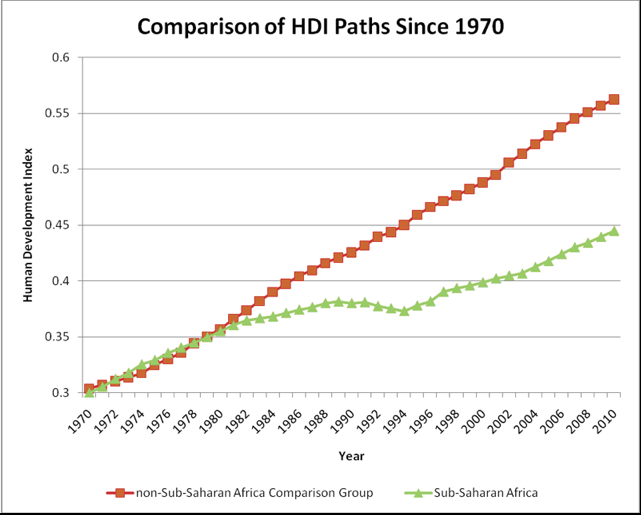
HDI divergence

The new HDI rankings are out. Some in the blogosphere have beef with the new geometric (as opposed to additive) method of calculating final scores. I don’t.

Aid Watch’s beef is that:

The biggest change in method was that the new HDI is a geometric average rather than a normal (additive) average. Geometric average means you multiply the separate indices (each ranging between 0 and 1) for income, life expectancy, and education together and then take the cube root (I know your pulse starts to race here…)

Now, students, please notice the following: if one of these indices is zero, then the new HDI will be zero, regardless of how great the other indices are. The same mostly applies if one of the indices is close to zero. The new HDI has a “you’re only as strong as your weakest link” property, and in practice the weakest link turns out to be very low income (and guess which region has very low income).

My two cents on this discussion is that the Continent looks bad irrespective of how we arrive at its HDI scores. It’s best performers are tiny Botswana and Mauritius. It’s biggest countries and potential engines for growth are the DRC, Ethiopia and Nigeria, need I say more? And per capita income has not changed in most places in half a century.

I rarely disagree with Easterly but on this count I do. Let’s not shift posts for Africa. The idea of “African Standards” is condescending and demeaning to Africans. Norway and Chad look like they are eons apart. If the numbers reflect that fact so be it.

I hope this year’s report embarrasses the African ruling elite enough to wake them up from their stupor (come on, I am allowed one wishful thought per post).

More on this here and here. For a summary of this see Blattman.

frustrations of the african intellectual

William Easterly on Aid Watch captures the frustrations of African intellectuals and their continued neglect by both the aid industry and their home governments.

African intellectuals continue to be on the periphery of the discourse on African socio-economic development. The independence leaders jailed, killed or exiled many of them, leading to fifty years of disastrous misrule and general mediocrity from Dakar to Mogadishu, Khartoum to Jo’burg. The current crop of autocrats and pretend-democrats did not learn a thing from the last half-century and continue to opt for career poverty-voyeurs development experts from donor countries instead of their own people who may have greater incentives to see their homeland match the achievements of the newly emerging states of Brazil, India and China.

the mdgs

Since everyone is currently talking about the MDGs and how they may or may not be achieved on time here is a nice piece from Bill Easterly.

According to an Oxfam study, eliminating US cotton subsidies would “improve the welfare of over one million West African households – 10 million people – by increasing their incomes from cotton by 8 to 20 per cent”.

I may not always agree with Bill but I think his basic approach to development is spot on. Just like in most human endeavors (politics, economics, sports) systems based on human goodwill are bound to fail while those based on self-interestedness thrive. There is no magic bullet in development, but there is definitely a better approach than is currently being employed. Lets not forget that aid is supposed to eventually lead to self-reliance.

It is already clear that the goals will not be met by their target date of 2015. One can already predict that the ruckus accompanying this failure will be loud about aid, but mostly silent about trade. It will also be loud about the failure of state actions to promote development, but mostly silent about the lost opportunities to allow poor countries’ efficient private business people to lift themselves out of poverty.

Bono has a slightly less realistic more hopeful take on the progress towards achieving the MDGs.

slum politics

The just released results of the 2009 population census dethrones Kibera from the dubious status of Africa’s largest slum. The figures are much lower than most analysts believe. Only 170,070 people live in the slum. This compared to the oftentimes cited figure of close to a million. The total population of the immediate Nairobi area is 3.1 million.The Nation adds:

“Erasing the Kibera lie from history will need one enormous eraser. The lie has been fed to all, from poor residents of the slum who have since grown accustomed to flashing camera lights from tourists taking shots of “the biggest slum in Africa,” to schoolchildren who cram the lie everyday in geography classes.”

More interestingly…

“According to a UN report, over 90 per cent of Kibera residents pay an estimated Sh4.5 billion every year to the real owners of Kibera. This makes the Kibera a sociological paradox-a slum to the poor, a gold mine to the rich.”

And it is not just slum lords who are benefiting from Kibera’s title of biggest slum in Africa. Aid workers Easterly where are you? are also having a field day:

“there are between 6,000 and 15,000 community-based organisations working in Kibera. That is one charitable organisation for every 15 residents of Kibera. Throw in an estimated 2,000 governmental organisations, and you get a rough idea exactly how the billions of shillings pumped into “the biggest slum in the world” are spent.”

sunday roundup

Easterly goes to church in Ghana.

This post has pictures on some interesting way to use bed nets…. It seems like the only way we shall ever eliminate malaria on the Continent is by getting rid of all the mosquitoes. Other tropical places have done it. Why can’t it be done on the Continent, at least in the urban areas??

And lastly, I found this video clip totally cool.

Happy Sunday!

JAMBO!

William Easterly’s Burden

William Easterly continues his great crusade against the development establishment. I like his pitch for spontaneous development, but I remain skeptical of his quick dismissal of the role of the state in African development for two reasons:

1. The rest of the world has a massive head start which means that if the African entrepreneur is to survive the state must be there to provide the relevant public goods and some minimal protection from foreigners.

2. Let us not forget that stable societies are those in which capital and politics have a symbiotic relationship. The realities of the political economy of development are such that the state – and current holders of political power – must be brought on board if real and lasting development is to be achieved.

Also, check out Blattman’s Blog.

links that i liked

TED talk by Esther Duflo here

and Texas in Africa has a few things to say about attitudes towards aid.

Cool map of eastern Africa over time.

after sudan, ethiopia

Sudan’s Omar al-Bashir is here to stay. Ethiopia’s Meles Zenawi is up next on a list of African autocrats who face elections this year. Ethiopia holds parliamentary elections on May 23rd in a vote that will determine who becomes Prime Minsiter. Africa’s second most populous country cremains under tight rule by the increasingly despotic Meles Zenawi. It is a foregone conclusion that Mr. Zenawi’s party will win. The only non-academic part of these elections will be how many seats the opposition is allowed to win. Mr. Zenawi has run the country since 1991 when he led a rebellion that overthrew the tinpot dictatorship of Mengistu Haile Mariam.

More on Mr. Zenawi’s rule here.

The other elections coming up in the next month include Mauritius (May 5th) and the Central African Republic (May 16th). Keep track of these elections here.

Development and how to achieve it

A while back I argued for a move away form small scale, “pro-poor” development strategies to more robust development strategies aimed at economic innovation and large-scale job creation. This is not to say that micro-development should be neglected. What I am saying is that jua kali kiosks will not increase Africa’s per capita income to 10,000 USD. The most they do is enable people to cope without really changing their standard of living.

Alkags, a blog I just discovered, deals with this debate.

Aid watch also has videos from a conference at the Yale law school on development. Chris Blattman and William Easterly are some of the featured development experts. Blattman makes some interesting comments about micro-finance, industrialization (medium to large farms) and development.

Quoting Blattman: “I think we have gone too far in the pro-poor direction…… we don’t necessarily have trade-offs. Factories are pro-poor.”

I like Hayek too

OK, I have to admit, I am one of those who read “The Road to Serfdom” and totally loved it. Hayek was spot on about the folly of planned economies. The markets are not perfect. But having imperfect markets beats planned economies on any day. We just have to provide a reasonable amount of regulation and provide social safety nets that take care of those who end up taking one for the team because of the dynamics of the free market.

And that is why I thought this post by Easterly was kind of neat.

I also found this post kind of interesting and to be an important part of the debate on the viability of certain African states. I am not into the whole idea of blaming colonial “arbitrary” borders for holding Africa back. The fact of the matter is that Africa has been held back by Africans like Samuel Doe, Mobutu, Emperor Bokassa, Sani Abacha, Idi Amin, Omar al-Bashir and other crazies of their ilk. That said, I also think that certain states should either be split up (Nigeria, DRC, Sudan) or absorbed into other states (most of the Sahelian states. )

jeffrey gettleman is back

Texas in Africa has a piece on Gettleman’s style of journalism. Mr. Gettleman is of course not new to this type of criticism. I have voiced my opinion on his reporting style a few times before.

This is not an argument for the mis-representation of the goings on on the Continent. (By all means tell us who is starving and is under incredible disease burden or being killed in a civil conflict). It is an argument for respectful reporting of the suffering of other people. This sort of sensationalism that you often see on the front pages of major newspapers does more harm than good.

And about Kristof. He should know better. I guess it must feel great to walk into a conflict zone ridden with poverty and get the reception of a rock star such as what Kristof got in Goma.

The line between helping the needy and this sort of vulgar self-gratification can be thinly thin sometimes.

the “brain drain” debate

The first time I saw this paper/chapter presented at a workshop last year it left me with more questions than answers. I have since been convinced. The paper makes intuitive sense. That said, I am still a little uneasy with some of the implications of the argument. For one, providing education with a foreign labor market in mind may distract us from trying to find solutions to local problems. If we follow this route we may end up with a lot of government trained cosmetic surgeons ready to move to London or Paris but very few specialists in tropical diseases.

The minor objection cited above aside, I am all for exposure through immigration (and eventual return, of course). This might just be what it will take to undo the isolationist effects of the Sahara (from the Eurasian land mass) from centuries past.

More on this here

where are the african governments in this debate?

I am a regular reader of Bill Easterly’s Aid Watch blog. I like his skepticism with regard to the efficacy of aid in the developing world. But every time I read something by him I am always left wondering; what do African finance ministers’ think? I would appreciate having some opinions from the people he keeps writing about – because otherwise he is no better than the WB or IMF clowns who conduct their business from a distance without local input. Easterly’s solutions-based approach could do with a little bit of input from third world government officials.