Africa’s newfound love with creditors: Bond bubble in the making?

I know it is increasingly becoming not kosher to put a damper on the Africa Rising narrative (these guys missed the memo, H/T Vanessa) but here is a much needed caution from Joe Stiglitz and Hamid Rashid, over at Project Syndicate, on SSA’s emerging appetite for private market debt (Africa needs US $90b for infrastructure; it can only raise $60 through taxes, FDI and concessional loans):

To the extent that this new lending is based on Africa’s strengthening economic fundamentals, the recent spate of sovereign-bond issues is a welcome sign. But here, as elsewhere, the record of private-sector credit assessments should leave one wary. So, are shortsighted financial markets, working with shortsighted governments, laying the groundwork for the world’s next debt crisis?

…….Evidence of either irrational exuberance or market expectations of a bailout is already mounting. How else can one explain Zambia’s ability to lock in a rate that was lower than the yield on a Spanish bond issue, even though Spain’s [which is not Uganda…] credit rating is four grades higher? Indeed, except for Namibia, all of these Sub-Saharan sovereign-bond issuers have “speculative” credit ratings, putting their issues in the “junk bond” category and signaling significant default risk.

The risks are real, especially when you consider the exposure to global commodity prices among the ten African countries that have floated bonds so far – Ghana, Gabon, the Democratic Republic of the Congo, Côte d’Ivoire, Senegal, Angola, Nigeria, Namibia, Zambia, and Tanzania.

In order to justify the exposure to the relatively higher risk and lending rates on the bond market (average debt period 11.2 years at 6.2% compared to 28.7 years at 1.6% for concessional loans) African governments must ensure prudent investment in sectors that will yield the biggest bang for the buck. And that also means having elaborate plans for specific projects with adequate consideration of the risks involved.

Here in Zambia (which is heavily dependent on Copper prices), the Finance Minister recently had to come out to defend how the country is using the $750 million it raised last year on the bond market (2013-14 budget here). Apparently there was no comprehensive plan for the cash so some of the money is still in the bank awaiting allocation to projects (It better be earning net positive real interest).

“They are fighting each other. By the time they have projects to finance, they will have earned quite a lot of interest from the Eurobond money they deposited. So, all the money is being used properly,” he [Finance Minister] said.

Following the initial success the country’s public sector plans to absorb another $4.5b in debt that will raise debt/GDP ratio from current ~25% to 30%. One hopes that there will be better (prior) planning this time round.

Indeed, last month FT had a story on growing fears over an Emerging (and Frontier) Markets bond bubble which had the following opening paragraph:

As far as financial follies go, tulip mania takes some beating. But future economic historians may look back at the time when investors financed a convention centre in Rwanda as the moment that the rush into emerging market bonds became frothy.

The piece also highlights the fact that the new rush to lend to African governments is not entirely driven by fundamentals – It is also a result of excess liquidity occasioned by ongoing quantitative easing in the wake of the Great Recession.

I remain optimistic about the incentive system that private borrowing will create for African governments (profit motive of creditors demands for sound macro management) and the potential for this to result in a nice virtuous cycle (if there is one thing I learned in Prof. Shiller’s class, it is the power of positive feedback in the markets).

But I also hope that when the big three “global” central banks start mopping up the cash they have been throwing around we won’t have a repeat of the 1980s, or worse, a cross between the 1980s (largely sovereign defaults) and the 1990s (largely private sector defaults) if the African private sector manages to get in on the action.

African governments, please proceed with caution.

Museveni: UN missions stifling state capacity development in Africa

The Daily Nation reports:

Ugandan President Yoweri Museveni has said UN peacekeeping missions [especially in the DRC] are derailing efforts by African governments to end conflicts.

He criticised the UN system of peacekeeping saying: “External support by the UN makes governments lazy and they don’ t focus on internal reconciliation.”

“The mistake is internal actors with no correct vision and the UN which does not focus on internal capacity building but instead focusing on peace keeping all the time. Without the internal solutions, you can’t have peace, ” Mr Museveni said in a statement on Thursday.

Some Congolese and experts on the DRC may disagree with Museveni’s analysis but it has some truth to it. As I pointed out in an African Arguments post several months ago, there is no short cut to fixing the Congo. State capacity development must be THE overriding concern (for more on this see here and here).

Also, The International Crisis Group has a nice piece on the recent takeover of the mining town of Lubumbashi by Mai-Mai fighters. The writer notes:

Since President Joseph Kabila’s controversial election victory in November 2011, government control over DRC territory has been in drastic decline. Beyond the fall of Goma to the M23 rebellion, Kinshasa has failed to repel the activities of various other armed groups: the Mai-Mai Morgan in Province Orientale, the Ituri Resistance Patriotic Front (FRPI) and the Mai-Mai Yakutumba in South Kivu, Rayia Mutomboki in North and South Kivu, as well as the Mai-Mai Gédéon in Katanga. (On the eastern Congo armed groups, see the October 2012 briefing Eastern Congo: Why Stabilisation Failed. On the Katanga armed groups, see the report Katanga: The Congo’s Forgotten Crisis.)

Kerry or Rice? The View From Africa

The window is closing fast on the chances of having an Africanist as US Secretary of State (Minister of Foreign Affairs). Republicans in the US Congress, human rights activists and a section of Africanists have come out in opposition to Ambassador Susan Rice. Republicans insist that she lied to Americans about the real masterminds of the attack on the US embassy in Libya that resulted in the deaths of four Americans, including the ambassador. The Africanists and human rights activists are not enthused by Ms Rice’s cozy relationship with the regimes of Paul Kagame of Rwanda and the late Meles Zenawi of Ethiopia. A section of African elites (the elitist sovereignty crowd) may also be wary of her support for interventionism on humanitarian grounds.

Source: Wikipedia

Source: Wikipedia

As things stand Pres. Obama might be forced to choose Sen. John Kerry over Ms Rice in order to avoid an unnecessary war with a section of Congress at a time when everyone and their dogs and cats should be worrying about the fiscal cliff.

John Kerry would not be a terrible choice. His past focus on drug trafficking in Latin America, free trade agreements and climate change would make him useful to Africa.

As I have written before, Africa is increasingly becoming a transit point for drugs from Asia and Latin America destined for the European market. Africa also needs more trade with the US beyond AGOA. And climate change will probably affect Africans the most since the vast majority of them depend on rain-fed agriculture and live under conditions that can least withstand natural disasters. But Kerry is not an Africa expert and has done little on the region beyond his support for the South Sudanese cause. This makes it hard to see how he will connect his global focus on these important issues to the African context.

Susan Rice on the other hand has studied Africa and has in the past shown a pragmatism that you want in the top US diplomat. Plus it helps that Ms Rice would have Obama’s ear as she is reported to be very close to the president. She has had successes at the UNSC, the highlight of which was the intervention in Libya to stop Gaddafi from butchering civilians in Benghazi. Rice is a smart straight-talker whose undiplomatic streaks can be a plus in a region full of under-achieving strongmen.

For a very long time Foggy Bottom has seen Africa through a humanitarian lens. Even Hillary Clinton, with all her awesomeness, has done little in new initiatives for Africa beyond human rights issues and a campaign that involved providing cameras for rape victims in eastern DRC. These are not unimportant issues. I am not saying that human rights catastrophes in Africa should be ignored. Just that this should not be a secretary of state’s pet project for the entire the region.

In my opinion Ms Rice’s biggest plus is that she gets one of Africa’s biggest challenges: state incapacity.

It would be nice to have a US secretary of state who takes state capacity development in the region as her pet project (and has the guts to at times subordinate democracy promotion to this project). Her praise of Kagame and Zenawi (no doubt both rabid and at times murderous autocrats) was centred around this very same idea (and to be honest, the ghosts of Rwanda circa 1994). Democracy promotion is a noble cause. But it must be done with a sober mind. The last thing you want is a procrustean approach to the promotion of rights, freedoms and liberties like we have seen in the past.

(Just for the record, I am pro-democracy and have criticized the likes of Kagame here and here, among other forums).

Anyone who reads the development reports side by side with the human rights reports from Rwanda and Ethiopia must be conflicted. I have talked to a senior opposition figure from Ethiopia who told me that she thinks the biggest challenge to fighting Meles Zenawi (at the time) is that “people see the dams and the roads.” It is hard to ignore revealed competence. I would hazard to guess that most people would rather live in autocratic Singapore than democratic Malawi. Yes, it is not an either/or argument with these regimes. All I am saying is that interventionism has to be constructive and not lead to the rolling back of hard fought gains against disease, illiteracy and poverty in these states.

As I opined following Obama’s reelection, I think that security will be at the top of the US Africa policy, of course dressed up in rhetoric about democracy and human rights. John Kerry will handle that on auto pilot. His focus will be on the Middle East and South Asia. It would have been better to have an Africanist at the helm who understands more about the continent and could sneak in a few policy agendas here and there that could make a difference on the ground. An aggressive focus on state capacity development could have been one of those policies.

This is a missed opportunity for Africa. For the first time in history Africa had a chance to have the number one American diplomat be a person who is an expert on a section of the region (Ms Rice wrote a thesis on Zimbabwe). Her defense of a couple of African autocrats aside, I think Ms Rice would have been better for Africa than John Kerry – who in all likelihood will focus on the Middle East and South Asia and continue Sub-Saharan Africa’s designation to the “humanitarianism column.”

Governing on the cheap in Africa

What is striking and surprising here is just how easy it can be to take over some African states, or large parts of them.  The post-independence historical record provides numerous examples where dozens or a few hundred armed men have done it.  This is generally just assumed to be the way things are in Africa, but when you think about it it is actually really puzzling.  Being the president in African countries (and many others besides) can be an incredibly lucrative deal.  Why don’t these rulers, in their own self-interest, take some of that money and use it to build crack units, presidential guards, or strong and loyal army divisions that would protect their hold on power against two dozen putchists, or a hundred or a couple thousand rebels armed with rifles and maybe some mortars?

I don’t think we have really good explanations for this in the relevant Pol Sci literatures.  Maybe the most promising hypothesis is that African presidents are so afraid of coups and attacks from inside their regime that they don’t want to support the construction of any organization that would be competent at using force.  Keeping the military weak  may lower their coup risk somewhat, but effectively trades coup risk off against higher risks of rural rebellion, insurgency, and foreign depredations such as we are seeing in Eastern Congo.

That is Jim Fearon writing over at Monkey Cage. More on this here.

Jim’s concern extends beyond security matters. Much of Africa remains under-governed in other regards as well – tax collection, garbage collection, provision of public goods like water and sanitation, roads, etc etc.

One key driver of this phenomenon, I believe, is the manner in which sectional elites (and those that they purportedly represent) are incorporated into the national system.

You see, many African national governments tend to have a president surrounded by a coalition of ethnic/sectional elites representing specific geographic regions or communities. This sort of incorporation of elites and the regions/social groups that they represent allows African central governments to govern on the cheap since as long as ethnic chief from region X can bring his people and sort of make them feel represented in the centre then the government has no reason to establish a strong presence in the chief’s homeland region (unless that region is economically viable).

A keen observer may ask why co-ethnics of these “ethnic chiefs” never demand for more from their supposed representatives at the centre.

The answer lies in the nature of citizenship in most of Africa. In many countries citizenship (and the associated claims on the state) tends to be mediated through one’s ethnic group. Talk of “our people” is common across much of the region. Even educated people have internalized the fact that you can only get jobs if a co-ethnic is in a high position in government. Everyone therefore invests in having a powerful ethnic representative at the centre that can effectively bargain with whoever is president (or in the core of the governing coalition) to get enough jobs for the boys and girls from back home.

But having such a person obviates the need for the central government to establish its presence at the local level since it is much cheaper to give the ethnic chief his own fiefdom in the name of a cabinet ministry. Barriers to entry allow for very long tenures for these ethnic chiefs thus breeding incompetence of the worst possible kind – like the case of Kenyan police officers accepting bribes from al-Shabab operatives to allow for passage of explosives destined for Nairobi.

From the president’s/government’s perspective, all you have to do to prevent an all out rebellion is be on good terms with enough of these ethnic chiefs or make it beneficial for them to live under your rule.

Seen this way, under-government is not just for the sake of coup-proofing but also an unintended consequence of the manner in which the masses and their representative elites are incorporated into the national government/state.

The best book out there that I have read on this subject is Catherine Boone’s Political Topographies of the African State. Boone is best read with Jeffrey Herbst’s States and Power in Africa, although Herbst’s conclusions are too deterministic for my liking.

Foreign Aid for Institutional Development?

In a speech at the Clinton Global Initiative, U.S. Republican presidential candidate Mitt Romney urged that more of U.S. foreign assistance should have strings attached. Mr. Romney said that:

“Working with the private sector, the program will identify the barriers to investment and trade and entrepreneurialism in developing nations…………. In exchange for removing those barriers and opening their markets to U.S. investment and trade, developing nations will receive U.S. assistance packages focused on developing the institutions of liberty, the rule of law, and property rights.”

Romney also added that:

“The aim of a much larger share of our aid must be the promotion of work and the fostering of free enterprise. Nothing we can do as a nation will change lives and nations more effectively and permanently than sharing the insight that lies at the foundation of America’s own economy — and that is that free people pursuing happiness in their own ways build a strong and prosperous nation.”

I am of the opinion that an approach to foreign assistance embodying the spirit of the latter quote is more likely to succeed than the former.

The thing with institutions is that they often reflect already existing social equilibria. The courts, the police, the military, the legislature, the stock exchange, etc, all reflect established norms and moral claims that individual stakeholders have on the system and on each other. When Westerners foreigners come in (many of whom often have very little understanding of the social basis of the existing equilibria) they often tend to work at cross-purposes with the existing social compacts (a good example here is the phenomenon of mono-issue activism – think of Human Rights Watch fighting the World Bank at the expense of locals).

Granted in some parts of the world these very social compacts need to be changed (e.g. misogynous social systems). But even in such cases the changes have to be grounded in local political arrangements that are self-enforcing. Media pronouncements from Western ambassadors are not enough.

Many development academics and practitioners alike often neglect the fact that in European history (contemporary Western experience informs a lot of institutional proselytizing) political development (i.e. the creation of responsive and impartial bureaucratic institutions to manage the affairs of the state) was preceded by modernization and general economic development. In most of the developing world this relationship is reversed. Political development has become the independent variable charged with driving the process of modernization and economic growth and development.

As a result, the mantra seems to be that if only everyone could get governance right then everything would fall in place and we’d all be on the road to becoming Denmark.

May be this can be achieved. I remain skeptical.

Six Questions You Always Wanted to Ask About Africa….

Rohac and co-authors provide answers (from Rwanda) to six questions you always wanted to ask about Africa. The questions and answers revolve around issues of rule of law, police-making, institutions, development assistance, human capital and culture.

Check out the publication here.

Give Kagame a break!

I admire Richard Dowden, Director of the Royal African Society. That said, I disagree with the concluding paragraph in his latest post on the Rwandese military’s involvement in eastern Congo over at African Arguments:

“When a similar situation occurred in Sierra Leone, the Special Court for Sierra Leone went after the main supporters and funders of the rebel movement, in particular the President of Liberia, Charles Taylor. He was recently sentenced to 50 years in jail for his part in funding the murder and destruction of Sierra Leone. Yet the evidence of Rwanda’s support for warring groups in Congo is as strong – if not stronger – than the evidence that convicted Taylor. But because of the genocide in Rwanda and because both Uganda and Rwanda have good development programmes that western donors love to fund, they will not be criticised. Eastern Congo will continue to suffer.”

Following the damning UN report on Kigali’s adventures in the Congo and concerted campaigns by human rights activists, a number of donor countries, including the US, UK, Germany and the Netherlands, have (unwisely) stopped sending aid money to Kigali.

I am inclined to believe that there is truth to the claim that Rwanda supports the M23. But that does not necessary lead me to conclude that Rwanda should therefore be ostracized by the international community, for the following reasons:

  • Rwanda faces a real security threat from rebels in eastern Congo. Kagame is a dictator, no doubt about that (He is not your average tin pot dictator, but that’s beside the point for now). But he is also a purveyor of order in this rather volatile region of central Africa. The last thing eastern and central Africa needs is a slow motion civil war as is currently underway in Burundi. As long as Kinshasa’s incompetence continues to provide a safe launching base for rebels aiming to depose Kagame, Kigali will have no option but to (rightly so) intervene in eastern Congo. Let us not pretend otherwise.
  • The insurgencies in eastern Congo are a direct result of Kinshasa’s calculated inability to project power and control. In this instance, I think the Huntongian view that degree of government matters trumps concerns over the type of government. Eastern Congo needs order, period. Attempts at political negotiations with the numerous rebel factions must also be accompanied with strong military action to defeat all the rebel movements that refuse to come to the table. Kinshasa’s continued failure at either attempt leaves Rwanda no option but to step in in light of the observation above.

In a way the campaign to have Rwanda punished for its adventures in the DRC is emblematic of the problems associated with “mono issue activism” (Remember the danger of a single story?)

This is not a defense of Kagame’s human rights record. Everyone knows it is in the toilet. It is also not a blanket endorsement of foreign interventionism. What it is is an acknowledgement of the very complex context in which Kagame acted, and a consideration of the unintended consequences of cutting aid to Rwanda.

Rwanda’s involvement is a symptom of, and not the cause of the mess that is eastern DRC.

To those that want Kigali punished, I ask: What would it mean for Rwanda’s and the wider region’s security? What would it mean for economic growth and development for the 12 million Rwandese? What would it mean for infant and maternal mortality that have been on the decline (more rapidly than in most of the developing world) over the last decade?

Punishing Kagame (and the people of Rwanda) for Kinshasa’s ineptitude will not solve the problems in eastern Congo. That is just a fact.

UPDATE:

Please check out the comments section below for some insightful discussion on this subject. Despite the combativeness of some of the comments, they all raise some important points that I could not have incorporated in a short blog post.

Is regionalism helping the East African Community

Evidence seems to suggest it is:

Trade between the EAC countries almost doubled from $2.2 billion in 2005 to $4.1 billion in 2010, although regional trade with the rest of the world expanded faster, meaning that the relative share of intra-EAC trade has stayed around 21 per cent since 2005 [The African Average is 11 %]. “Europe enjoys 64 per cent internal trade; our 21 per cent is better than we thought, but we have to make efforts to do better,” said Betty Maina, chairperson of the Kenya Association of Manufacturers.

Kenya still remains the biggest economy in the region, although some convergence is definitely likely to happen in the next decade or so given the large hydrocarbon discoveries in Uganda and off the Tanzanian coast.

The region’s oil consumption rose from 96,000 barrels per day in 2003 to 144,000 barrels per day in 2010, with Kenya consuming more than all the other EAC countries put together. East Africa now accounts for 10 per cent of all mobile subscribers in Africa, with the number of mobile subscribers surging from just three million in 2002 to a staggering 64 million in 2010.

More on this here.

Africa’s Singapore or Uganda waiting to happen?

Yet Rwanda has one huge advantage: the rule of law. No African country has done more to curb corruption. Ministers have been jailed for it. Transparency International, a watchdog, reckons Rwanda is less graft-ridden than Greece or Italy (though companies owned by the ruling party play an outsized role in the economy). “I have never paid a bribe and I don’t know anyone who has had to pay a bribe,” says Josh Ruxin, one of the owners of Heaven, a restaurant in Kigali, the capital.

The country is blessedly free of red tape, too. It ranks 45th in the World Bank’s index of the ease of doing business, above any African nation bar South Africa and Mauritius. Registering a firm takes three days and is dirt cheap. Property rights are strengthening, as well—the government is giving peasants formal title to their land.

That is the Economist on Rwanda. I remain cautiously optimistic about Kagame’s brand of effective authoritarianism. I just hope that he will not be tempted to degenerate into the Musevenis of this world.

Kenyan Court Orders Bashir Arrest, Sudan Expels Kenyan Ambassador

UPDATE:

The BBC reports:

Sudan ordered the expulsion of the Kenyan ambassador after a Kenyan judge issued an arrest warrant for Sudan’s President Omar al-Bashir, Sudan’s foreign ministry has said.

Mr Bashir is wanted by the International Criminal Court (ICC) for alleged war crimes in Darfur.

Sudan has ordered the Kenyan ambassador to leave the country within 72 hours.

It has also ordered the Sudanese ambassador in Kenya to return to Khartoum.

*************************************************************

A Kenyan court has issued an arrest warrant for Sudan’s President Omar al-Bashir over alleged war crimes in Darfur.

The ruling came after Kenya allowed Mr Bashir to visit in August in defiance of an International Criminal Court (ICC) warrant for his arrest.

The judge said he should be arrested if he “ever set foot in Kenya” again, the AFP news agency reports.

Kenya is a signatory to the treaty which established the ICC in 2002.

The new Kenyan constitution requires that the government implements its international treaty obligations. The ruling, though without much bite – I doubt Bashir will need to be in Kenya any time soon, has immense symbolism in the region.

It also matters for Kenyan domestic politics. Presently, a few high ranking Kenyan politicians – including the Finance minister, two former ministers and former police boss – are on trial at the ICC for crimes against humanity. The accused await judgment on the admissibility of their cases later this year or early next. The Bashir ruling means that if the charges against the “Ocampo Six” are confirmed but the government drags its feet in implementing an arrest warrant then the courts will step in.

More on the Bashir case here and here.

In other news, Uganda and Tanzania have rejected Khartoum’s petition to join the East African Community, citing “several issues like their democracy, the way they treat women and their religious politics.” Yeah right.

The other dimension of the (origins of) Congolese Conflict

UPDATE: Stay updated on the run-up to the elections in the DRC here.

**************************************************

In reaction to Dodd-Frank many in the blogosphere, including yours truly, have insisted that the problem in eastern Congo is not a law enforcement problem but a governance problem whose solution must come primarily from Kinshasa.

Often ignored is the regional dimension of the conflict.

The involvement of Rwanda and Uganda in eastern DRC (in the first and second Congo wars) have been excellently documented in Dancing in the Glory of Monsters (the author also blogs at Congo Siasa).

The invading forces may have left, but the geopolitical posturing remains and has consequences for the flow of arms and mushrooming of militias in the region.

Here’s a short documentary on the same.

This is not to simply vilify Uganda and Rwanda – one could argue that the presence of rebels from both countries in the Congo provided legitimate grounds for an invasion.

The point here is that the regional dimension of the conflict should not be ignored even as we insist that attention should shift to Kinshasa in an attempt to provide a lasting end to the conflict in eastern DRC.

The EAC needs a defense pact

UPDATE: The Government of South Sudan has barred people of Somali origin from entering the country by road for “security reasons.” This wrongheaded move has created an awkward situation since not all people of Somali origin are from Somalia. In Kenya, for instance, a good chunk of the long haul transport sector is run by Kenyans of Somali origin.

********************************************************

The Ugandan government recently went on a $1 billion shopping spree for six fighter jets. The deal, which almost broke the bank, made a significant dent on Uganda’s forex reserves. Many, while acknowledging the risks that might have motivated the purchase, have questioned the wisdom of spending that much money on six jets.

For those not in the know, the key motivation for Museveni’s purchase was a desire to project military power in the region for two key reasons:

Firstly, in order to create a market for Ugandan light industries – cooking oil, soap, etc – Kampala has had to project military power to help in the pacification of pockets of eastern DRC and northern Uganda/South Sudan. These markets are crucial because they create jobs in Uganda, allowing Museveni some room as he continues to preside over Uganda’s decline into a dysfunctional police state.

The second reason was Museveni’s desire for military grandeur in the region. Kigali and Khartoum are not in the best of terms with Kampala. Museveni is probably suspicious of a potential Odinga presidency in Kenya. For these reasons, the Ugandan military establishment – the real rulers of Uganda – might have wanted to ensure that non of their neighbors are in a position to bully them in the near future.

While most of Museveni’s militarism is inspired by a mentality from a bygone era, I find Kampala’s fears against Khartoum as legitimate grounds for a regional defense pact. It is an open secret that Khartoum will try as much as it can to destabilize the new government of South Sudan (and by extension the wider region). And they have a few options:

  • They can foment civil war within South Sudan – there are a lot of disgruntled armed bands within South Sudan who might decide to take their chances with Khartoum; Remember that even Riek Machar, the current vice president of South Sudan, formed a Khartoum-backed splinter group (SPLA-Nasir) that fought Garang’ back in the early 1990s.
  • They can use armed groups in the wider central African region – including Kony’s LRA and the plethora of roving bandits in eastern DRC to engineer insecurity in South Sudan. Khartoum has used the LRA against SPLM in the past.
  • They can invade in an all out war. This option is the riskiest because of its potential to generate international opprobrium. But remember that Ethiopia and its secessionist former province Eritrea fought a bloody war that generated nothing but “stern” warnings from the UN and the wider international community. The US even armed Ethiopia because it needed Addis Ababa to fight its war in Somalia.
  • Lastly, they can use non-conventional tactics. Terrorism is slowly growing in the wider east African region. So far Eritrea has been the biggest state sponsor of terror in the region – mostly aimed at Ethiopia in the Ogaden, Oromo land and Somalia. The involvement of Ugandan and Burundian troops in Somalia has created even more enemies for these groups. There is no reason to believe that Khartoum would not use these same groups to destabilize South Sudan, if for nothing then as a survival tactic for a beleaguered Bashir administration that will forever be blamed for having lost the South’s oil.

Needless to say, an unstable South Sudan is bad for the region. Period.

The proliferation of small arms is already a major problem in the areas bordering the Ilemi triangle and eastern Uganda. That instead of sticks pastoralists have to roam around with AK-47’s says it all. More conflict in South Sudan will only make a really bad situation even worse. The potential for proxy wars within the region would also be an unnecessary drain on limited resources. Because of various interests in Juba, an aggression by Khartoum against South Sudan will definitely be met with reaction in one form or another from Kenya, Ethiopia and Uganda.The conflict will definitely be regionalized. Lastly, Eritrea’s bad habit of supporting terrorists should not be permitted to catch on. Khartoum must know that if it tries this dirty tactic it will be met by more than just resolutions from the AU, IGAD or the UN.

Which is why I think that the EAC should have a robust defense pact. War should have to be a last resort. But that does not mean that the East African Community should not prepare for such an eventuality, if it arise.

That way, no single country will be burdened with the task of buying all the necessary hardware needed to keep Khartoum deterred.

Such a plan would face significant challenges, of course – key among them the fact that the region’s armies are non-professionalized. A functional defense pact would require near total civilian control of the army. Only Kenya and Tanzania come close to this in the EAC. Rwanda, South Sudan and Uganda are dominated by their respective armies. Burundi can’t even win against rebels within its territory and remains a militarized tin pot dictatorship. And Ethiopia, if it were to join, is still dominated by the remnants of the rebellion that ousted Mengistu.

These challenges aside, it might be worth a try. Such a pact might even help professionalize and de-politicize the officer corp in the region’s armed forces.

And the biggest winner if this were to happen is MORE regional trade.

Quick hits

Texas in Africa’s review of Fighting for Darfur.

Blattman on economic growth and development.

The long arms of the Rwandan state?

The Zambian elections will be close. Last time round the opposition leader lost by a mere 3% (I will be there for the campaigns this summer).

And lastly, Kenya’s trillion-shilling proposed budget. High on development expenditure but could it crowd out the private sector?


Dictatorship and Disease

Most Bad things go together.

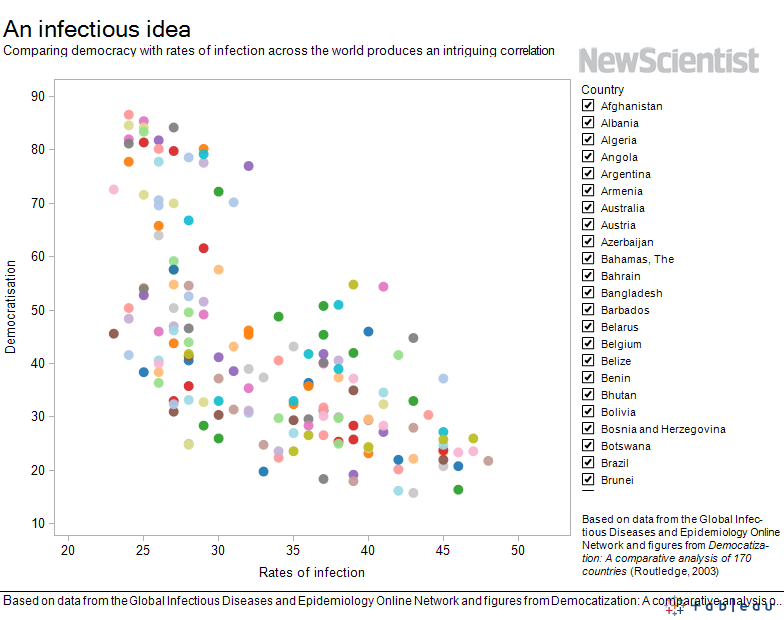
Like Keating at FP, I am unwilling to make any causal claims linking dictatorship to disease or vice versa but suffice it to say that most people who live under dictatorships – in Chad, Zimbabwe, Myanmar, North Korea, etc – do live despite great odds occasioned by their respective governments’ incompetence and runaway lack of accountability.

It is not obvious that democracy necessarily leads to good outcomes. In this regard I agree with Huntington that it is not the type of government that matters but the degree of government. China and Rwanda, for instance, are competent autocracies with high degrees of government. They also register much better outcomes than many nominal democracies out there

(Just for the record, this is not to say that we should not promote democracy. Despite the sobering reality of this world, I believe that everyone should do all in their capacity to help disperse power whenever they see it being concentrated in one individual or institution — paraphrasing my officemate Tomer).

africa’s Middle class

Elizabeth Dickinson at FP reports:

Given all this, perhaps the only thing about Africa that isn’t changing quickly is our perceptions of it. There’s an image impressed in all of our minds of a starving child, symobilizing an impoverished continent. If that was ever true, this is an excellent reminder that today, it’s at most a snapshot. Yes, there’s great human suffering and it’s not hard to find. But Africa as a whole is becoming a middle class continent.

It is hard to completely buy Dickinson’s optimism given the fact that Somalia, the DRC, Chad, Central Africa Republic, Sudan, among others are still far from being stable polities. The precarious nature of the stability in the more stable African states such as Uganda, Kenya, Ethiopia, Rwanda e.t.c. are also cause for concern.

That said, the reality is that there are many Africas. Those who fail to internalize that fact continue to do so at their own peril. Just ask the Indians and the Chinese.