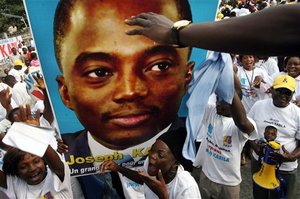
Waiting for Kabila to be Charlemagne

Joseph Kabila was sworn in today as President of the DRC following disputed elections last month. The main opposition has vowed to not recognize him as the legitimate president and are planning street protests. Some analysts believe that there will be blood in the streets of Kinshasa and other major urban centers.

If you think for a moment about the size and diversity of the DRC it becomes clear how hard it will be for the incorrigibly inept enormously challenged Joseph Kabila to be the one to drag the DRC out of its 50 year tailspin.


Democratic Republic of Congo

The truth be told, Mr. Kabila would not do any better running a village mboga kiosk. He is not an autocrat in the mold of Kagame, Zenawi, Museveni or even Sankara. He is closer to Samuel Doe, Bokasa and Valentine Strasser, ineffectual at best and outright disastrous at worst.


$500 million, and for what?

Congolese go to the polls on Monday, the 28th of November. The result of the election is almost a foregone conclusion. Incumbent president Joseph Kabila looks set to win another term in office – another 5 years to continue the mismanagement of the DRC’s resources through shady mining deals.

According to the Economist:

Whatever the result, doubts about the election’s fairness will persist, not least because of a perception that the electoral commission’s head is a friend of the president. Logistical problems are also ubiquitous, despite an election budget of $500m or so. As well as 11 presidential candidates, 18,000 hopefuls, including several pop stars and a rebel leader accused of ordering the rape of more than 300 women in eastern Congo last year, are contesting 500 seats in parliament. Some of the ballots will exceed 50 pages, which will surely daunt even the minority of voters who can read.

(Read the whole piece here)

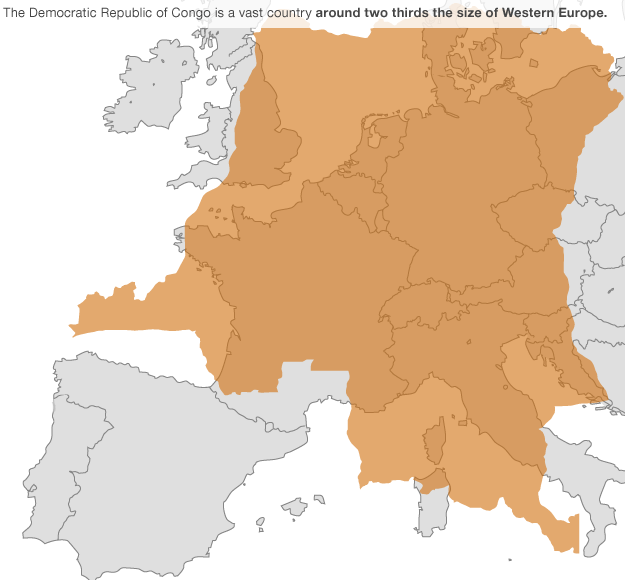
If I were in charge of the promotion of democracy in the DRC I would push for a system of staggered elections, both nationally and at the provincial level. I would also try and broker a deal to create a government of national unity in Kinshasa (representing the provinces) and competitive elections at the provincial level. In my view, the longer that everyone keeps pretending that the Congo – with its 70m+ and landmass the size of Western Europe – can be run by a single central government in Kinshasa – the longer it will take to put the country on the path of institutional development that will be conducive to long run economic growth.

Centralized state development definitely makes sense for smaller African states (think of the infamous trio of the Mano River basin). But if you are the DRC, capacity development in the capital must necessarily be accompanied by the strengthening of institutions at the provincial level – with more emphasis, in my view, on the latter than the former.

The number one problem facing the DRC right now is woeful state incapacity. It is doubtful that elections alone will force politicians’ hand in the right direction.

For more on the elections follow Congo Siasa.
Mining and Voting in the Congo

Elections in the DRC have come to be marked by a fire sale of state assets. A recent report by the UK parliament estimates that the government may have lost up to $5.5 b due to undervaluation of these state assets before sale.

No prizes for guessing where part of the difference in these sales go.

The whole situation is pretty stinky:

The IMF has asked the government to clarify several obscure contracts signed by Gécamines, which suggests that state assets have been sold for absurdly low prices…….. This would put the loss to the state at $870 mn.

The Chief Executive of Gécamines, Albert Yuma Mulimbi, has refused all requests, from the Mines Ministry to the IMF and others, to publish the controversial contracts, claiming that as a private company it is not obliged to, even though the state owns all its shares. The government has instructed Yuma, we understand, not to provide the information.

More on this here and here.

The other dimension of the (origins of) Congolese Conflict

UPDATE: Stay updated on the run-up to the elections in the DRC here.

**************************************************

In reaction to Dodd-Frank many in the blogosphere, including yours truly, have insisted that the problem in eastern Congo is not a law enforcement problem but a governance problem whose solution must come primarily from Kinshasa.

Often ignored is the regional dimension of the conflict.

The involvement of Rwanda and Uganda in eastern DRC (in the first and second Congo wars) have been excellently documented in Dancing in the Glory of Monsters (the author also blogs at Congo Siasa).

The invading forces may have left, but the geopolitical posturing remains and has consequences for the flow of arms and mushrooming of militias in the region.

Here’s a short documentary on the same.

This is not to simply vilify Uganda and Rwanda – one could argue that the presence of rebels from both countries in the Congo provided legitimate grounds for an invasion.

The point here is that the regional dimension of the conflict should not be ignored even as we insist that attention should shift to Kinshasa in an attempt to provide a lasting end to the conflict in eastern DRC.

conflict minerals in the congo

As is now common knowledge, the mineral glut in the DRC has been more a source of pain rather than gain. Minerals have financed both corrupt governments and their cronies in Kinshasa and marauding rebel groups in the ungoverned corners of the vast country.

To over-simply the issue, reforms will have to tackle both angles of the problem, i.e. both Kinshasa and the plethora of armed groups will have to come clean with regard to the extraction and sale of mineral resources. Kinshasa’s hoarding of all the benefits from the trade provides a perverse legitimacy for armed groups to continue their illicit activities.

Jason Stearns, the author of Dancing In the Glory of Monsters [I highly recommend the book], has a post on the complexities surrounding conflict minerals in the DRC.

First, “cautious” is the operative word. The Congolese export ban (September 2010 – March 2011) and the US electronic industry’s embargo of untraced minerals (April 2011 – present) have caused major job losses in the Kivus, as well as played into the hands of a select elite of military commanders, including ICC-indictee Bosco Ntaganda. It is, however, important to point out that neither initiative was caused directly by the Dodd-Frank legislation in the US. Rather, the export ban was decreed by the Congolese presidency, while the industry embargo was an aggressive interpretation of the US legislation. Dodd-Frank call for companies to carry out due diligence and to report their findings; the OECD guidelines call on companies to minimize the risk of financing armed groups.

Secondly, the Malaysia Smelting Corporation (MSC), which I had reported as having signed a deal for the largest tin mines in the Kivus, has not yet officially concluded a deal. A large Congolese delegation visited Malaysia earlier this year, and MSC and their Belgian partners Traxys then came to meet with President Kabila. A “confidentiality agreement” was signed with MSC regarding the Sakima concessions in Maniema, a good place to start as most of the mines there are removed from the main areas of conflict. In addition, MSC has not yet given $10 million for certification an tracing schemes, although the mining minister says they have agreed to fund these initiatives.

More on this on Jason’s blog here.

from the annals of history

One insurgent movement within the country lingers from the 1964-65 wave of rebellions. Localized in the Fizi-Baraka area by Lake Tanganyika, this group – known in recent years as the Parti de la Revolution (PRP) – achieved notoriety in 1975 by kidnapping four Stanford students from a zoological research station in Tanzania. Its composition is ethnically restricted to Bembe, though its leader, Laurent Kabila, is a Shaba Luba. The movement now has only a few hundred followers, and has no possibility of enlarging its base of operations.

That was Crawford Young writing in Foreign Affairs in 1978.

In 1997 Laurent Kabila, backed by Rwanda, Burundi, and Uganda, was in charge of a much stronger force and marched from the east of the DRC (then Zaire) into Kinshasa. After the overthrow of Mobutu Laurent Kabila was sworn in as president, only to be assassinated in 2002 and succeeded by his adopted son, Joseph Kabila. The younger Kabila continues to face a simmering insurgency in the east of the country.

Karl Marx once noted that history repeats itself, the first time as tragedy, the second time as farce. President Kabila’s continued ineptitude may be watering the seeds of his own ouster by rebels from the east in a farcical repeat of history.

quick hits

The Christian Science Monitor reports on the robbery that most African governments (in this case in the DRC) continue to visit upon their people, unabated. Some of the deals they make sound so bad they’d embarrass a two year old.

Gertler was just 27 when he first became involved in the Congo in 2000, obtaining a monopoly of diamond exports (worth around $600 million) in return for $20 million. He had previously been involved in diamonds in Angola and he is the grandson of Moshe Schnitzer, the founder of the Israel Diamond Bourse. He is now one of the richest Israelis.

Industry insiders, however, suggest that the last big round of mining concession acquisitions happened just before the last elections and helped the president raise funds for his expensive campaign. The next elections are in 2011.

More on this here.

Also, Tech crunch has a nice piece on how the future belongs to the global south

bemba’s case begins at the icc

Jean-Pierre Bemba is the ICC’s highest profile defendant yet (The other big names from the Continent’s conflicts have been tried under the UN special tribunals for Rwanda and Sierra Leone). The former Vice President of the DRC is on trial for crimes against humanity and war crimes, including rape, murder and pillage, in the Central African Republic (CAR).

Typical of most African conflicts which are labeled “civil” but are in actual sense international wars,  the DRC’s civil war extended beyond its borders. Bemba’s militia – The Movement for the Liberation of Congo (MLC) – was used by its backers in the Central African Republic to put down a rebellion in the south of CAR.

The ICC has many failings. But its deterrent effect is beginning to take hold. Justice is political, no illusions about that. However, the court’s activities provide a guarantee that in some cases, once in a while, the voice of the voiceless men, women and children who bear the brunt of the Continent’s conflicts will be heard.

The BBC has more on this.

The democratic republic of congo

Just in case you forgot, the Kivus are still on fire. Thousands of people remain displaced. Dozens routinely get killed and raped by both government and rebel forces, and sometimes even by UN peacekeepers. Things are crazy bad out there.

Meanwhile, Kabila and his cabal in Kinshasa remain as ineffectual as ever with no apparent strategy or plan, not just for the Kivus, but for the whole country.

The ICG has this nice report on the Congo. People may not agree on the priorities and approaches of resolving the conflict in the Kivu’s, but this report provides a good background for those who are new to the conflict.

Also check out this Report on the Congo from the Congressional Research Office.

The DRC is 50 today

The Democratic Republic of Congo is 50 years old. The last 50 years (after they killed Lumumba) have been absolutely disastrous for this vast country in the middle of the Continent; Independence merely replaced the brutality, cruelty and pillage of King Leopold’s men (King Albert II attended the independence day “festivities”) with the brutality and kleptocracy of Mobutu. All I can say is that I hope the future holds a less punishing existence for the country’s 63 million plus.

Congratulations to Congolese people the world over for their enduring spirit. Kofi Olomide, the prolific Congolese soukous musician, sums it up in a quote from Samba: “This is hell’s system. The fire is raging but we don’t get burned.”

The other Continental disaster, Somalia, also turned 50 on Wednesday. No cause for celebration there either.

comparative child mortality stats, and other news

The Continent still lags the rest of the world in the effort to reduce child mortality. Malaria and GI related illnesses (due to unclean water and what not) are still the number one killers of children in Africa.

For more on the child mortality stats see Aidwatch.

In other news, IRIN reports that “Humanitarian officials will look to the Chad government to protect civilians and secure aid operations after the UN Security Council decided on 25 May to withdraw some 3,000 UN peacekeepers from the country’s volatile east.” Yeah right. The rather incompetent and grossly corrupt President Idris Deby of Chad has so far failed in his quest to eliminate the Union of Forces for Resistance (UFR) based in the East of the country and in Darfur, Sudan. In 2008 the rebels managed to stage a massive offensive in the Capital N’Djamena. Mr. Deby barely managed to repel them, possibly with French assistance. Government incapacity in Deby’s Chad, Francois Bozize’s Central African Republic and Joseph Kabila’s Democratic Republic of Congo continues to provide safe havens for rebel groups in the great lakes region. I am beginning to think that allowing countries with extra-territorial ambitions like Rwanda and Uganda to run AU-controlled mandates in segments of such countries might not be such a crazy idea.

the democratic republic of congo, what a mess

The Democratic Republic of Congo is in a deep hole. And it is not just because its president, the younger Kabila, wants to extend presidential terms by 2 years and then may be abolish term limits, at least according to the Economist.  It is primarily because almost everyone in the country seems to have incentives to keep the war in the east raging on – well, everyone except the civilians on the ground. The New York Times reports that an upcoming UN Report will implicate bigwigs in the Congolese army of colluding with rebels in the east to profit from illegal mineral exports, among other commodities. FDLR, the rebel outfit which has among its ranks remnants of the genocidal Intarahamwe from Rwanda, is among the chief beneficiaries.

Quoting the Times:

There is ….. creeping warlordism. Local army commanders are taxing timber, charcoal, tomatoes, anything that passes through their roadblocks, making $250,000 a month, the report said. Commanders are even conscripting civilians to haul wood through the forest, reminiscent of the Belgian colonial days when pith-helmeted officers whipped Congolese porters with hippopotamus hide.”

The Congo conflict is more than anything else an economic conflict. It will only stop when those profiting from it come to their senses (I don’t know what will prompt this if 5 million deaths and counting can’t do the trick). And the web of war-profiteers  is huge.

Meanwhile in Zambia, it’s everything goes like it is still 1991. A section of donors have suspended aid to the health ministry because $ 2.1 million went missing (“more than 100,000 Zambians die every year from malaria and HIV/AIDS”– Economist). The government is reluctant to fight corruption. Mr. Rupiah Banda, the current president, seems bent on becoming the new Frederick Chiluba – the kleptocrat who ruled Zambia for ten years. Things never change.