A Ugandan journalist and a politician respond to Kony 2012

Angelo Izama, Ugandan journalist (and a good friend of yours truly) has a thoughtful op-ed piece in the Times. He makes the case that:

Campaigns like “Kony 2012” aspire to frame the debate about these criminals and inspire action to stop them. Instead, they simply conscript our outrage to advance a specific political agenda — in this case, increased military action.

African leaders, after all, are adept at pursuing their own agendas by using the resources that foreign players inject and the narratives that they prefer — whether the post-9/11 war on terror or the anti-Kony crusade. And these campaigns succeed by abducting our anger and holding it hostage. Often they replace the fanaticism of evil men with our own arrogance, and, worse, ignorance. Moreover, they blind us by focusing on the agents of evil and not their principals.

At the same time over at FP Nobert Mao, politician from northern Uganda and former presidential candidate, has the following to say:

It’s clear that the aim of the video [Kony 2012] was never intellectual stimulation. I don’t think the founders of Invisible Children are the foremost analysts of the complicated political, historical and security dynamics in our troubled part of Africa. They certainly wouldn’t earn high marks in African Studies. But I will go to my grave convinced that they have the most beautiful trait on earth — compassion.

Such sentiments matter, even today.  There are those who say the war is over in Northern Uganda. I say the guns are silent but the war is not over. The sky is overcast with an explosive mix of dubious oil deals, land grabs, arms proliferation, neglected ex-combatants, and a volatile neighborhood full of regimes determined to fish in troubled waters. What we have is a tentative peace. Our region is pregnant with the seeds of conflict. The military action in the jungles of Congo may capture Kony, but we need to do more to plant the seeds of peace founded on democracy, equitable development, and justice. Like peace, war too has its mothers, fathers, midwives, babysitters, and patrons. Perhaps Kony 2012 will help sort out the actors. The video has certainly shaken the fence, making fence-sitting very uncomfortable, indeed.

The two may disagree on the usefulness of tactics such as those that made the now famous video, but they certainly agree on the need to acknowledge agency of local actors in all these problems that require outside intervention.

My two cents on this is that there is definitely room for Africans to shape the narrative and tactics of advocacy in Western capitals (or elsewhere). Emotionally charged  mobilization tactics, like Kony 2012, are definitely a distraction from the real issues. But they also present an opportunity for African actors to leverage international attention and support against their own leaders who refuse to deal with problems that affect their daily lives. I am glad that in the case of Kony 2012 Ugandans have stepped in to provide perspective on the narrative and, hopefully, influence the eventual response by the relevant policymakers in DC.

$500 million, and for what?

Congolese go to the polls on Monday, the 28th of November. The result of the election is almost a foregone conclusion. Incumbent president Joseph Kabila looks set to win another term in office – another 5 years to continue the mismanagement of the DRC’s resources through shady mining deals.

According to the Economist:

Whatever the result, doubts about the election’s fairness will persist, not least because of a perception that the electoral commission’s head is a friend of the president. Logistical problems are also ubiquitous, despite an election budget of $500m or so. As well as 11 presidential candidates, 18,000 hopefuls, including several pop stars and a rebel leader accused of ordering the rape of more than 300 women in eastern Congo last year, are contesting 500 seats in parliament. Some of the ballots will exceed 50 pages, which will surely daunt even the minority of voters who can read.

(Read the whole piece here)

If I were in charge of the promotion of democracy in the DRC I would push for a system of staggered elections, both nationally and at the provincial level. I would also try and broker a deal to create a government of national unity in Kinshasa (representing the provinces) and competitive elections at the provincial level. In my view, the longer that everyone keeps pretending that the Congo – with its 70m+ and landmass the size of Western Europe – can be run by a single central government in Kinshasa – the longer it will take to put the country on the path of institutional development that will be conducive to long run economic growth.

Centralized state development definitely makes sense for smaller African states (think of the infamous trio of the Mano River basin). But if you are the DRC, capacity development in the capital must necessarily be accompanied by the strengthening of institutions at the provincial level – with more emphasis, in my view, on the latter than the former.

The number one problem facing the DRC right now is woeful state incapacity. It is doubtful that elections alone will force politicians’ hand in the right direction.

For more on the elections follow Congo Siasa.

The Consequences of Dodd-Frank in the Kivus

The dusty streets of Goma, North Kivu’s capital and a mining hub, illustrate Congo’s ills. Metals dealerships dominated the city’s economy until last year but are mostly padlocked now. Repair shops and bars that relied on mining business are empty. So are most public offices. Local government, financed by mining taxes, is insolvent; salaries have not been paid in full for months.

In the past year Goma has suffered a miserable decline. Hundreds of mines in the surrounding countryside have cut output by as much as 95%. At the Humule coltan mine a few gumbooted miners scramble up a red-earth ravine where last year there were thousands. Most stopped coming because they could no longer find buyers for their nuggets of coltan, a metal used in electronic gadgets. They blame what they call “the American law”.

That is the Economist reporting on the mining sector in the DRC.

Dodd-Frank (found here) is a lesson in the failure of solutions imposed from 30,000 feet. As has been stressed by many DRC experts (see Mvemba, Aronson and Seay, for instance), the problem with eastern DRC is not a law enforcement problem but a weak state problem.

With that in mind, it is sad that Joseph Kabila, the man who has failed to pacify the country, is poised for reelection this November. Good governance, even in relatively peaceful and cohesive states, take a long time to evolve. Once can only imagine how much longer Congolese will have to wait before they can get an effective and accountable state.

For  a slightly different opinion check out AFJN.

quick hits

Mau Mau veterans allowed to sue the UK government for atrocities committed during Kenya’s independence rebellion. The court might have just opened a pandora’s box for a whole lot of lawsuits.

Kim on the ongoing protests in Malawi. Kenya’s Daily Nation reports that at least 12 people have died in the protests over the last two days.

Pardhan on the limits of the NGO movement in global development.

Some cool graphics showing the cellular connection map of the US.

The US will, after all, be sending humanitarian aid to Al-Shabab controlled areas suffering the ongoing famine in Somalia. I hope this does not turn into a farcical repeat of Ethiopia in the 1980s. Back then food aid was used as a weapon of war by both government and Meles Zenawi’s rebel forces.

Lastly, remember Glencore? The firm that has been involved in not so clean mineral deals in the DRC? Well, they are now in South Sudan. I hope Juba doesn’t go this route. You can’t stay clean while playing with someone covered in mud.

No ICC hearings in Kenya

The ICC Pre-Trial Chamber Judge Ekaterina Trendafilova on Wednesday decided that the trial of suspects of the 2007-08 election violence in Kenya will not be held in the country.

Great move.

I am of the view that holding the hearings in Kenya would have created an unnecessary distraction from the important task of implementing Kenya’s new constitution. Already, the bigwigs accused of masterminding the violence that killed 1300 and displaced over 300,000 Kenyans have ethnicized their predicament. Holding the hearings in Kenya would have handed them an opportunity for a circus of ethnicity-charged rallies and demonstrations in Nairobi.

The ICC continues to be a source of debate in Kenya and across Africa. Many have faulted the court’s apparent bias against African leaders. Some have even called it a form of neocolonialism. While admitting that the court could use a little bit more tact [principally by acknowledging that it cannot be apolitical BECAUSE it is an international court SANS a world government] I still think that it is the best hope of ending impunity on the African continent – at least until African leaders internalize the fact that it is not cool to kill your own people.

Among the cases that should have been handled with a sensitivity to political realities include Sudan and Libya [and may be the LRA in Uganda]. Kenya’s Ocampo Six, the DRC’s Jean-Pierre Bemba and Cote d’Ivoire’s Laurent Gbagbo, on the other hand, should not raise questions of national sovereignty. Murderous dictators and their henchmen do not have internal affairs. In any case sovereignty for many an African country means nothing more than sovereignty for the president and his cronies.

Related posts here and here.

Graphical Illustration of China’s global reach

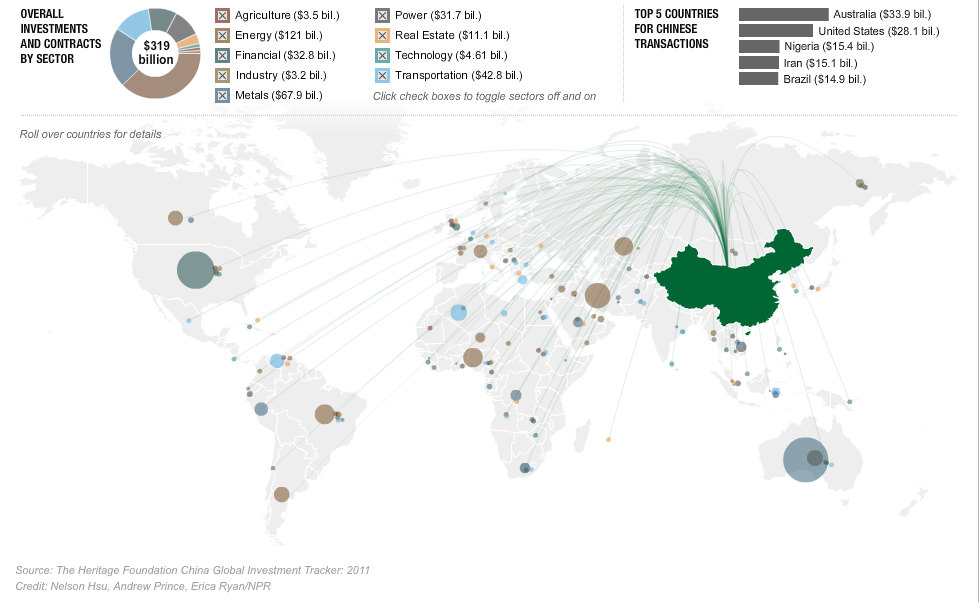
NPR has this cool graphic on China’s global investments [click on image to enlarge].

Notice that Nigeria is among the top destinations of Chinese investments.

In my alternate universe Abuja (the undisputed regional hegemon) is stable and uses this, and the fact that it is also among the most important sources of US-bound crude oil, as leverage to nudge the two biggest global powers in the direction of a more stable and coherent Africa policy.

More on this here.

Quick hits

1. If you don’t have a summer reading list already, Blattman has one for you. The list is obviously not exhaustive, but two pressing titles I might add are Avner Greif’s Institutions and the Path to the Modern Economy and Gerschenkron’s Economic Backwardness in Historical Perspective.

2. In yet another not so nice chapter in the relationship between the Angolans and Congolese, Angola has deported thousands of Congolese. According to IRIN:

The expulsions are symptomatic of the tense relations between Luanda and Kinshasa, rooted in disputes over border demarcation and natural resources. Angola’s alleged loss of hundreds of millions of dollars in revenue due to the unauthorized artisanal exploitation of diamonds is a particular bone of contention.

3. Michelle Obama is in Africa on one of those first lady gigs. Many Africa watchers have complained that the visit does not have any real policy agenda beyond the usual talking points.

I agree.

But I would also like to point out that the failure of Africa to reap an Obama dividend is not just because of the State Dept.’s indifference to Africa but also because Africa lacks a coherent voice in Washington. Is there an Africa lobby? What does it do?

Instead of a calculated strategic response to the election of the first US president of African descent the Continent has swung from euphoria to disappointment over the fact that manna did not fall from heaven.

4. Lastly, the fortunes of the AU force in Somalia appear to be on an upswing. Now if only Somali politicians can get their act together and form a stable government.

conflict minerals in the congo

As is now common knowledge, the mineral glut in the DRC has been more a source of pain rather than gain. Minerals have financed both corrupt governments and their cronies in Kinshasa and marauding rebel groups in the ungoverned corners of the vast country.

To over-simply the issue, reforms will have to tackle both angles of the problem, i.e. both Kinshasa and the plethora of armed groups will have to come clean with regard to the extraction and sale of mineral resources. Kinshasa’s hoarding of all the benefits from the trade provides a perverse legitimacy for armed groups to continue their illicit activities.

Jason Stearns, the author of Dancing In the Glory of Monsters [I highly recommend the book], has a post on the complexities surrounding conflict minerals in the DRC.

First, “cautious” is the operative word. The Congolese export ban (September 2010 – March 2011) and the US electronic industry’s embargo of untraced minerals (April 2011 – present) have caused major job losses in the Kivus, as well as played into the hands of a select elite of military commanders, including ICC-indictee Bosco Ntaganda. It is, however, important to point out that neither initiative was caused directly by the Dodd-Frank legislation in the US. Rather, the export ban was decreed by the Congolese presidency, while the industry embargo was an aggressive interpretation of the US legislation. Dodd-Frank call for companies to carry out due diligence and to report their findings; the OECD guidelines call on companies to minimize the risk of financing armed groups.

Secondly, the Malaysia Smelting Corporation (MSC), which I had reported as having signed a deal for the largest tin mines in the Kivus, has not yet officially concluded a deal. A large Congolese delegation visited Malaysia earlier this year, and MSC and their Belgian partners Traxys then came to meet with President Kabila. A “confidentiality agreement” was signed with MSC regarding the Sakima concessions in Maniema, a good place to start as most of the mines there are removed from the main areas of conflict. In addition, MSC has not yet given $10 million for certification an tracing schemes, although the mining minister says they have agreed to fund these initiatives.

More on this on Jason’s blog here.

africa’s Middle class

Elizabeth Dickinson at FP reports:

Given all this, perhaps the only thing about Africa that isn’t changing quickly is our perceptions of it. There’s an image impressed in all of our minds of a starving child, symobilizing an impoverished continent. If that was ever true, this is an excellent reminder that today, it’s at most a snapshot. Yes, there’s great human suffering and it’s not hard to find. But Africa as a whole is becoming a middle class continent.

It is hard to completely buy Dickinson’s optimism given the fact that Somalia, the DRC, Chad, Central Africa Republic, Sudan, among others are still far from being stable polities. The precarious nature of the stability in the more stable African states such as Uganda, Kenya, Ethiopia, Rwanda e.t.c. are also cause for concern.

That said, the reality is that there are many Africas. Those who fail to internalize that fact continue to do so at their own peril. Just ask the Indians and the Chinese.

quick hits

The long awaited discussion about the real content of higher education in Africa is underway. Be a part of it.

The DRC is getting ahead of itself with elections. One wonders whether holding elections is the wisest thing to do right now. Wars raging in the east. A country the size of western Europe but with the most rudimentary infrastructure. Loads of mineral wealth that create a few billionaires – most of them non-Congoleses – while the real Congolese starve or eke out a living with one eye on the lookout for marauding rebels and government forces thugs. The DRC is one big mess in need of radical clean up. Kabila simply will not do it. But he will win these elections for sure. And that means more instability in the great lakes region.

I just found out that I shall be in Zambia for the election campaigns – elections due in October – so watch this space for stuff on Zambian politics this August and September.

And lastly, China is upping its involvement in the Kenyan economy. According to Business Daily:

Several Chinese manufacturers are already setting up local production plants in Kenya, shifting from the previous strategy in which they supplied the domestic consumer market with goods imported from their home country.

More jobs = lower infant mortality rates. Everybody wins.

Africa needs zuma (to have a coherent foreign policy)

This week the Economist rightly called out South African president Jacob Zuma on his country’s lack of a coherent foreign policy. South Africa was reborn in 1994 with the moral authority and international goodwill to be Africa’s shining light in the world. Instead, under Mbeki and now Zuma, the country has squandered all that away.

Mbeki did it with his intransigence against reason on the issue of HIV/AIDS and support of Robert Mugabe in Zimbabwe. Mr. Zuma is doing the same with his support for Mugabe and equivocal pronouncements against other murderous tyrants on the Continent. Since his election he has not spoken strongly against any injustices or electoral fraud on the Continent; this task has been left to Ian Khama, president of tiny but relatively prosperous Botswana.

Sub-Saharan Africa is desperately in need of a regional hegemon to help it chart a coherent path in global politics. Latin America has Brazil. South Asia has India. East Asia has China. Even Europe has Germany. In Africa, Nigeria (pop. 150+m), South Africa (~40m, biggest economy), Ethiopia (85m) and the Democratic Republic of Congo (~70m) – all potential regional leaders – have woefully underperformed.

Nigeria is Nigeria. Ethiopia is dirt poor and needs to clean its own mess, Somalia’s and Eritrea’s, before it can venture further afield. The DRC is struggling to keep itself afloat. South Africa, by far, has the capacity and the requisite soft power to take up the job of regional guiding light. The country is slated to become a BRIC country soon, making the BRICS (Brazil, Russia, India, China and South Africa).

It is a shame that Mr. Zuma has chosen to abdicate his role as the Continental leader. He alone, among the members of the Continent’s club of kleptocratic autocrats (a.k.a AU), has the clout to stand up to the evils we continue to see in Cote d’Ivoire, Darfur, Zimbabwe and elsewhere.

TP Mazembe beat Brazil’s Internacional 2-0

Many of you may not know TP Mazembe, the reigning African club champions. The Lubumbashi (DR Congo) club surprised soccer football enthusiasts the world over by beating Brazilian champions Internacional in the world club championship semi final. They will play either the European champions Inter Milan or Seongnam Ilhwa of Korea in the final. This is the first time that an African side has reached the finals of a major international football tournament.

Check out both goals here.

Quick hits

If I were the president of the DRC, I would be seriously researching how Charlemagne did it (the medieval King ruled over a land mass the size of the DRC), how Brazil did it (their green revolution was a success) and how Vietnam is doing it (some people call it little China). I can bet my grad school stipend for next quarter that the younger Kabila has no local brain trust (who needs one if the Brussels boys can jet in and out of Kinshasa with copious amounts of “advice” on development??). The lets-just-stay-afloat-with-foreign-aid paradigm that informs governance in Africa is a guarantee that 50 years from now Africa will still be the poster child for bad governance and socio-economic underdevelopment.

Also, I just discovered a blog by The Bank’s chief economist for Africa region. Check it out (via Blattman).

Lastly, Wronging Rights has a post on the series of post by Texas in Africa on how social science works.

africa is not a country

The Economist reports on a project hatched to rebrand sub-Saharan Africa. Nobody can dispute the need to revamp the image of the Continent to make it be more than just about warring Congolese, corrupt Nigerians, or starving Ethiopians. That said, I am not too excited about the idea of packaging the entire continent as one brand for the following reasons:

1. This effort creates incentives for free-riding. Reforming is hard and therefore Chad will not reform if it can get away with attracting marginal investments because a reforming Central African Republic, through the neighborhood effect, has given it a better image.

2. It is the same Africa-is-one-country paradigm that denies the better performing states in Africa foreign investment and good press. Giving the whole continent a single brand does not solve this problem. Each African country should own up to its failures and not be given incentives to hide under an African umbrella.

For instance, ONLY South Africa deserves to bask in the glory of having hosted a successful World Cup tournament. Chad, CAR, Niger, Somalia, the DRC, etc,  had nothing to do with it. In the same vein, only Botswana, Kenya, Rwanda, Malawi and other reforming African states should tout their respective successes. It is by highlighting these countries’ competencies, without diluting them with the others’ mediocrity, that the image of the Continent will be improved.

failed states panel

FP has a live stream discussion on the issue of failed states. Catch it here

Update: Texas in Africa has a post on the conflict in eastern Congo.