Human brutality timeline

The Times has a chat on the timeline of human brutality. Encouragingly, the overall picture appears to be that (compared to past periods) less people – as a percentage of the total – die from violence. Here is the Times on the top three most deadly human conflicts:

The savagery of the Mongol conqueror Genghis Khan may have culled the global population by about 11 percent; two bloody upheavals in China — the An Lushan Rebellion and the collapse of the Xin Dynasty — each may have felled about 6 percent of humanity. Those are but 3 of the 100 worst atrocities in history, as cataloged by Matthew White in “The Great Big Book of Horrible Things,” an amusing (really) account of the murderous ways of despots, slave traders, blundering royals, gladiators and assorted hordes.

More on this here.

What does a Sata Presidency Mean for Zambia?

UPDATE:

For a closer take on the Sino-Zambian connection check out Louise Redvers’ piece for the BBC.

************************************

So the Economist beat me to writing about what a Sata presidency means for the Zambian economy, especially with regard to foreign investment.

For the two of you out there who are not conversant with the campaign details in the Zambian election, Mr. Sata’s main campaign strategy involved characterizing incumbent President Banda as someone who was out to mortgage Zambia’s future to foreign investors, and especially China.

Here is what the Economist had to say:

“He is too savvy a politician not to realise how much this impoverished country of 13m people needs China’s cash. Over the past decade, the Chinese have invested over $2 billion in Zambia, the GDP of which is only $16 billion. More than half of that came in last year. And China is committed to pouring in billions more. There are now about 300 Chinese companies in Zambia, most of them privately owned, employing around 25,000 locals. Standards differ: some companies treat their workers badly, but most of the big state-owned companies genuinely seek to respect local labour laws.”

The long and short of it is that Sata will definitely kick out a few shady companies that were operating outside the law – and these are not just Chinese firms; the South Africans and Australians also have some shady businesses in Zambia. The former, especially, have a lot of money-laundering operations.

More on this here and here.

On the democracy and governance front, things won’t change much. President Sata’s camp is full of recycled UNIP veterans. UNIP was the independence party that ruled Zambia between 1964 and 1991. Mr. Sata, however, could surprise us by finally passing through a new constitution for Zambia. The last parliament killed the proposed constitution.
The decline of odious ODA?

The Economist has a piece outlining the paradox of Indian overseas development assistance (to the tune of 11 billion over the next 5-7 years). With figures from the CIA factbook I have calculated that about 300 million indians live below the poverty line. The Economist piece also touts the emergence of middle income donors, especially among the BRICs.

In this world Europeans and Americans no longer dominate aid. China is the biggest source of investment in Africa and the Gates Foundation is as important as many donor governments (and much more innovative). Private capital flows to Africa outstrip aid flows, contradicting an old justification that aid is necessary because investors hold back.

For the poorest, the new donors are more important because Western aid is shrivelling. Congress is proposing to chop American aid by a fifth. Brazil is giving more to the Somali famine than Germany, France and Italy combined. There are exceptions: Britain and Australia promise to boost aid spending. But they seem like a last hurrah of Western generosity.

Adding that:

In this new world the justification for aid and the behaviour of donors must change. For India and others, it is far from clear why the government should send aid abroad when it has so many poor people at home. No doubt, aid will be defended as a boost to global influence. The risk for India is that, just like the West did in the 1960s, it will pour money into grand projects which fail—and encourage bad government.

I disagree with this latter assessment. It is not aid per se that caused the epic governance problems facing most of the low-income countries of the world. Sure it stunted the co-evolution of accountable government and domestic revenue generation. But the biggest failure of aid was what it was spent on.

Aid being highly fungible meant that most of the money wound up in the private accounts of venal leaders and gun-runners.

Things have since changed a bit. For instance, China’s resources-for-infrastructure deals can be a model for Aid 2.0 (this no doubt needs some tweaking too, as this damaging expose on Sino-Angolan oil deals shows). Plus this time the infrastructure investments are different. In an earlier period most of the investments were overtly white elephant projects (like Moi’s infamous hydro-electric dam in Turkwel). Most of the current projects are in roads, telecoms, and to some extent agriculture – investments that will have a much bigger impact because of their broader reach.

You can find a related earlier post here.

Graphical Illustration of China’s global reach

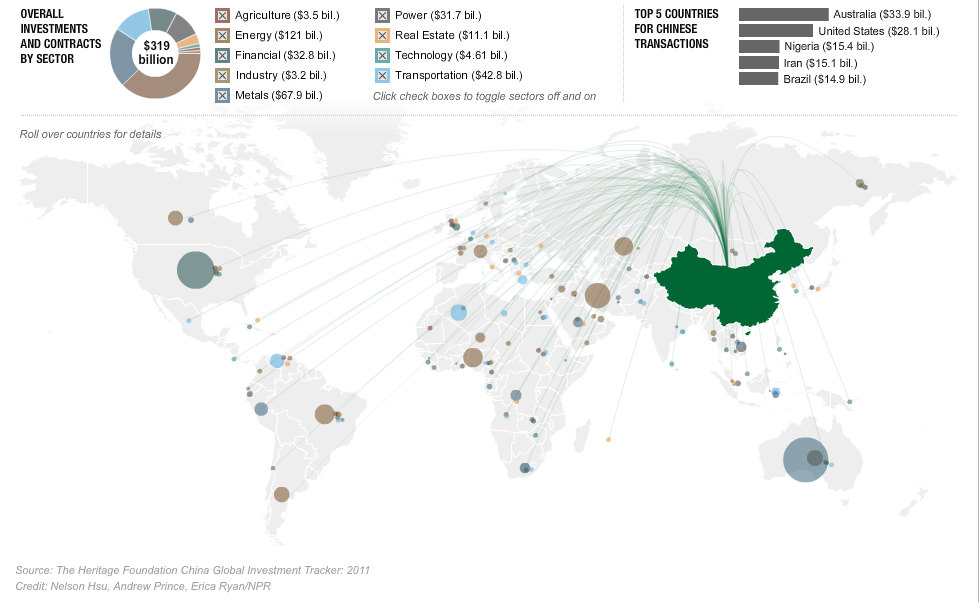
NPR has this cool graphic on China’s global investments [click on image to enlarge].

Notice that Nigeria is among the top destinations of Chinese investments.

In my alternate universe Abuja (the undisputed regional hegemon) is stable and uses this, and the fact that it is also among the most important sources of US-bound crude oil, as leverage to nudge the two biggest global powers in the direction of a more stable and coherent Africa policy.

More on this here.

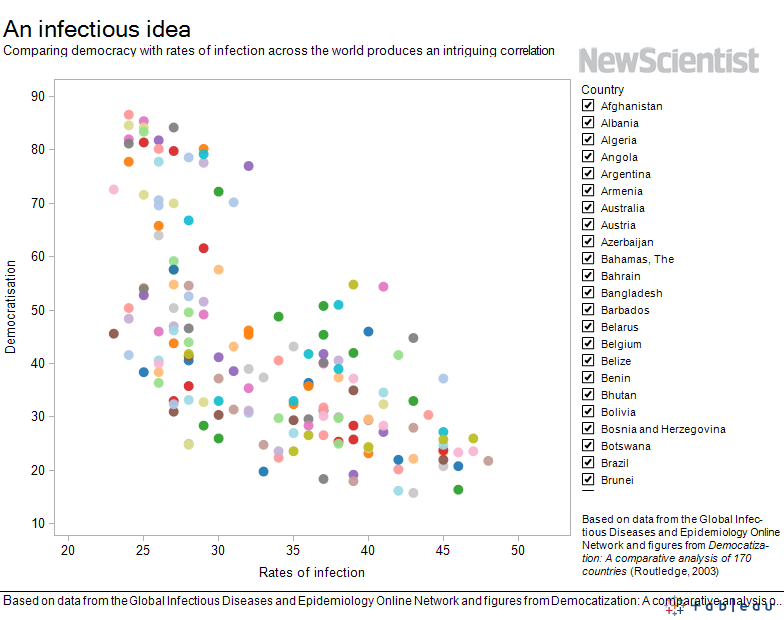
Dictatorship and Disease

Most Bad things go together.

Like Keating at FP, I am unwilling to make any causal claims linking dictatorship to disease or vice versa but suffice it to say that most people who live under dictatorships – in Chad, Zimbabwe, Myanmar, North Korea, etc – do live despite great odds occasioned by their respective governments’ incompetence and runaway lack of accountability.

It is not obvious that democracy necessarily leads to good outcomes. In this regard I agree with Huntington that it is not the type of government that matters but the degree of government. China and Rwanda, for instance, are competent autocracies with high degrees of government. They also register much better outcomes than many nominal democracies out there

(Just for the record, this is not to say that we should not promote democracy. Despite the sobering reality of this world, I believe that everyone should do all in their capacity to help disperse power whenever they see it being concentrated in one individual or institution — paraphrasing my officemate Tomer).

will the latest land grab help africa?

Update: You can find individual country reports from the Oakland Institute, a California based think tank, here.

I am on record as having reservations about the latest scramble for Africa African governments leasing vital arable land to foreign companies and governments (esp. in the face of high levels of food insecurity in the region).

Like many, my first reaction was to protest against these land deals. Like most natural-resource concessions on the Continent, they appeared to favor only the foreigners and a tiny clique of well placed individuals in African governments – at the expense of the many.

But I am beginning to have second thoughts. This latest land grab on the continent maybe the catalyst of an African green revolution. Most African governments gave up on non cash-crop agriculture in the 1970s. Some, like Nigeria, abandoned agriculture wholesale and quickly became net exporters of agricultural goods. Bad policy (see Bates) and non-agricultural resources (mostly oil and metals) were to blame.

While my general skepticism remains, here are potential upsides:

  1. Commercialization of non cash-crop agriculture: The vast majority of agricultural production in Africa takes place in smallholder farms that are hard to finance or insure (tea, coffee, and other cash crops get all the money). Their small sizes also limit the economic feasibility of improvements such as mechanization, irrigation, etc. The advent of commercial production of food crops in the region will have market effects, for sure. Agricultural SM&Es and even Big Agriculture will bring much needed capital to this vital sector of the economy.
  2. Land consolidation: This is already happening (and is the main source of my skepticism regarding the benefits of these deals). With consolidation comes economics of scale, R&D, mechanization, etc. I hope that African governments will ensure that this latter day enclosure movement takes place in a humane manner. It is in their own interest since most of these governments’ political bases reside in the countryside and live on subsistence agriculture. Consolidation might also spur further growth by creating demand for more goods (people earn wages and their are no longer producing their own food). Remember that specialization determines the extent of the market (Adam Smith).
  3. Technological diffusion: With commercialization will come irrigation, mechanization, use of fertilization, R&D, etc that will most certainly diffuse to the local agricultural sector. Rain-fed agriculture when you have the Nile, the Niger, the Voltas, the Congo, the Zambezi, Tana, Athi, etc, is so pre-Mesopotamia.
  4. Political reforms: In my view, one of the key impediments to political reforms in Africa has been the persistence of what Hyden called the “uncaptured peasantry.” A landed peasantry that can live off the land allows politicians to play with the macro-economy like there is no tomorrow. If the people get off the land, the general performance of the national economy will have a bigger impact on their lives. Suddenly, reaction to stratospheric inflation rates and other failures in the macroeconomy will not be confined only to urban centres. This will, in part, serve to end Africa’s tyranny of the countryside – a situation in which ethnic chiefs elected from the countryside ignore the underrepresented urban dwellers – and spur real democratic accountability.

Discussion of the downside of these deals is already out there. It also helps to look at the potential upside (at least in the long-run). I remain convinced that the real pro-poor growth in Africa will come from SM&Es and big business, whether in agriculture or other sectors.

africa’s Middle class

Elizabeth Dickinson at FP reports:

Given all this, perhaps the only thing about Africa that isn’t changing quickly is our perceptions of it. There’s an image impressed in all of our minds of a starving child, symobilizing an impoverished continent. If that was ever true, this is an excellent reminder that today, it’s at most a snapshot. Yes, there’s great human suffering and it’s not hard to find. But Africa as a whole is becoming a middle class continent.

It is hard to completely buy Dickinson’s optimism given the fact that Somalia, the DRC, Chad, Central Africa Republic, Sudan, among others are still far from being stable polities. The precarious nature of the stability in the more stable African states such as Uganda, Kenya, Ethiopia, Rwanda e.t.c. are also cause for concern.

That said, the reality is that there are many Africas. Those who fail to internalize that fact continue to do so at their own peril. Just ask the Indians and the Chinese.

the lion and the panda: still working on the relationship

The ambiguities in China’s relationship with Africa have created fertile ground for politicians. Opposition parties, especially in southern Africa, frequently campaign on anti-China platforms. Every country south of Rwanda has had acrimonious debates about Chinese “exploitation”. Even in normally calm places like Namibia, antipathy is stirring. Workers on Chinese building sites in Windhoek, the capital, are said to get a “raw deal”. In Zambia the opposition leader, Michael Sata, has made Sino-scepticism his trademark.

Much of this is wide of the mark. Critics claim that China has acquired ownership of natural resources, although service contracts and other concessions are the norm. China is also often accused of bringing prison labour to Africa—locals assume the highly disciplined Chinese workers in identical boiler suits they see toiling day and night must be doing so under duress.

Even so, the backlash is perhaps unsurprising. Africans say they feel under siege. Tens of thousands of entrepreneurs from one of the most successful modern economies have fanned out across the continent. Sanou Mbaye, a former senior official at the African Development Bank, says more Chinese have come to Africa in the past ten years than Europeans in the past 400. First came Chinese from state-owned companies, but more and more arrive solo or stay behind after finishing contract work.

Many dream of a new life. Miners and builders see business opportunities in Africa, and greater freedom (to be their own bosses and speak their minds, but also to pollute). A Chinese government survey of 1,600 companies shows the growing use of Africa as an industrial base. Manufacturing’s share of total Chinese investment (22%) is catching up fast with mining (29%).

That is the Economist reporting on the ever-growing Sino-African relationship. The main takeaway point is that Africa is increasingly becoming a manufacturing base for Chinese companies. With that comes transfer of technology, development of local expertise, increased competition and exposure to what’s happening outside the continent. In a few decades Chinese labor will get too expensive to support a robust export-oriented economy. That, coupled with increased domestic consumption in China will provide a good chance for African countries to finally begin their own move towards export-oriented industrialization and service provision.

bribing Bashir in order to let the southerners go

The BBC reports that the US government is willing to strike Sudan off the list of state sponsors of terrorism if the Bashir regime allows the independence referendum in South scheduled for early January.

Sudan has an oil-based relationship with China which has made it hard for the US and other Western states to use the usual coercive mechanisms via the security council. Southern Sudanese politicians have vowed to secede in January referendum or no referendum. East African countries, including Kenya and Uganda have expressed a strong preference for Southern independence.

Quick hits

If I were the president of the DRC, I would be seriously researching how Charlemagne did it (the medieval King ruled over a land mass the size of the DRC), how Brazil did it (their green revolution was a success) and how Vietnam is doing it (some people call it little China). I can bet my grad school stipend for next quarter that the younger Kabila has no local brain trust (who needs one if the Brussels boys can jet in and out of Kinshasa with copious amounts of “advice” on development??). The lets-just-stay-afloat-with-foreign-aid paradigm that informs governance in Africa is a guarantee that 50 years from now Africa will still be the poster child for bad governance and socio-economic underdevelopment.

Also, I just discovered a blog by The Bank’s chief economist for Africa region. Check it out (via Blattman).

Lastly, Wronging Rights has a post on the series of post by Texas in Africa on how social science works.

million dollar beds and lumbering in Madagascar

The BBC reports that the illegal logging of wood in Madagascar is increasing the risk of extinction of certain endangered tree species.  Already the felling of ebony, pallisander and rosewood is illegal in Madagascar. However, enforcement of this law continues to be hampered by the absence of a functional legitimate state in the island country off the coast of eastern Africa. Madagascar has been plagued by political instability since Andry Rajoelina, former DJ and mayor of Antananarivo, seized power in a coup last year.

Most of the wood finds it way to the US, Europe and China and is used among other things to make million dollar beds in China.

frustrations of the african intellectual

William Easterly on Aid Watch captures the frustrations of African intellectuals and their continued neglect by both the aid industry and their home governments.

African intellectuals continue to be on the periphery of the discourse on African socio-economic development. The independence leaders jailed, killed or exiled many of them, leading to fifty years of disastrous misrule and general mediocrity from Dakar to Mogadishu, Khartoum to Jo’burg. The current crop of autocrats and pretend-democrats did not learn a thing from the last half-century and continue to opt for career poverty-voyeurs development experts from donor countries instead of their own people who may have greater incentives to see their homeland match the achievements of the newly emerging states of Brazil, India and China.

china in africa: getting the right picture

Here is a new blog on this by Brautigam. I attended her talk at Stanford and kind of liked the book.

I am glad that a consensus seems to be emerging that one-sided and blind China-bashing is not productive, especially with regard to Chinese involvement in Africa.

And in other news, what is Kagame up to? The man appears to be turning into a paranoid autocrat. It’s been 16 years since 1994 and about time he started being more open to constructive criticism.

development issues

My promise to write a post on African development is almost becoming like Dr. Dre’s promise to release the Detox album. I promise it will come soon, after I settle on an opinion that is robust enough to withstand more than a few critiques.

For now we should be content listening to much wiser development experts – like Blattman, TN Srinivasan (the man who taught me intermediate microeconomics) and cynic in chief Bill Easterly.

A few years ago I used to conflate economic development with modernization. I thought that all it took to make vibrant economies in the global south was the importation of technology, material goods and ideas of governance from the more developed parts of the globe. But time has taught me that historical lock-in effects matter. The global south’s geography, historical poverty and social structures have created path dependencies that will take a lot of time to undo. This is not to say that we should give up on the idea of accelerated development. What I am suggesting is that as we do this we should have it in mind that certain things take time to change and that short-term failures disappear when you look at the long-term picture.

In other news, the conflict in Darfur has become less sexy and so it is no longer all over the news. But Darfurians are still suffering. The same applies to the Congo. Here is yet another reminder that the madness in the land of Mobutu continues unabated.

clinton statement is bad news for Darfuris

“Human rights cannot interfere with the global economic crisis, the global climate change crisis and the security crises.” These were the words of Hillary Clinton, the US secretary of state on her current visit to China. In an effort to warm up relations with the Asian mammoth (the party preferred to have a Republical White House), the Obama Administration seems to be willing to turn a bling eye to some nagging questions, at least for now.

But I say that this is the wrong approach. Chinese poor record on human rights issues at home and abroad cannot be ignored. China should be embarrassed into stopping its support for the genocidal regime of Mohammed al-Bashir in Sudan. The US  (and the world) cannot afford to put aside human rights issues just because of the world economic crisis. Indeed this might be the only time in the near future when China would feel vulnerable enough to feel threatened by international condemnation. Letting this opportunity pass by will be a big mistake for secretary Clinton and the Obama White House.