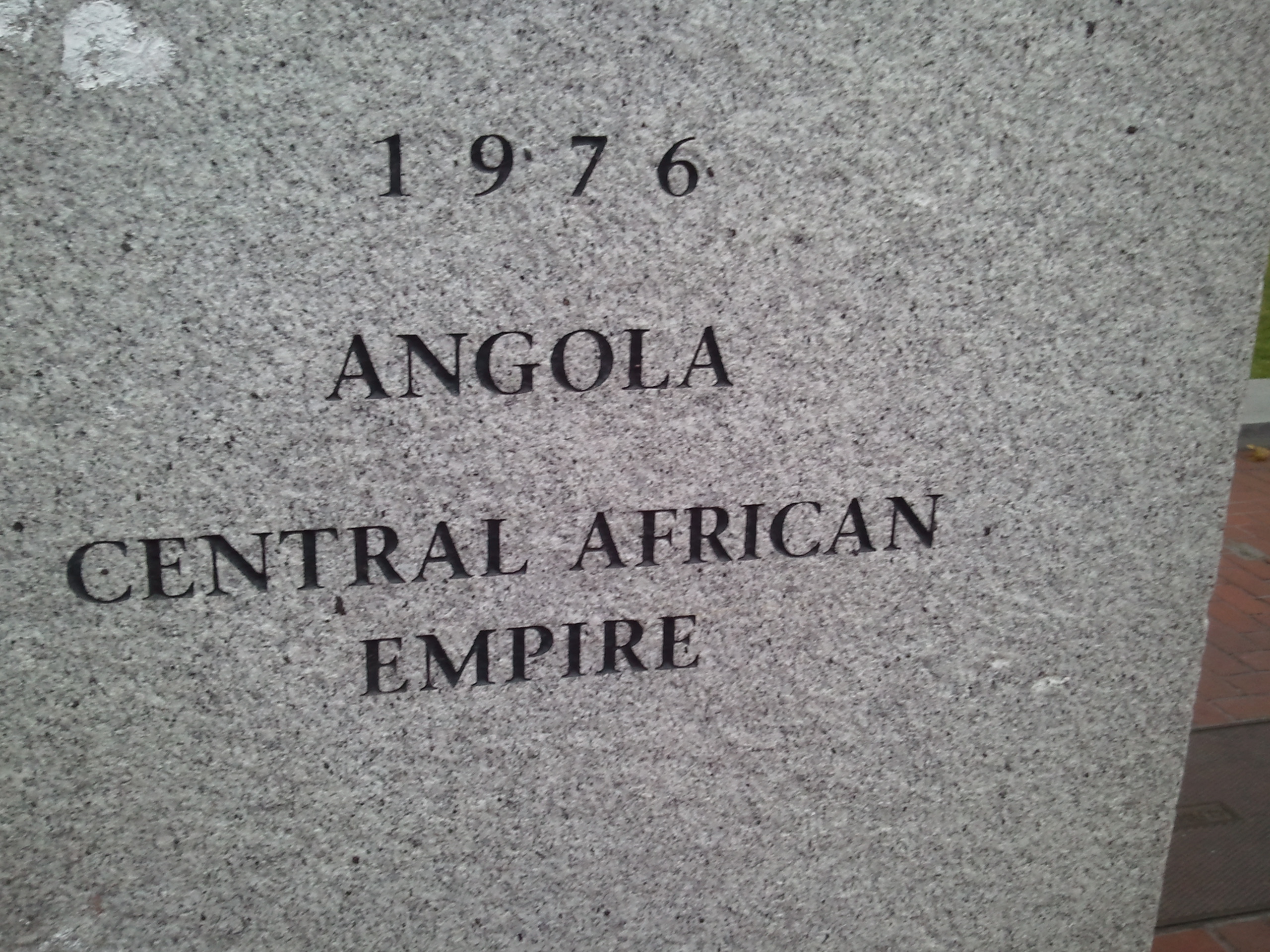
Emperor Bokassa’s madness immortalized at the UN Plaza in San Francisco

Emperor Bokassa (of the Central African Republic/”Empire”) ranks high among Africa’s worst dictators. For his coronation as emperor of the Central African Empire he spent half the national budget (with the assistance of the French, of course).

This afternoon I once more encountered his colossal error which remains immortalized at the UN Plaza in San Francisco.

central african republic president re-elected

Francois Bozize, dictator of the Central African Republic, has been re-elected with 66% of the vote. Capital FM reports that:

Government spokesman Fidele Ngouandjika declared: “It is a victory of democracy for someone who took power in a (2003) coup d’etat and who was legitimised by the ballot in 2005.”

More like Democracy 0 Bozize 10

More on this here.

elections and democracy in the central african republic

The Central African Republic is a country the size of Texas with a population of 4.8 million and GDP that is “significantly smaller than that of Pine Bluff, Arkansas.” Since independence from France, a string of autocrats (including the infamous Emperor Bokassa), have held power in Bangui without much care for the hinterlands. The current president, Francois Bozize, seized power in a 2003 coup. In response to domestic and international pressure, well orchestrated elections were held last Sunday.

Mr. Bozize’s “Work nothing but Work” (KNK) party is expected to win. In 2008 he signed a peace agreement with several rebel movements spread throughout the country that were opposed to his rule. Elections were part of the deal.

But of what use are elections in places like Central African Republic?

“William Easterly recently argued that “good governance” rhetoric notwithstanding, aid to dictators has remained steady since 1972. The rich countries no long have strategic interests at stake, but the “Gerund Defense” enables donors to keep the money flowing: with only a few exceptions, no matter how corrupt or autocratic a regime, it could be said to be “developing” or “democratizing” and hence on a progressive course necessitating assistance. But the dictators hold “farcical ‘elections'” and nothing changes. If we take Easterly’s warning seriously and start to question the progressivist aid ideology, what should we do about those places where elections occur, and aren’t exactly farcical, but meaningful democracy – in which citizens’ grievances and claims are taken seriously and responded to by their political leaders – remains elusive? The Central African Republic (CAR), whose citizens voted in first-round presidential and legislative elections Sunday, is one such place. In the end, the case of places like CAR might prove more insidious, because it calls into question the definitional link between elections and democracy.”

More on this here

ushering in the new year

Happy new year to all readers.

2011 will be a crucial year for a few countries on the Continent. On January 9th Southern Sudan will vote for secession, creating the newest state in the world. The aftermath of that might be all out war with North Sudan (over borders and oil) and/or civil war in the south (ethnically motivated warfare over control of the new state). That is what most analysts predict. I think there is a glimmer of hope for peace due to heavy Kenyan investment in the south and the desire to build, link and orient the new nation towards the East African Community. Watch this space as it all unfolds.

Uganda will hold elections on February 18th. Yoweri Museveni will win big and dig in even more now that Uganda has oil in the west of the country. Also bolstering Mr. Museveni’s hold on power will be the LRA’s delusional insurgency in the north of the country and the continuing war on terror in the horn of Africa – Uganda’s troops form the core of the African Union (AU) forces in Somalia. Mr. Museveni has been in power since 1986.

The other major election will be in Nigeria, the continental behemoth in the west. President Goodluck Jonathan is favored to win, but his victory will most certainly be tainted with chaos and irregularities.

Other countries holding elections in the new year are Central African Republic, Benin, Madagascar, Cape Verde, Chad, Djibouti, Niger and Liberia.

Electoralism remains largely dysfunctional and inconsequential in Africa because of a myriad of structural impediments (poverty, weak institutions, monarchical presidentialism, etc). In the recent past events in Kenya, Zimbabwe and Cote d’Ivoire have shown how far the Continent is from being a liberal democratic paradise (may be democracy is not for everyone at all times?). 2011’s elections will no doubt fail to buck the trend.
the central african republic, forever failing

update: For a history of the CAR read this: History of CAR

The Central African Republic (CAR) is perhaps the biggest joke as far as states within the international system go. Francois Bozize, the Gabon-born dictator that currently runs it, has failed to meet even the barest of needs of his countrymen. The IRIN reports:

“There is plenty of fertile land in the region [south east of CAR] but violence is interfering with traditional ways of life such as agriculture, hunting and fishing, with farmers often afraid to stray far from town to work their fields for fear of attack. This has reduced production, pushing up prices to the point at which not everyone can afford to buy food, even when it’s available,” said Christa Utiger, the International Committee of the Red Cross (ICRC) economic security coordinator for the CAR.

4.8 million people live in the country. A person born in the CAR can expect to live to be 50. The literacy rate is a woeful 49%. Per capita income (PPP) is US$ 700 (yes, PPP). Gold and timber are the main export earners, with the vast majority of people living on subsistence agriculture. 16% of CAR’s children under 5 are acutely malnourished. Rebel groups, including Uganda’s Lord’s Resistance Army routinely use CAR’s territory as launching bases. The only people who appear to be benefiting from the existence of CAR as a country are the thugs who run it, from David Dacko, to the self-proclaimed Emperor Bokassa to Francois Bozize.

the icc and the congo

IRIN news reports that arrests in Europe of political leaders of rebel movements in the Congo may not have much impact on the goings on on the ground. Even the FDLR is not immune to the commonplace principal-agent problems we are all aware of. The disconnect between the political leaders in Europe and generals on the ground is limiting the deterrence effects of the arrests.

I am not a huge fan of the ICC. But I am not one to throw out the baby with the bath water. The institution has potential to be a voice for the voiceless. Because of the ICC Kenyan politicians in the future will think twice before ordering jobless youth to murder innocent civilians. Because of the ICC rebel leaders cannot fly in and out of Brussels to raise money with abandon. These are not trivial achievements.

Accusations against the court’s Africa-bias may have some merit. Even more important are charges that the court does not appreciate the political consequences of justice or that the very idea of justice is political (see the Bashir case in Sudan). Others even point out the fact that going after the big fish ignores local offenses that also require redress. These are serious concerns that the ICC should address. But that said, overall I think that the ICC does more good than harm.

great idea

African nations have finally woken up to the threat of the ever advancing Sahara. The “great green wall of Africa” will be several kilometres wide and stretch from Senegal to Djibouti. Whoever is funding this project should condition cash transfers on need level (aridity, terrain and what not) so we can have a way of measuring state capacity (and thus name and shame the laggards) across the many Sahelian states that will be planting this wall.

comparative child mortality stats, and other news

The Continent still lags the rest of the world in the effort to reduce child mortality. Malaria and GI related illnesses (due to unclean water and what not) are still the number one killers of children in Africa.

For more on the child mortality stats see Aidwatch.

In other news, IRIN reports that “Humanitarian officials will look to the Chad government to protect civilians and secure aid operations after the UN Security Council decided on 25 May to withdraw some 3,000 UN peacekeepers from the country’s volatile east.” Yeah right. The rather incompetent and grossly corrupt President Idris Deby of Chad has so far failed in his quest to eliminate the Union of Forces for Resistance (UFR) based in the East of the country and in Darfur, Sudan. In 2008 the rebels managed to stage a massive offensive in the Capital N’Djamena. Mr. Deby barely managed to repel them, possibly with French assistance. Government incapacity in Deby’s Chad, Francois Bozize’s Central African Republic and Joseph Kabila’s Democratic Republic of Congo continues to provide safe havens for rebel groups in the great lakes region. I am beginning to think that allowing countries with extra-territorial ambitions like Rwanda and Uganda to run AU-controlled mandates in segments of such countries might not be such a crazy idea.

after sudan, ethiopia

Sudan’s Omar al-Bashir is here to stay. Ethiopia’s Meles Zenawi is up next on a list of African autocrats who face elections this year. Ethiopia holds parliamentary elections on May 23rd in a vote that will determine who becomes Prime Minsiter. Africa’s second most populous country cremains under tight rule by the increasingly despotic Meles Zenawi. It is a foregone conclusion that Mr. Zenawi’s party will win. The only non-academic part of these elections will be how many seats the opposition is allowed to win. Mr. Zenawi has run the country since 1991 when he led a rebellion that overthrew the tinpot dictatorship of Mengistu Haile Mariam.

More on Mr. Zenawi’s rule here.

The other elections coming up in the next month include Mauritius (May 5th) and the Central African Republic (May 16th). Keep track of these elections here.

people don’t go to war because they are poor

So as promised, I read the piece by Burke et al. They claim to have found a correlation between temperature increases and the onset of civil conflict in most of Africa. The mechanism is that hot weather messes up crop yields and therefore increases the likelihood of conflict (especially in places where people depend on rain-fed agriculture). This conclusion is based on the findings of a tight correlation between economic underdevelopment and civil wars. Nice and dandy, if you believe that people fight because they are poor. Sure, the opportunity costs are much lower for the poor aggrieved who oftentimes than not choose the conflict route to settling disputes. But state capacity, in my view, has a much greater influence on whether people choose to fight or not.

The paper’s policy prescriptions are even dodgier. The authors recommend that foreign aid be conditioned on projected adverse effects of climate change. Firstly, this “solution” is based on the premise that greater proportions of Africans will continue to depend on agriculture into the foreseeable future. This might be true, but shouldn’t we be trying to expand African economies and reducing dependence on agriculture (which necessarily forces us to deal with issues of governance)? Secondly, the idea that foreign aid should be conditioned on climate change is just, well, silly. Many a failed development initiative on the Continent can be blamed on the erratic nature of foreign aid. Adding more variance by pegging aid flows to climate changes will only make things worse.

For a more refined critique see Chris Blattman’s Blog.

how hard can it be?

The Lord’s Resistance Army (LRA) continues to run amok in the great lakes region, killing, maiming and abducting civilians at will. The governments of Uganda, The DRC, Central African Republic and Southern Sudan have proven unable to provide a solution to the LRA problem once and for all. A joint military operation by the governments of Uganda and the DRC early this year only served to fuel further attacks from the rebel movement – leading to 500 deaths, according to a UN report.

All this makes one wonder: How hard can it be to conclusively deal with the LRA? They need not be completely routed. The huge UN peacekeeping force in the DRC and the very active Ugandan military must be capable of reducing the human toll from the operations of LRA. And more importantly, isn’t it time that Uganda made up its mind on whether it wants to negotiate or pursue a military solution to the conflict with Kony and his murderous gang? Kampala’s indecision continues to cause hundreds of deaths in the wider great lakes region. Museveni should either agree to talk with Kony or take the fight to him (conclusively – and this can be done, with proper planning and commitment. The LRA is not al-Qaeda or al-Shabab). Fighting a war of attrition with a rebel movement whose MO is to maim and abduct young children is simply not an option.