Kenya: Five Things About Al-Shabaab and the Somalia Question

Early Thursday morning militants from the al-Shabaab terror group stormed Garissa University College in Kenya and killed at least 147 students. The second worst terror attack in Kenya’s history lasted 13 hours and was made excruciatingly horrific by the fact that many of the victims remained in communication with their loved ones until the very last moments. Unbearable images of young students laying dead in their own pools of blood in classrooms will forever be etched in Kenyans’ memories. The attack echoed the September 21, 2013 Westgate Mall terror attack that killed 67 people. After Westgate many Somalia analysts insisted that such daring missions were the kicks of a dying horse, and cited successes by AMISOM and AFRICOM in taking back territory from al-Shabaab and decapitating the organization through drone strikes against it leadership.

Following Garissa, it might be time to reconsider this persistent narrative and overall Somalia policy in the Eastern African region. Here are my thoughts:
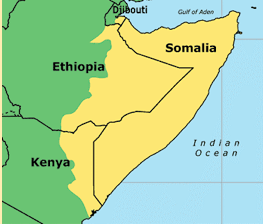
Screen Shot 2015-04-03 at 9.51.35 AM1. Regional powers do not want a powerful central government in Mogadishu: Since independence several governments in Somalia have espoused a dream of re-uniting all the Somali lands and peoples in eastern Africa (under “Greater Somalia,” see map). That includes parts of Ethiopia, Kenya, Djibouti, and more recently the breakaway regions of Somaliland and Puntland. A strong central government in Mogadishu would most certainly revive this old irredentist dream, despite the fact that the irredentist dreams of Somalia’s pre-Barre governments and the costly wars with Ethiopia (and proxy wars with Kenya as well thereafter) were the beginning of the end of stability in Somalia. Nairobi and Addis are acutely aware of this and that is part of the reason Kenya has for years maintained a policy of creating an autonomous buffer region in southern Somalia – Jubaland. The problem, however, is that a weak Mogadishu also means diffused coercive capacity and inability to fight off breakaway clans, militias, and terror groups like al-Shabaab.

The situation is complicated by the fact that Ethiopia and Kenya do not see eye to eye on the question of Jubaland. Addis Ababa is worried that a government in Jubaland dominated by the Ogaden clan could potentially empower the Ogaden National Liberation Front (ONLF), a separatist Somali insurgent group it has fought in its southeastern Ogaden Region.

2. The African Union and its regional partners do not have a coherent game plan for Somalia: To a large extent, African governments fighting under AMISOM are merely carrying water for Western governments fighting jihadist elements in Somalia. The West pays and provides material and tactical support; and the West calls the shots. Ethiopia and Kenya have some room to maneuver, but overall policy is driven by AFRICOM and the Europeans. The lack of local ownership means that African troops, especially the Kenyan and Ugandan contingents, are in the fight primarily for the money. Kenyan generals are making money selling charcoal and smuggling sugar (the UN estimates that al-Shabaab gets between US $38-56m annually from taxing the charcoal trade). The Ugandans are making money with private security contracts dished out to firms with close ties to Museveni’s brother. Only the Ethiopians appear to have a clear policy, on top of the general international goal of neutralizing al-Shabaab so that they do not attack Western targets.

What kind of settlement does Kenya (and Ethiopia) want to see in Somalia? (See above). What does the West want? What do Somalis want? Are these goals compatible in the long run?

3. The internationalization of the al-Shabaab menace is a problem: Western assistance in fighting al-Shabaab and stabilizing Somalia is obviously a good thing. But it should never have come at the cost of unnecessary internationalization of the conflict. Al-Shabaab has been able to get extra-Somalia assistance partly because it fashions itself as part of the global jihad against the kafir West and their African allies. Internationalization of the conflict has also allowed it to come up with an ideology that has enabled it to somehow overcome Somalia’s infamous clannish fractionalization (although elements of this still persist within the organization). Localizing the conflict would dent the group’s global appeal while at the same time providing opportunities for local solutions, including a non-military settlement. AMISOM and the West cannot simply bomb the group out of existence.

4. Kenya is the weakest link in the fight against al-Shabaab: Of the three key countries engaged in Somalia (Ethiopia, Kenya, Uganda), Kenya is the least militarized. It is also, perhaps, the least disciplined. According to the UN, Kenyan troops are engaging in illegal activities that are filling the coffers of al-Shabaab militants (charcoal worth at least $250 million was shipped out of Somalia in the last two years). Back home, Nairobi has allowed its Somalia policy to be captured by a section of Somali elites that have other agendas at variance with overall national policy. The Kenya Defense Force (KDF) risks becoming a mere pawn in the clannish struggles that straddle the Kenya-Somalia border. It is high time Nairobi reconsidered its Somalia policy with a view of decoupling it from the sectional fights in Northeastern Province. The first step should be to make the border with Somalia real by fixing customs and border patrol agencies; and by reining in sections of Somali elites who continue to engage in costly fights at the expense of ordinary wananchi. The government should adopt a strict policy of not taking sides in these fights, and strictly enforce this policy at the County level.

5. Kenya will continue to be the weakest link in the fight against al-Shabaab: Of the countries in Somalia Kenya is the only democracy with a government that is nominally accountable to its population and an armed force with a civilian leadership. This means that:

(i) Generals can run rings around State House and its securocrats: Unlike their counterparts in Uganda and Ethiopia, the Kenyan generals do not have incentives to internalize the costs of the war in Somalia. The cost is mostly borne by the civilian leadership. They are therefore likely to suggest policies that primarily benefit the institution of the military, which at times may not be in the best interest of the nation. And the civilian leadership, lacking expertise in military affairs, is likely to defer to the men in uniform. The result is makaa-sukari and other glaring failures.

(ii) Kenyan internal security policies are subject to politicization: With every al-Shabaab attack (so far more than 360 people have been killed) Kenyans have wondered why Ethiopia, which is also in Somalia and has a large Somali population, has remained relatively safe. My guess is that Ethiopia has done better in thwarting attacks because it has a coherent domestic security policy backed by unchecked coercion and surveillance of potential points of al-Shabaab entry among its Somali population.

Now, Kenya should not emulate Ethiopia’s heavy-handed tactics. Instead, focus should be on an honest assessment of how internal security policies in Mandera, Garissa, Wajir, Kwale, Kilifi, Mombasa, Nairobi, and elsewhere are playing into the hands of al-Shabaab. What is the best way to secure the “front-line” counties that border Somalia? What is the role of local leaders in ensuring that local cleavages and conflicts are not exploited by al-Shabaab? How should the security sector (Police and KDF) be reformed to align its goals with the national interest? What is the overarching goal of the KDF in Somalia and how long will it take to achieve that goal? How is the government counteracting domestic radicalization and recruitment of young Kenyan men and women by al-Shabaab?

These questions do not have easy answers. But Kenyans must try. The reflexive use of curfews and emergency laws, and the blunt collective victimization of communities suspected to be al-Shabaab sympathizers will not work.

I do not envy President Uhuru Kenyatta: Withdrawing from Somalia will not secure the homeland. Staying the course will likely not yield desired results given the rot in KDF and the internal politics of northeastern Kenya. Reforming the police and overall security apparatus comes with enormous political costs. A recent shake up of security chiefs and rumors of an impending cabinet reshuffle are signs that Kenyatta has realized the enormity of the insecurity situation in the country (and overall government ineffectiveness due to corruption). But will Kenyans be patient and give him the benefit of the doubt? Will the president be able to channel his laudable nationalist instincts in galvanizing the nation in the face of seemingly insurmountable security threats and ever more corrupt government officials?

Meanwhile 2017 is approaching fast, and if the situation doesn’t change Mr. Kenyatta might not be able to shrug off the title of “Goodluck Jonathan of the East.”

For the sake of Kenyan lives and the Jamuhuri, nakutakia kila la heri Bwana Rais.
Rwanda, 20 Years On

Caution: This is not an apology for President Kagame and his autocratic tendencies that have resulted in carnage and death in the DRC, Rwanda and elsewhere.

At a conference last year a US State Department official told a group of us that Rwanda was so polarizing that even at the Consulate in Nairobi the DRC crowd did not get along well with the Rwanda crowd.

It is not surprising why that might have been the case, or why the present analysis on the commemoration of the 20th anniversary of the 1994 genocide remains polarized.

rwandainfantmort

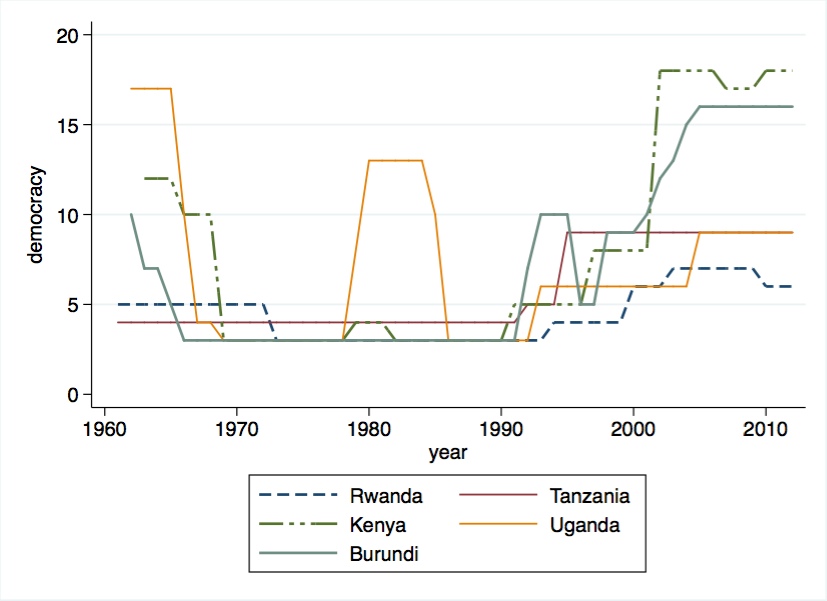
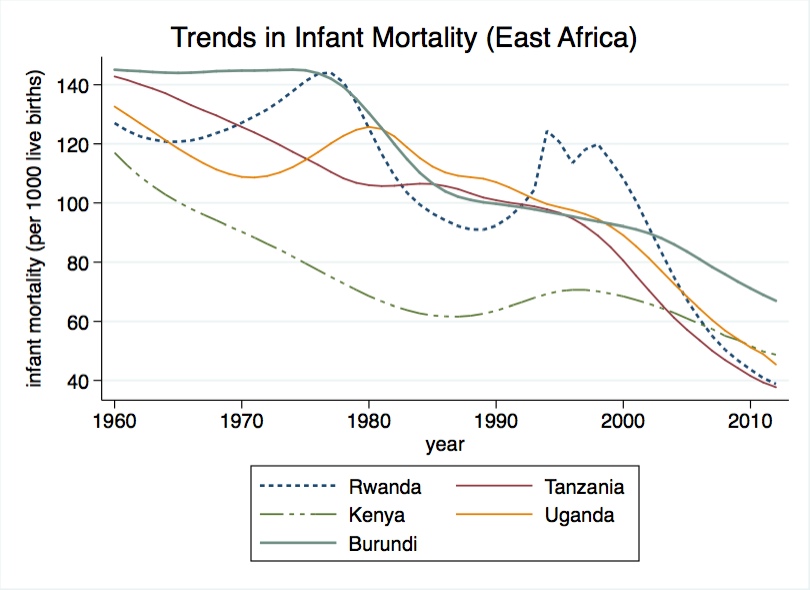
If one just looks at the improvements made in advancing human welfare since President Paul Kagame and the RPF took power (see graph, data from the World Bank) it is hard not to arrive at the conclusion that ordinary Rwandese are unambiguously better off. The country is the least corrupt in the region and has also been consistently ranked top in the ease of doing business. But there is also the side of the Kigali government that most reasonable people love to hate: the murderous meddling in the DRC and the oppression and occasional murder of dissidents at home and abroad. Those who admire what President Kagame has done tend to emphasize the former, while his critics tend to emphasize his autocratic tendencies which have made Rwanda the least democratic country in East Africa (see below, data from Polity). Many wonder if the post-1994 achievements are sustainable enough to outlast President Kagame’s rule.

So is Mr. Kagame a state-builder or your run of the mill autocrat whose achievements will vanish as soon as he relinquishes power?

ImageIn my view, I think that Rwanda is the best success story of state-building in Africa in the last 20 years. I also think that this (state-building) should be the paramount consideration for those who care about the Rwandese people and want to help them achieve greater freedoms. The fundamental problem in states like CAR, Sierra Leone or Liberia has never been the insufficiency of democracy. Rather, it has been the problem of statelessness. The contrast between Rwanda and Burundi is instructive (see both graphs, the two are neighbors with similar ethno-political histories. Rwanda has historically had a stronger state, though. See here and here). Despite the latter being the second most democratic state in the region, it has consistently performed the worst on nearly all human development indicators. Part of the reason for this is that Burundi remains a classic papier mache state confined to Bujumbura and its environs.

May be I am too risk averse. But I am scared stiff of anything that could lead to a recurrence of the horrors of the early 1990s stretching from the Mano River region to the Horn. As a result I am always skeptical of activism that takes state capacity (including coercive capacity) for granted.

With this in mind, the fight against autocratic rule in Rwanda should not come at the expense of the state-building achievements of the last 20 years. The international community and those who genuinely care about Rwandese people should be careful not to turn Rwanda into “democratic” Burundi in the name of democracy promotion. Interventions will have to be smart enough to push President Kagame and the ruling elite in the right direction, but without gutting the foundations of political order in Rwanda.

Absent a strong state (even after Kagame), the security dilemmas that occasioned the 1994 “problem from hell” would ineluctably resurface.

Lastly, I think the level of discourse in the “Rwanda Debate” could be enhanced by the extension of the privilege of nuance to the case. For example, if all we focused on were drones killing entire families at weddings in Yemen or the horror that is the South Side of Chicago we would probably get mad enough to ask for regime change in Washington. But we don’t. Because people tolerate the “complications and nuance of American politics.” The same applies to less developed countries. Politics is complicated, everywhere. And those who approach it with priors of good-or-bad dichotomies are bound to arrive at the wrong conclusions. One need not be a Kagame apologist to realize the need for a delicate balance in attempts to effect political change in Kigali.

Before you hit the comment button, notice that this is neither an apology nor an endorsement of autocracy in Rwanda. It is a word of caution regarding the choices outsiders make to accelerate political change in Rwanda.

Tyranny is not the panacea to underdevelopment. But neither is stateless democracy.

For background reading on the 1994 genocide in Rwanda see Samantha Power’s Problems From Hell; Mahmood Mamdani’s When Victims Become Killers; and Philip Gourevitch’s We Wish to Inform You That Tomorrow We Will be Killed With Our Families.

Understanding Uganda’s Military Adventurism Under Museveni

On January 15th 2014 President Yoweri Museveni finally admitted that Uganda People’s Defence Force troops are engaging in combat operations within South Sudan. Right after the political fallout in Juba and escalation of hostilities between forces loyal to President Salva Kiir and those behind his former deputy Riek Machar, Mr. Museveni threatened Machar with military action if he did not come to the table to negotiate with Kiir. Museveni’s military involvement in the conflict has caused concern in Nairobi and other capitals in the region. For one, Uganda’s military intervention in the conflict may yet jeopardize the ceasefire agreement that was signed on January 23, 2014 in Addis Ababa. The regional body IGAD (Intergovernmental Authority on Development) is supposed to be a neutral arbiter and monitor in the conflict. Museveni’s clear leanings towards the government in Juba may bring to question IGAD’s neutrality in the mediation effort.

For historical reasons (see below) Khartoum fears Kampala’s military involvement in South Sudan. But this time the situation is slightly different, and a little more complex. Bashir has already shown his hand in support of Juba against Machar, possibly for two reasons: (i) Khartoum needs Juba’s help in weakening the rebellion by the rump SPLA (SPLA-North) that is still active in Blue Nile and South Kordofan, regions that border South Sudan; and (ii) Bashir needs to keep the oil flowing in order to ward off internal turmoil within Sudan due to rapidly deteriorating economic conditions (see here). Kiir’s willingness to throw SPLA-N under the bus comes as no surprise since it is an offshoot of the “Garang Boys” (mostly PhDs) who occupied a special place, unlike Kiir and others, in John Garang’s SPLA. SPLM-N’s leader Malik Aggar, shared Garang’s vision of one united reformed Sudan, as opposed to secession by the South. At the same time, however, Khartoum does not want a super strong South Sudan free of rebels. Total cessation of conflict in South Sudan would rob Khartoum of proxies to keep Juba in check. Uganda’s involvement could tip the balance in Juba’s favor vis-à-vis potential Bashir allies.

Meanwhile in Nairobi and Addis Ababa concern is growing over Uganda’s claim that the IGAD should foot the bill of UPDF’s adventures in South Sudan. Both Ethiopia and Kenya prefer settling the conflict at the negotiating table, partly because both have their security forces stretched by domestic armed groups and bandits and the war in Somalia. Kenya has said categorically that it will not send troops to South Sudan, even under IGAD. The wariness in Nairobi and Addis to send troops or cash for a military cause in South Sudan contrasts sharply with Kampala’s choice of military action from the moment the current flare up started in Juba. This despite the fact that Uganda also has troops serving in Somalia.

Which raises the question: What explains Uganda’s international military adventurism under Museveni? The answer lies in the confluence of history, international geopolitics, and Uganda’s internal politics.

Uganda is one of the more militarized states in Africa, with the military having direct representation in parliament (10 seats). It is also interventionist, with a history of combat engagement and support for rebel groups in six neighboring states – Burundi, the Central African Republic (CAR), the Democratic Republic of Congo (DRC), Rwanda, Somalia, and South Sudan. More recently, the nation has been a key advocate for greater integration within the East African Community (EAC). Indeed, Ugandan President Yoweri Museveni fancies himself as a possible head of an EAC political federation should it ever materialize. Uganda is also a key player in the African Capacity for Immediate Response to Crises (ACIRC), a proposed standby force with capacity to rapidly deploy troops to trouble spots in Africa (other key supporters include South Africa, Chad, and Tanzania).

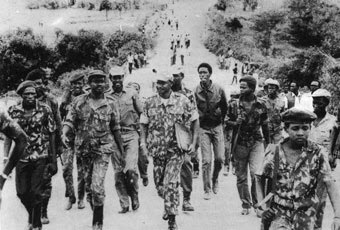
Museveni and his kagogo (little) soldiers

Museveni and his kadogo (little) soldiers

President Yoweri Museveni’s military adventurism and internationalist outlook have deep roots. As a young student in Tanzania, Museveni was involved in exile organizations opposed to Iddi Amin. Indeed, Museveni’s National Resistance Army (NRA), started off as the Popular Resistance Army (PRA) in Tanzania (As testament to its Tanzanian roots, NRA borrowed the idea of political commissars from the Tanzanian military to educate civilians in “liberated” Luweero Triangle). In Tanzania and even after returning to Uganda Museveni made regional connections that he maintained even after he ascended to power in 1986 – including Rwanda’s Paul Kagame, Sudan’s John Garang’, and leaders of Mozambique’s FRELIMO. Before rebelling against Kigali, Kagame was Museveni’s Chief of Military Intelligence. Museveni supported Garang’s Sudan People’s Liberation Army (SPLA).

Once in power, Museveni styled himself as the guarantor of peace and stability in Uganda. Many (both at home and abroad) evaluated his performance relative to the disastrous years under Amin and the ensuing civil war. The resulting peace dividend (albeit restricted to the south of the country) was marked by relative macro-economic stability, with growth averaging about 6% for much of the 1990s. This made Museveni a darling of Western donors and international financial institutions. However, Museveni’s record with regard to democracy and human rights remained dubious. This put him in awkward position vis-à-vis the West, especially since the 1990s was the zenith of Western promotion of liberal democracy.

To this Museveni reacted cleverly, and worked hard to position Uganda as a strategic player in the wider region’s geopolitics. In order to maintain his international stature and secure his position domestically, Museveni labored to bolster Uganda’s relevance to the West.

Museveni enters Kampala (Source)

Museveni enters Kampala (Source)

Beginning in the early 1990s, Uganda got militarily involved in a number of neighboring states. Support for Garang’s SPLA drew the ire of Khartoum, which in turn supported the Lord’s Resistance Army (LRA) in northern Uganda. Subsequently, the Ugandan military conducted raids against LRA bases in Sudan while also offering combat assistance to the SPLA. For instance, the 1997 battle at Yei featured Ugandan soldiers alongside the SPLA against the Sudan Armed Forces (SAF). It is around this time that the seed was planted for future military involvement abroad at the turn of the century (this time in Somalia under the Western-funded AU mission, AMISOM, to help stabilize the country). After US President Bill Clinton designated Sudan as a state sponsor of terror, Uganda positioned itself as an ally in the frontline of “Global War on Terror.” Kampala served as an intermediary for US aid to SPLA, thereby further strengthening US-Uganda military ties. It is telling that in 2003 Uganda was among only a handful of African states that supported the US-led Iraq War. About 20,000 Ugandans worked in US military bases in Iraq (this was also an excellent job creation tool; and a way of earning Forex).

So far Uganda’s most complex military adventure was in the Democratic Republic of Congo (DRC). A mix of strategic geopolitical positioning, the need to secure markets for Ugandan goods, private greed and domestic politics drove Uganda’s invasion of the DRC. The first Congo War (1996-97) was swift, aimed at helping Laurent Kabila oust Mobutu Seseseko (Rwanda and Angola also helped). Soon after Uganda and Rwanda fell out with Kabila, occasioning the Second Congo war (1998-2003), which involved four other African states. It is then that the façade of intervention for regional stability completely broke down. Ugandan and Rwandan commanders exploited existing and new cross-border smuggling and semi-legitimate trade networks to orchestrate massive pillaging of natural resources in eastern DRC (Competition between the two militaries later intensified, resulting in the “Kisangani Wars.”)

For instance, in the year 2000 despite only producing 0.00441 tonnes of gold, Uganda exported 11 tonnes. A UN report indicates that well-connected generals (including Museveni’s half-brother) created entities headquartered in Kampala to facilitate the illicit trade. It’s important to note that Museveni’s tolerance of the semi-autonomous activities by his generals was strategic (it generated revenue through Kampala-based entities and kept the generals happy) and did not lead to fracturing within the military. Indeed, many of those involved were later promoted.

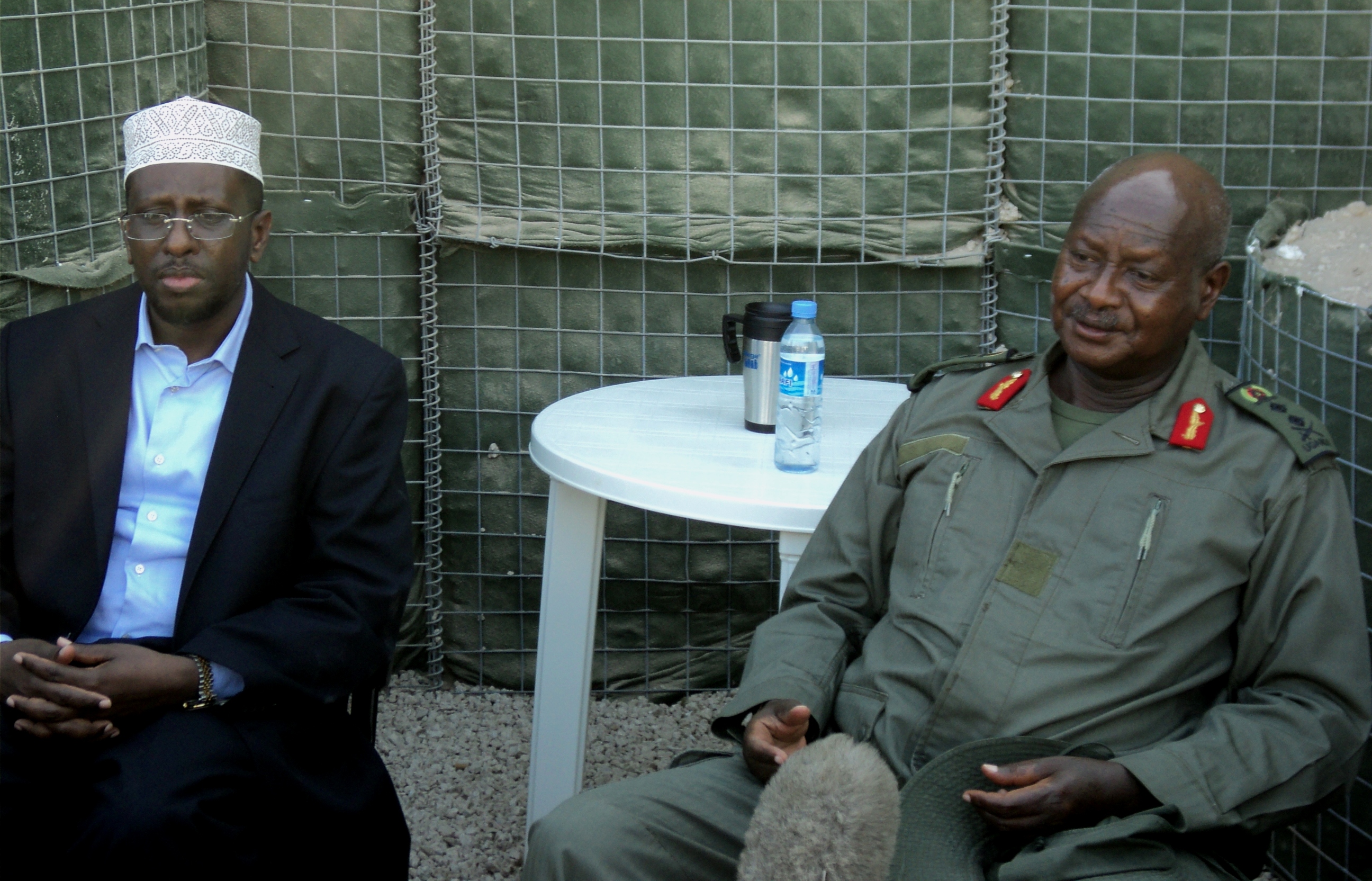
Museveni meets Somali President, Shayk Sharif Ahmed in Mogadishu in 2010


Incidentally, the present involvement in South Sudan also reflects the multifaceted logic of Ugandan international military adventurism. Historical alliances with the SPLA against the LRA and SAF make Kampala and Juba natural bedfellows. But the intervention is also about securing markets for Ugandan goods. According to figures from the Bank of Uganda, in 2012 the country’s exports to South Sudan totaled an estimated USD 1.3 billion. About 150,000 Ugandan traders operate across the border, not to mention countless more primary producers in agriculture who benefit from cross-border trade with their northern neighbor.

The above account explains Museveni’s efforts in the recent past to build an image as the regional powerbroker: heading peace talks between the DRC, Rwanda and eastern DRC rebels; intervening in Somalia to prop up the government in Mogadishu; and in the latest episode siding militarily with President Salva Kiir in South Sudan’s domestic political cum military conflict. Domestically, Museveni’s grip on power is as strong as ever. Recent reshuffles in the military removed powerful Historicals (the original “bush war heroes”) thereby leaving Museveni (and his son) firmly in control of Uganda’s armed forces. There is no end in sight for Uganda’s international military adventurism.

In many ways Uganda’s international adventurism has been a case of agency in tight corners. The country is a landlocked; has neighbors with sparsely governed borderlands that provide rear-bases for Ugandan armed groups; and Kampala needs Western aid to maintain the regime, a situation that necessitates acts of geopolitical positioning – especially with regard to the “Global War on Terror” and maintenance of regional peace and stability. Furthermore, oil discovery along the conflict-prone DRC border on Lake Albert and the need for pipelines to the sea to export Ugandan oil will necessitate even greater regional involvement. So while Uganda’s present outward adventurism is primarily because of Museveni’s peculiar personal history, it is correct to say that even after Museveni (still far into the future) the country will continue to be forced to look beyond its borders for economic opportunities, security, and regional stature.

How Eastern Africa can avoid the resource curse

This post originally appeared on the African Development Bank’s Integrating Africa Blog, where yours truly is a regular contributor. 

Eastern Africa is the new fossil fuel frontier (for more check out this (pdf) Deloitte report). In the last few years Kenya, Uganda, Tanzania and Mozambique have discovered large quantities of commercially viable oil and gas deposits, with the potential for even more discoveries as more aggressive prospecting continues. There is reason to be upbeat about the region’s economic prospects over the next three decades, or at least before the oil runs out. But the optimism must be tempered by an acknowledgement of the dangers that come with the newfound resource wealth. Of particular concern are issues of governance and sound economic management.

We are all too aware of the dangers of the resource curse. This is when the discovery and exploitation of natural resources leads to a deterioration of governance, descent into autocracy and a fall in living standards. Associated with the resource curse is the problem of the Dutch disease, which occurs when natural resource exports (e.g. oil and gas) lead to an appreciation of the exchange rate, thereby hurting other export sectors and destroying the ability of a country to diversify its export basket. The new resource-rich Eastern African states face the risk of having both problems, and to avoid them they must cooperate.

In many ways Eastern African states are lucky to be late arrivals at the oil and gas game. Unlike their counterparts in Western and Central Africa, nearly all of them are now nominal electoral democracies with varying degrees of institutionalized systems to ensure transparency in the management of public resources. Across the region, the Big Man syndrome is on the decline. But challenges remain. Recent accusations of secrecy, corruption and bribery surrounding government deals with mining companies suggest that there is a lot of room for improvement as far as the strengthening of institutions that enforce transparency (such as parliaments) is concerned. It is on this front that there is opportunity for regional cooperation to improve transparency and resource management.

While it is easy for governments to ignore weak domestic oversight institutions and civil society organizations, it is much harder to renege on international agreements and treaties. A regional approach to setting standards of transparency and accountability could therefore help ensure that the ongoing oil and gas bonanza does not give way to sorrow and regret three decades down the road. In addition, such an approach would facilitate easier cross-border operations for the oil majors that are currently operational in multiple countries, not to mention drastically reduce the political risk of entering the region’s energy sector. It would also leave individual countries in a stronger bargaining position by limiting opportunities for multinational firms to engage in cross-border regulatory arbitrage.

The way to implement regional cooperation and oversight would be something akin to the African Peer Review Mechanism, but with a permanent regional body and secretariat (perhaps under the East African Community, EAC). Such a body would be mandated to ensure the harmonization of laws to meet global standards of transparency and protection of private property rights. The body would also be mandated to conduct audits of national governments’ use of revenue from resources. The aim of the effort would be to normalize best practices among states and to institute a global standard for states to aspire more – more like the way aspirations for membership in the European Union has been a catalyst for domestic reforms in the former Yugoslavia and Eastern Europe.

Regional cooperation would also provide political cover to politicians with regard to economically questionable fuel subsidies. The realities of democratic government are such that politicians often find themselves forced to concede to demands for fuel subsidies from voters. But history shows that more often that not subsidies come at an enormous cost to the economy and instead of benefitting the poor only benefit middlemen. In addition, as the case of Nigeria shows, once implemented such policies are never easy to roll back both due to politics and the power of entrenched interests. Regional agreements capping any fuel subsidies at reasonable levels would be an excellent way to tie politicians’ hands in a credible manner, while at the same time providing them with political cover against domestic criticism.

Beyond issues of governance, there is need for cooperation on regional infrastructure development in order to reap maximum value for investment and avoid unnecessary wastes and redundancies. Landlocked Uganda and South Sudan will require massive investments in infrastructure to be able to access global energy markets. The two countries’ oil fields are 1,300 km and 1,720 km from the sea through Kenya, respectively. One would hope that as these projects are being studied and implemented, there will be consideration for how to leverage the oil and gas inspired projects to cater to other exports sectors – such as agriculture, tourism and light manufacturing – as well. KPMG, the professional services firm, recently reported that transportation costs eat up as much as 20 per cent of Africa’s foreign exchange earnings.  There is clearly a need to ensure that the planned new roads and railways serve to reduce the cost of exports for all outward oriented sectors in the region. Embedding other exports sectors (such as agriculture, timber, domestic transport, etc.) in the process of developing new transportation infrastructure will minimize the likelihood of their being completely crowded out by the energy sector.

In isolation, each country’s resource sector policy is currently informed by domestic political economy considerations and regional geo-politics. There is an emerging sense of securitization of resources, with each country trying to ensure that the exploitation of its resources does not depend too much on its neighbours. Because of the relatively small size of the different countries’ economies, the risk of ending up with economically inefficient but expensive pipelines, roads and railways is real. South Sudan is currently deciding whether to build a pipeline through Kenya (most likely), through Ethiopia, or stick with the current export route for its oil through Sudan (least preferred due to testy relations). For national security and sovereignty reasons, Uganda is planning on a 30,000-barrel per day refinery in Hoima, despite warnings from industry players that the refinery may not be viable in the long run. Some have argued for the expansion of East Africa’s sole refinery in Mombasa to capture gains from economies of scale, an option that Uganda feels puts its energy security too much in Kenya’s hands.

In the meantime, Kenya and Tanzania are locked in competition over who will emerge as the “gateway to Eastern Africa,” with plans to construct mega-ports in Lamu and Tanga (Mwambani), respectively. While competition is healthy and therefore welcome, this is an area where there is more need for coordination than there is for competition among Eastern African governments. The costs involved are enormous, hence the need for cooperation to avoid any unnecessary redundancies and ensure that the ports realize sufficient returns to justify the investment. Kenya’s planned Lamu Port South Susan Ethiopia Transport Corridor (LAPSSET) project will cost US $24.7 billion. Tanzania’s Mwambani Port and Railway Corridor (Mwaporc) project will cost US $32 billion.

Chapter 15 of the EAC treaty has specific mandates for cooperation in infrastructure development. As far as transport infrastructure goes, so far cooperation has mostly been around Articles 90 (Roads), 91 (Railways) and 92 (Civil Aviation and Air Transport). There is a need to deepen cooperation in the implementation of Article 93 (Maritime Transport and Ports) that, among other things, mandates the establishment of a common regional maritime transport policy and a “harmonious traffic organization system for the optimal use of maritime transport services.”

The contribution of inefficient ports to transportation costs in the regional cannot be ignored. Presently, the EAC’s surface transportation costs, associated with logistics, are the highest of any region in the world. According to the African Development Bank’s State of Infrastructure in East Africa report, these costs are mainly due to administrative and customs delays at ports and delays at borders and on roads. Regional cooperation can help accelerate the process of reforming EAC’s ports, a process that so far has been stifled (at least in Kenya) by domestic political constituencies opposed to the liberalization of the management of ports. The move by the East African Legislative Assembly to pass bills establishing one-stop border posts (OSBPs) and harmonized maximum vehicle loads regulations is therefore a step in the right direction.

Going back to the issue of governance, more integrated regional cooperation in the planning and implementation of infrastructure development projects has the potential to insulate the projects from domestic politics and patronage networks that often limit transparency in the tendering process. Presently, Uganda is in the middle of a row with four different Chinese construction firms over confusion in the tendering process for a new rail link to South Sudan and port on Lake Victoria. The four firms signed different memoranda with different government departments in what appears to be at best a massive lapse in coordination of government activities or at worst a case of competition for rents by over-ambitious tenderpreneurs.  This does not inspire confidence in the future of the project. A possible remedy to these kinds of problems is to have a permanent and independent committee for regional infrastructure to oversee all projects that involve cross-border infrastructure development.

In conclusion, I would like to reiterate that Eastern Africa is lucky to have discovered oil and gas in the age of democracy, transparency and good governance. This will serve to ensure that the different states do not descend into the outright kleptocracy that defined Africa’s resource sector under the likes of Abacha and Mobutu in an earlier time. That said, a lot remains to be done to ensure that the region’s resources will be exploited to the benefit of its people. In this regard there is a lot to be gained from binding regional agreements and treaties to ensure transparency and sound economic management of public resources. Solely relying on weak domestic institutions and civil society organizations will not work.

Can ethnic quotas mitigate against negative legacies of ethnic exclusion and conflict?

I examine the consequences of quota-based integration in Burundi’s military after a brutal and ethnically charged civil war. The evidence shows that at the macro level, the new Burundian military operates as a deeply integrated and cohesive institution. This is indicative of the possibility of quota-based integration in difficult settings such as postwar Burundi. At the micro level, evidence from a natural experiment suggests that this cohesion may be undergirded by the fact that integration itself reduced prejudice and caused no apparent increase in ethnic salience among soldiers. This is indicative of the promise of quota-based integration as a strategy for addressing ethnic conflict in this difficult setting.

That is Cyrus Samii in an excellent paper in the August issue of the APSR. Definitely worth a read if you are interested in ethnic politics/conflict and institutions.

Museveni: UN missions stifling state capacity development in Africa

The Daily Nation reports:

Ugandan President Yoweri Museveni has said UN peacekeeping missions [especially in the DRC] are derailing efforts by African governments to end conflicts.

He criticised the UN system of peacekeeping saying: “External support by the UN makes governments lazy and they don’ t focus on internal reconciliation.”

“The mistake is internal actors with no correct vision and the UN which does not focus on internal capacity building but instead focusing on peace keeping all the time. Without the internal solutions, you can’t have peace, ” Mr Museveni said in a statement on Thursday.

Some Congolese and experts on the DRC may disagree with Museveni’s analysis but it has some truth to it. As I pointed out in an African Arguments post several months ago, there is no short cut to fixing the Congo. State capacity development must be THE overriding concern (for more on this see here and here).

Also, The International Crisis Group has a nice piece on the recent takeover of the mining town of Lubumbashi by Mai-Mai fighters. The writer notes:

Since President Joseph Kabila’s controversial election victory in November 2011, government control over DRC territory has been in drastic decline. Beyond the fall of Goma to the M23 rebellion, Kinshasa has failed to repel the activities of various other armed groups: the Mai-Mai Morgan in Province Orientale, the Ituri Resistance Patriotic Front (FRPI) and the Mai-Mai Yakutumba in South Kivu, Rayia Mutomboki in North and South Kivu, as well as the Mai-Mai Gédéon in Katanga. (On the eastern Congo armed groups, see the October 2012 briefing Eastern Congo: Why Stabilisation Failed. On the Katanga armed groups, see the report Katanga: The Congo’s Forgotten Crisis.)

Why are African Presidents so Popular?

Gallup recently (April 25) released a new report showing approval ratings of African leaders. Many of them are inexplicably popular (a case of respondent preference falsification?). The polls were conducted in 2011.

Top of the list are the likes of Pierre Nkurunziza (Burundi) and Francois Bozize (CAF). Even the unapologetic, unreconstructed autocrats  Paul Biya (Cameroon) and Blaise Compraore (Burkina Faso) poll above 70%.

The whole report is here.

The least popular African leader is Eduardo dos Santos of Angola who polled at a dismal 16%. Angola is Sub-Saharan Africa’s second largest oil producer and China’s largest trade partner on the continent – China imports upwards of 43% of Angola’s oil. The likely denouement of the dos Santos succession is still unclear but one cannot rule out the possibility of turmoil when Angola gets to cross that bridge, especially in light of the fact that Angola’s appear to blame both dos Santos and the country’s leadership.

Is regionalism helping the East African Community

Evidence seems to suggest it is:

Trade between the EAC countries almost doubled from $2.2 billion in 2005 to $4.1 billion in 2010, although regional trade with the rest of the world expanded faster, meaning that the relative share of intra-EAC trade has stayed around 21 per cent since 2005 [The African Average is 11 %]. “Europe enjoys 64 per cent internal trade; our 21 per cent is better than we thought, but we have to make efforts to do better,” said Betty Maina, chairperson of the Kenya Association of Manufacturers.

Kenya still remains the biggest economy in the region, although some convergence is definitely likely to happen in the next decade or so given the large hydrocarbon discoveries in Uganda and off the Tanzanian coast.

The region’s oil consumption rose from 96,000 barrels per day in 2003 to 144,000 barrels per day in 2010, with Kenya consuming more than all the other EAC countries put together. East Africa now accounts for 10 per cent of all mobile subscribers in Africa, with the number of mobile subscribers surging from just three million in 2002 to a staggering 64 million in 2010.

More on this here.

Kenyan Intervention in (al-Shabab dominated) Southern Somalia

The ICG has an excellent new report on the state of the the Kenyan military intervention in Somalia.

The pressing issues raised in the report include economic, political and social concerns:

The slow pace of the military operation and the high cost of keeping troops in the field are the main reasons behind Nairobi’s desire to operate under AMISOM command. The treasury would then not have to pay the full cost of the campaign. It is estimated that Linda Nchi is costing the government at least KSh 210 million ($2.8 million) per month in personnel costs alone in a year of a record KSh 236 billion ($3.1 billion) budget deficit. If the interven- tion’s cost is not contained, already high inflation will spiral, and local discontent could become more serious…..

The intervention in Somalia is likely to have a complex impact on Kenyan Somalis’ political positions, because their attitude toward it is not straightforward. The government’s desire to establish a buffer zone between the border and the rest of Somalia privileges the Ogaden, the majority Kenyan-Somali clan. The possibility of a semi-autonomous state in the south of Somalia politically dominated by Ogaden may not be favoured by the minority, marginalised clans of north-eastern Kenya, such as the Ajuran and Degodia…..

Views within the ethnic Somali and wider Muslim community regarding the war are mixed but predominantly critical. Even those now mildly supportive could easily become hostile, especially if things go badly wrong, and civilian deaths mount. The notion that the war is popular within the Muslim community is wishful thinking, and the potential to exacerbate already worrying radicalisation in the country is very real. The police and other security services have shown some restraint in bigger cities, but there have been numerous reports of abuses in North Eastern Province.

Kenyan Court Orders Bashir Arrest, Sudan Expels Kenyan Ambassador

UPDATE:

The BBC reports:

Sudan ordered the expulsion of the Kenyan ambassador after a Kenyan judge issued an arrest warrant for Sudan’s President Omar al-Bashir, Sudan’s foreign ministry has said.

Mr Bashir is wanted by the International Criminal Court (ICC) for alleged war crimes in Darfur.

Sudan has ordered the Kenyan ambassador to leave the country within 72 hours.

It has also ordered the Sudanese ambassador in Kenya to return to Khartoum.

*************************************************************

A Kenyan court has issued an arrest warrant for Sudan’s President Omar al-Bashir over alleged war crimes in Darfur.

The ruling came after Kenya allowed Mr Bashir to visit in August in defiance of an International Criminal Court (ICC) warrant for his arrest.

The judge said he should be arrested if he “ever set foot in Kenya” again, the AFP news agency reports.

Kenya is a signatory to the treaty which established the ICC in 2002.

The new Kenyan constitution requires that the government implements its international treaty obligations. The ruling, though without much bite – I doubt Bashir will need to be in Kenya any time soon, has immense symbolism in the region.

It also matters for Kenyan domestic politics. Presently, a few high ranking Kenyan politicians – including the Finance minister, two former ministers and former police boss – are on trial at the ICC for crimes against humanity. The accused await judgment on the admissibility of their cases later this year or early next. The Bashir ruling means that if the charges against the “Ocampo Six” are confirmed but the government drags its feet in implementing an arrest warrant then the courts will step in.

More on the Bashir case here and here.

In other news, Uganda and Tanzania have rejected Khartoum’s petition to join the East African Community, citing “several issues like their democracy, the way they treat women and their religious politics.” Yeah right.

More on Eritrea and armed groups in eastern Africa

While Eritrea has in the past been repeatedly accused of supporting Somalia’s Islamist militia Al Shabaab, a charge it strenuously denies, the current report catalogues Afewerki’s growing notoriety in the world of terrorism finance, and in particular the global web through which these funds are routed, with Kenya serving as a global transaction distribution hub.

The report details the country’s activities in funding the terror group, following the money trail from its citizens in the diaspora in Europe and North America, through Dubai and the Eritrean embassy in Nairobi, and into the hands of Al Shabaab, all the while concealed in convoluted and opaque informal financial networks.

That is The East African reporting on Eritrea’s support for armed groups in the wider eastern African region. Mr. Afewerki’s actions are a threat to regional security for the following reasons:

1. Eritrea’s (opportunistic and cynically instrumental) use of Islam as a galvanizing force (against “Christian” Ethiopia) threatens to ignite a wider regional conflict that would probably include North Sudan and Egypt. The reason this is likely is because:

       (a) Remember that the use of the waters of the Nile continues to be a source of friction between Egypt and the riparian states of eastern Africa. Egypt itself has in the past been linked to armed groups in Somalia opposed to Ethiopian rule of the Ogaden region. Both countries have a history of funding rival clan militias in Somalia. In all of this the principle of my enemies’ enemies’ are my friends will most likely apply.

        (b) Because of its own problems with South Sudan, North Sudan might have an interest in using Eritrea’s networks to destabilize its southern neighbor. Recently the government of South Sudan banned all people of Somali origin from entering the country by land for security reasons. Juba clearly suspects either direct or indirect links between Khartoum and the myriad armed groups in war-torn Somalia

2. Given that the groups it supports (e.g. al-Shabaab) have other enemies besides Ethiopia, President Afewerki has effectively declared war on countries like Uganda, Burundi, South Sudan and Kenya that have also either been attacked or threatened by al-Shabaab. I wouldn’t be surprised if one or two of these EAC states decided to materially support the Ethiopian side the next time Addis and Asmara fight over their barren disputed border lands.

The EAC needs a defense pact

UPDATE: The Government of South Sudan has barred people of Somali origin from entering the country by road for “security reasons.” This wrongheaded move has created an awkward situation since not all people of Somali origin are from Somalia. In Kenya, for instance, a good chunk of the long haul transport sector is run by Kenyans of Somali origin.

********************************************************

The Ugandan government recently went on a $1 billion shopping spree for six fighter jets. The deal, which almost broke the bank, made a significant dent on Uganda’s forex reserves. Many, while acknowledging the risks that might have motivated the purchase, have questioned the wisdom of spending that much money on six jets.

For those not in the know, the key motivation for Museveni’s purchase was a desire to project military power in the region for two key reasons:

Firstly, in order to create a market for Ugandan light industries – cooking oil, soap, etc – Kampala has had to project military power to help in the pacification of pockets of eastern DRC and northern Uganda/South Sudan. These markets are crucial because they create jobs in Uganda, allowing Museveni some room as he continues to preside over Uganda’s decline into a dysfunctional police state.

The second reason was Museveni’s desire for military grandeur in the region. Kigali and Khartoum are not in the best of terms with Kampala. Museveni is probably suspicious of a potential Odinga presidency in Kenya. For these reasons, the Ugandan military establishment – the real rulers of Uganda – might have wanted to ensure that non of their neighbors are in a position to bully them in the near future.

While most of Museveni’s militarism is inspired by a mentality from a bygone era, I find Kampala’s fears against Khartoum as legitimate grounds for a regional defense pact. It is an open secret that Khartoum will try as much as it can to destabilize the new government of South Sudan (and by extension the wider region). And they have a few options:

  • They can foment civil war within South Sudan – there are a lot of disgruntled armed bands within South Sudan who might decide to take their chances with Khartoum; Remember that even Riek Machar, the current vice president of South Sudan, formed a Khartoum-backed splinter group (SPLA-Nasir) that fought Garang’ back in the early 1990s.
  • They can use armed groups in the wider central African region – including Kony’s LRA and the plethora of roving bandits in eastern DRC to engineer insecurity in South Sudan. Khartoum has used the LRA against SPLM in the past.
  • They can invade in an all out war. This option is the riskiest because of its potential to generate international opprobrium. But remember that Ethiopia and its secessionist former province Eritrea fought a bloody war that generated nothing but “stern” warnings from the UN and the wider international community. The US even armed Ethiopia because it needed Addis Ababa to fight its war in Somalia.
  • Lastly, they can use non-conventional tactics. Terrorism is slowly growing in the wider east African region. So far Eritrea has been the biggest state sponsor of terror in the region – mostly aimed at Ethiopia in the Ogaden, Oromo land and Somalia. The involvement of Ugandan and Burundian troops in Somalia has created even more enemies for these groups. There is no reason to believe that Khartoum would not use these same groups to destabilize South Sudan, if for nothing then as a survival tactic for a beleaguered Bashir administration that will forever be blamed for having lost the South’s oil.

Needless to say, an unstable South Sudan is bad for the region. Period.

The proliferation of small arms is already a major problem in the areas bordering the Ilemi triangle and eastern Uganda. That instead of sticks pastoralists have to roam around with AK-47’s says it all. More conflict in South Sudan will only make a really bad situation even worse. The potential for proxy wars within the region would also be an unnecessary drain on limited resources. Because of various interests in Juba, an aggression by Khartoum against South Sudan will definitely be met with reaction in one form or another from Kenya, Ethiopia and Uganda.The conflict will definitely be regionalized. Lastly, Eritrea’s bad habit of supporting terrorists should not be permitted to catch on. Khartoum must know that if it tries this dirty tactic it will be met by more than just resolutions from the AU, IGAD or the UN.

Which is why I think that the EAC should have a robust defense pact. War should have to be a last resort. But that does not mean that the East African Community should not prepare for such an eventuality, if it arise.

That way, no single country will be burdened with the task of buying all the necessary hardware needed to keep Khartoum deterred.

Such a plan would face significant challenges, of course – key among them the fact that the region’s armies are non-professionalized. A functional defense pact would require near total civilian control of the army. Only Kenya and Tanzania come close to this in the EAC. Rwanda, South Sudan and Uganda are dominated by their respective armies. Burundi can’t even win against rebels within its territory and remains a militarized tin pot dictatorship. And Ethiopia, if it were to join, is still dominated by the remnants of the rebellion that ousted Mengistu.

These challenges aside, it might be worth a try. Such a pact might even help professionalize and de-politicize the officer corp in the region’s armed forces.

And the biggest winner if this were to happen is MORE regional trade.

Failed states index out, the usual suspects top the list

FP has the annual list of failed states. The Continent has a heavy presence on the list, with the usual suspects like Somalia, Sudan, Chad, Niger and Central African Republic, among the top failures. Also on the list are otherwise stable places like Uganda, Nigeria, Kenya, Ethiopia, among others.

The list is, in some sense, a reminder that several states out there are in dire straits. Insecurity and poverty continue to be a daily experience of far too many people. But it also raises methodological questions regarding the rankings. Some of the rankings certainly do not make any substantive sense and merely feed into alarmist stereotypes we already have of certain countries or regions of the world.

Methodological issues aside, the list is yet another reminder that despite the recent surge in Afro-optimism, a lot still needs to be done in order to improve the human condition in Africa, among other regions of the world.

catch me if you can: of presidents and genocide

Those who conceive of justice as an end in itself must be livid. The last several days have seen one appeasement after another of heads of state who may have or have committed heinous crimes against their people. First there was the Kenyan invitation and failure to arrest suspected genocidaire Omar al-Bashir of Sudan. Then came the leaked UN report accusing Kagame’s men of committing crimes against humanity, and possibly genocide, in eastern Congo that did not stop regional presidents from attending the increasingly autocratic Kagame’s inauguration after his sham reelection. The damning report even forced the UN Secretary General to fly to Kigali in order to reassure Mr. Kagame and express his regret over the leaking of the report (I wonder if Mr. Kagame reminded Mr. Ki-moon about his peacekeepers’ abysmal failure to protect civilians from sexual violence in eastern Congo).

While appreciating the complexity of the respective cases (which have serious implications for regional security and stability), the recent events related to Messrs Bashir and Kagame may serve to  create a dangerous precedent. The whole point of the ICC was to make heads of state and other people in power think twice before going Pol Pot on their people. This objective will not be served if leaders realize that not even genocide can get in the way of regional and global geopolitical considerations.

In other news, as usual, Texas in Africa has interesting posts on the Congo. Check them out.

when will africa get it right?

A few months ago, after the Nigerian election, I read a piece in a leading international newspaper that said that Africa had yet again failed at democracy. The article infuriated me because it was a blanket write off of the entire continent as being undemocratic. I thought about Kenya, Senegal and Botswana as viable democracies that were capable of holding free and fair elections and which had freedom of the press.

But then Kenya happened. A country that was largely peaceful and with prospects of becoming a middle income country in the next decade and a half suddenly imploded and descended into never-before seen chaos. An election was stolen by a man who was viewed as one of the better behaved presidents on a continent infested with autocrats and dictators.

How, after all this, can we convince the world that Nigeria, Zimbabwe, the CAF, Equatorial Guinea, Sudan, Somalia, Chad, the DCR and all the others are isolated incidents? How are we going to convince ourselves that we are capable of running peaceful and prosperous countries when all that exist around us are chaos and murderous wars? Total failure?

It is true that countries like Botswana and Senegal still remain stable and democratic and also headed towards economic prosperity. South Africa is also doing quite well, although I am holding my breath to see what a Zuma presidency has in store for us. But the rest of the countries either have wars, or some form of instability and those that are peaceful have poverty rates that are utterly inhuman, to put it mildly.

It is extremely vital for the continent not to let a working model like Kenya sink into the same pit that has the Somalias of the continent. This is because many countries in East Africa depend on Kenya for their own economic success. A failed Kenya would mean no hope for Somalia and serious problems for Uganda, Rwanda, Burundi, Southern Sudan, Eastern DCR and Northern Tanzania. A failed Kenya will also mean a serious blow to the spread of democracy on the continent and especially East Africa. Besides Tanzania, Kenya was the only other democracy in the region. Uganda, Rwanda and Burundi all have autocrats who would happily use Kenya as an excuse for them to stay in power.