Failed states index out, the usual suspects top the list

FP has the annual list of failed states. The Continent has a heavy presence on the list, with the usual suspects like Somalia, Sudan, Chad, Niger and Central African Republic, among the top failures. Also on the list are otherwise stable places like Uganda, Nigeria, Kenya, Ethiopia, among others.

The list is, in some sense, a reminder that several states out there are in dire straits. Insecurity and poverty continue to be a daily experience of far too many people. But it also raises methodological questions regarding the rankings. Some of the rankings certainly do not make any substantive sense and merely feed into alarmist stereotypes we already have of certain countries or regions of the world.

Methodological issues aside, the list is yet another reminder that despite the recent surge in Afro-optimism, a lot still needs to be done in order to improve the human condition in Africa, among other regions of the world.

africa’s Middle class

Elizabeth Dickinson at FP reports:

Given all this, perhaps the only thing about Africa that isn’t changing quickly is our perceptions of it. There’s an image impressed in all of our minds of a starving child, symobilizing an impoverished continent. If that was ever true, this is an excellent reminder that today, it’s at most a snapshot. Yes, there’s great human suffering and it’s not hard to find. But Africa as a whole is becoming a middle class continent.

It is hard to completely buy Dickinson’s optimism given the fact that Somalia, the DRC, Chad, Central Africa Republic, Sudan, among others are still far from being stable polities. The precarious nature of the stability in the more stable African states such as Uganda, Kenya, Ethiopia, Rwanda e.t.c. are also cause for concern.

That said, the reality is that there are many Africas. Those who fail to internalize that fact continue to do so at their own peril. Just ask the Indians and the Chinese.

the lion and the panda: still working on the relationship

The ambiguities in China’s relationship with Africa have created fertile ground for politicians. Opposition parties, especially in southern Africa, frequently campaign on anti-China platforms. Every country south of Rwanda has had acrimonious debates about Chinese “exploitation”. Even in normally calm places like Namibia, antipathy is stirring. Workers on Chinese building sites in Windhoek, the capital, are said to get a “raw deal”. In Zambia the opposition leader, Michael Sata, has made Sino-scepticism his trademark.

Much of this is wide of the mark. Critics claim that China has acquired ownership of natural resources, although service contracts and other concessions are the norm. China is also often accused of bringing prison labour to Africa—locals assume the highly disciplined Chinese workers in identical boiler suits they see toiling day and night must be doing so under duress.

Even so, the backlash is perhaps unsurprising. Africans say they feel under siege. Tens of thousands of entrepreneurs from one of the most successful modern economies have fanned out across the continent. Sanou Mbaye, a former senior official at the African Development Bank, says more Chinese have come to Africa in the past ten years than Europeans in the past 400. First came Chinese from state-owned companies, but more and more arrive solo or stay behind after finishing contract work.

Many dream of a new life. Miners and builders see business opportunities in Africa, and greater freedom (to be their own bosses and speak their minds, but also to pollute). A Chinese government survey of 1,600 companies shows the growing use of Africa as an industrial base. Manufacturing’s share of total Chinese investment (22%) is catching up fast with mining (29%).

That is the Economist reporting on the ever-growing Sino-African relationship. The main takeaway point is that Africa is increasingly becoming a manufacturing base for Chinese companies. With that comes transfer of technology, development of local expertise, increased competition and exposure to what’s happening outside the continent. In a few decades Chinese labor will get too expensive to support a robust export-oriented economy. That, coupled with increased domestic consumption in China will provide a good chance for African countries to finally begin their own move towards export-oriented industrialization and service provision.

Trends on Aid, Growth and Government Spending in Africa

Data from the Penn Tables

The graph shows average growth rates, government expenditure as a fraction of GDP and foreign aid as a fraction of GDP in Sub-Saharan Africa since 1960. Both the growth and aid trends are encouraging. Growth has been positive since the mid-1990s and aid seems to be trending downward in the long-run. It is also apparent that the African growth tragedy was to a large extent confined to the disaster periods that were the “lost decade” of the 1980s (caused by the oil shocks, commodity bursts, debt crises and SAPs) and civil wars era of the early 1990s.

Despite the ongoing crises like this, this and this, the region as a whole appears to be experiencing an economic upswing. In the coming decade, the Economist projects that 7 out of 10 of the fastest growing economies in the world will be African.

inept african leaders should be pushed aside

Rant and Rave alert.

African dictators enjoy some of the highest expected tenures in the world. They are also some of the worst performing leaders. Theodore Obiang of Equatorial Guinea has been in power since the late 1970s. Abundant oil and a low population makes his country be classified as a high income country by the World Bank (over $34,000 per capita income); despite the fact that over 70% of his people live below the poverty line, even as his son plans to buy the 2nd most expensive boat in the world. A huge chunk of his country’s oil money goes directly to his bank account.

This has been the story of African leadership in the last 50 years. Half a century after independence Africans find themselves in a position in which former colonial powers can still roll in and take over with minimal resistance. At the moment Cote d’Ivoire, the jewel of post-independence West Africa, is on its knees. Former colonial power, France, controls the main international airport. It is as if 1960 never happened.

It is like 1960 never happened because tiny Portugal can still roll in and take over Equatorial Guinea.

At the risk of sounding like a dependence theorist, the reality is that external domination of the African Continent only ended on paper. Poor leadership has continued to confine the entire region in the sick ward of the world. The numbers tell it all. The region’s maternal and child mortality figures are mind-boggling. In many places the standards of living belong in centuries long past.

What is on the mind of Laurent Gbagbo as he continues to destroy the lives of millions of Ivorians? What is Idriss Deby’s plan for Chad, and its oil money that he continues to steal with alacrity? Why does Mugabe think that he is God’s gift to Zimbabwe? And why does Zuma of South Africa continue to be embroiled in useless and shameful sideshows involving his sexual life instead of assuming the important task of leading this rudderless continent out of mediocrity?

property rights and economic development in africa

Forget (almost) everything else. The trouble with African economies is simply and squarely the lack of property rights protection. It still beats me why the African political elite have failed at instituting even intra-elite property rights protection. The fact that the African political elite – who also happen to be the wealthiest people on the Continent – cannot invest in their own countries has resulted in massive capital flight. The quote below says it all.

Speaking at the New Partnership for African Development (NEPAD) meeting in Abuja, Nigeria, in December 2003, the former British secretary of state for international development, Lynda Chalker, noted that 40 percent of the wealth created in Africa is invested outside the continent.

And this is only what gets counted. Although obviously the upper bound, recent revelations of Mubarak’s wealth (between 20 -70 billion) may be an indication of the amount of personal wealth stashed overseas by long time autocrats like oil-rich Angola’s Edwardo do Santos, Equatorial Guinea’s Obiang’ and Sudan’s Bashir, among others.

The contrast is that:

In corrupt societies in Asia, such as Indonesia, Bangladesh and Pakistan the citizens still prosper because the corrupt elite keep their money at home. They invest in new mobile phone network, build private hospitals and tourist hotels (here).

In short, elite political instability and distrust in Africa is one of the key reasons why the region remains poorer than any other in the world.

textual presence

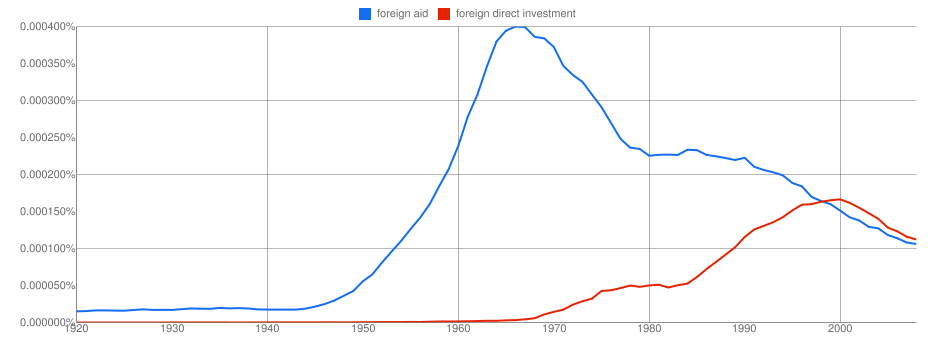
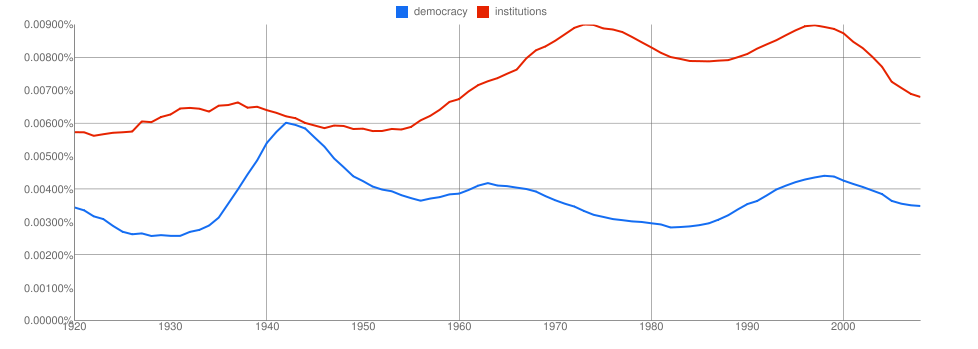
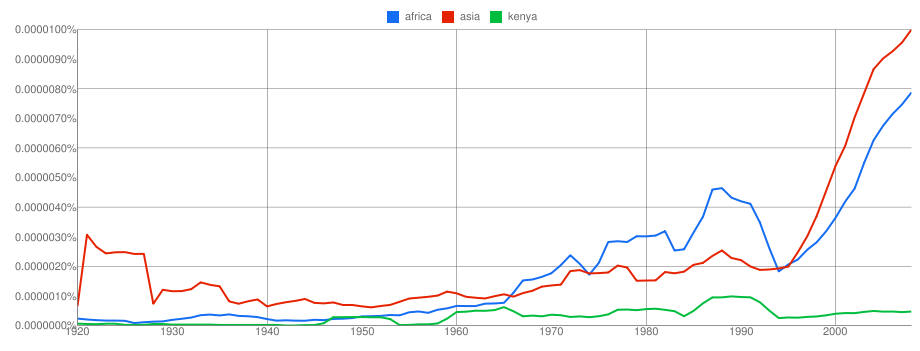
Google has digitized more than 5 million books in a project that also enables users to track changes in scholarly attention to particular topics. I did a few searches and came up with these results. They obviously do not mean much and are only useful in knowing what scholars paid more attention to at any given time.

There was a time when Africa was cooler than Asia


Positive trends: investment outbids aid


institutions beat democracy?


exactly when did the rain start beating africa?

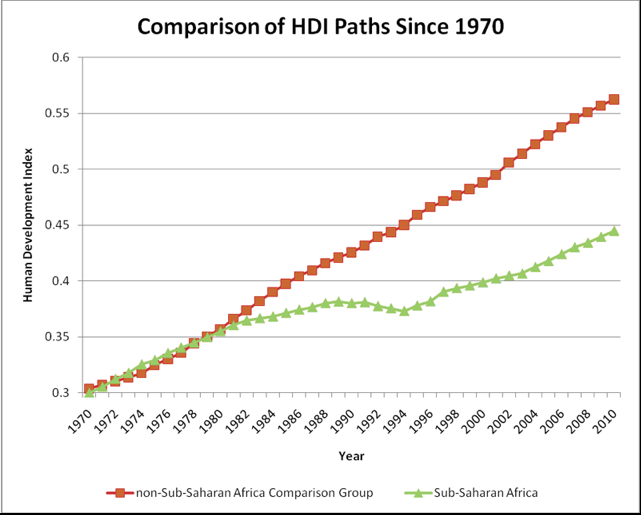
HDI divergence

The new HDI rankings are out. Some in the blogosphere have beef with the new geometric (as opposed to additive) method of calculating final scores. I don’t.

Aid Watch’s beef is that:

The biggest change in method was that the new HDI is a geometric average rather than a normal (additive) average. Geometric average means you multiply the separate indices (each ranging between 0 and 1) for income, life expectancy, and education together and then take the cube root (I know your pulse starts to race here…)

Now, students, please notice the following: if one of these indices is zero, then the new HDI will be zero, regardless of how great the other indices are. The same mostly applies if one of the indices is close to zero. The new HDI has a “you’re only as strong as your weakest link” property, and in practice the weakest link turns out to be very low income (and guess which region has very low income).

My two cents on this discussion is that the Continent looks bad irrespective of how we arrive at its HDI scores. It’s best performers are tiny Botswana and Mauritius. It’s biggest countries and potential engines for growth are the DRC, Ethiopia and Nigeria, need I say more? And per capita income has not changed in most places in half a century.

I rarely disagree with Easterly but on this count I do. Let’s not shift posts for Africa. The idea of “African Standards” is condescending and demeaning to Africans. Norway and Chad look like they are eons apart. If the numbers reflect that fact so be it.

I hope this year’s report embarrasses the African ruling elite enough to wake them up from their stupor (come on, I am allowed one wishful thought per post).

More on this here and here. For a summary of this see Blattman.

more from wikileaks

The Guardian reports:

The oil giant Shell claimed it had inserted staff into all the main ministries of the Nigerian government, giving it access to politicians’ every move in the oil-rich Niger Delta, according to a leaked US diplomatic cable.

Nice. Friedman was right. Firm’s only social responsibility should be to make profits. Forget about the population and the destroyed lives.

Also,

US diplomats fear that Kenya could erupt in violence worse than that experienced after the election in 2008 unless rampant government corruption is tackled.

America asked Uganda to let it know if its army intended to commit war crimes based on US intelligence – but did not try to prevent war crimes taking place.

Washington’s ambassador to the troubled African state of Eritrea described its president, Isaias Afwerki, as a cruel “unhinged dictator” whose regime was “one bullet away from implosion”.

Still (im)patiently waiting for the stuff on the Kenyan elections in 2007.

And lastly,

Apparently based on a conversation with Johnnie Carson, the US assistant secretary of state for African affairs, it said: “China is a very aggressive and pernicious economic competitor with no morals. China is not in Africa for altruistic reasons. China is in Africa for China primarily.”

Yeah right. Because the US involvement in Africa since the 1960s has been any different. At least the Chinese do not bother to be janus-faced about it [ok, that is a little too harsh, but you get my point].

the good news from africa, and their implications

The photo in the flyer says it all:

John Prendergast with two anonymous African children

John Prendergast is Jesus the bearer of good news and presumably a savior, through his tireless advocacy work, of the many African victims of fate, their governments and endless conflicts. It must feel good being the anonymous kids being used to massage a humanitarian worker’s ego in flyers like this one.

Mr. Prendergast, co-founder of the enough project, gave a talk this afternoon (I only attended the first part of the talk because of TA duty) at Stanford on the positive developments on the Continent and the state of the conflicts in central Africa. For more of what he does see Texas in Africa.

health and governance conference at Stanford

This weekend the Stanford Student Forum for African Studies is hosting a conference on health and governance in sub-Saharan Africa. If you are in the bay area feel free to show up for any of the panel discussions.

More information here.

the demographic origins of poverty and statelessness

A very low population density may be at the heart of Africa’s historical under-performance when it comes to territorial state-formation and economic development. Bad geography, the very high disease burden and mediocre leadership, among other variables, may be but secondary causal explanations for Africa’s underdevelopment. The proximate cause may be how these secondary variables have affected and/or interacted with population density.

OK. That was a weak argument, but check this out.

the ingredients of development

I am in the middle of writing a piece contrasting a subset of African and non-African dictatorships over the last half century. As most of you might know, quite a number of African countries have been mournfully commemorating celebrating 50 years of independence from European empires. Many of them, including the behemoth and perennial under-achiever that is Nigeria, have almost nothing to show for over half a century of self-rule. Disease, endemic poverty, general political and socio-economic stuntedness are what come to mind when one thinks of these places, and with good reason. Look at the latest UN HDI report if you think that Africa’s bad press is nothing but unfair afro-pessimism.

And keeping with the theme of development, here is a blog post that I really liked about Botswana, a country that many like to cite as Africa’s success story.

Lastly, a brief lesson on the Political Economy of Development.

zimbabwe is more than just afloat these days

As this piece in the Economist reports, Zimbabwe is slowly emerging from the hole that Mugabe and his men run it into. The pragmatic Tsvangirai and his MDC supporters appear to have decided that confronting the old man on every issue is a losing war and opted to placate him in the short run for long term gains. Importantly, Tsvangirai has strove to earn the confidence of Jacob Zuma, the South African president who is the de facto regional leader.

That Robert Mugabe is in the twilight of his despotic career is a given. What Tsvangirai and his men (and women, TIA) should be worried about is his cabal of leeches supporters who have continued to milk the country dry even as thousands of their fellow citizens died under crashing poverty and government brutality. These are the people in the way of Zim’s future.

the mdgs

Since everyone is currently talking about the MDGs and how they may or may not be achieved on time here is a nice piece from Bill Easterly.

According to an Oxfam study, eliminating US cotton subsidies would “improve the welfare of over one million West African households – 10 million people – by increasing their incomes from cotton by 8 to 20 per cent”.

I may not always agree with Bill but I think his basic approach to development is spot on. Just like in most human endeavors (politics, economics, sports) systems based on human goodwill are bound to fail while those based on self-interestedness thrive. There is no magic bullet in development, but there is definitely a better approach than is currently being employed. Lets not forget that aid is supposed to eventually lead to self-reliance.

It is already clear that the goals will not be met by their target date of 2015. One can already predict that the ruckus accompanying this failure will be loud about aid, but mostly silent about trade. It will also be loud about the failure of state actions to promote development, but mostly silent about the lost opportunities to allow poor countries’ efficient private business people to lift themselves out of poverty.

Bono has a slightly less realistic more hopeful take on the progress towards achieving the MDGs.