will the world sit and watch as ivorians massacre each other?

Laurent Gbagbo appears set to plunge his country back into civil war.

FP reports:

For the last several months, the Ivory Coast has been crawling back to civil war. Now, both sides are actively bulking up their forces in what looks like an alarming calculation that this country’s crisis will get worse before it gets better.  The Ivory Coast has been divided between a rebel-controlled north and a government-controlled south for the last decade. The fragile detante that restored peace in 2005 is shattering. Thousands upon thousands are fleeing the capital today in fear of exactly that.

In the southern city and capital of Abidjan, “thousands” of youth have joined the army, heeding a call from outgoing President Laurent Gbagbo, the man who lost November’s presidential election. The drive has been led by Gbagbo’s notoriously militant youth minister, Blé Goudé, who is under U.N. sanctions for violating the country’s peace agreement and impeding the U.N. peacekeeping missionin the country. He told Reuters, “Our country is under attack, so we’re organising ourselves to re-establish order … The legal way to do it is to put them in the regular army.”

Mr. Gbagbo lost an election late last year to challenger Alassane Ouattara but has refused to step down despite mounting international pressure. Most of the world, except Angola, Zimbabwe and a few autocratic presidents here and there, have condemned his refusal to step down.

Angola and Zimbabwe are arming Gbagbo. He is also busy recruiting militias within Abidjan and in neighboring Liberia. Mr. Ouattara, his challenger and Cote d’Ivoire’s legitimate president, has the backing of Forces Nouvelle, the rebel outfit that has controlled northern Cote d’Ivoire for most of the last 10 years. A blood bath between the two forces appears inevitable.

So what can be done? The AU’s mediation efforts have failed. The UN mission in Abidjan has been sloppy. ECOWAS, the regional bloc remains divided over the Ivorian issue. Confusion reigns. At the onset of the crisis most of those concerned wanted to avoid any conflict. But that calculus is already off the table. Now it is not whether there will be conflict, but how bad it will get. I say it is about time ECOWAS sent in troops (despite Ghanaian opposition) to take out Gbagbo before he becomes too entrenched in Abidjan.

This will be a lot less costly than waiting to send in a peacekeeping mission after hundreds of thousands have died.
 

cocoa exports and help from angola, zimbabwe keeping gbagbo afloat

Zimbabwe and Angola have been cited by UN investigators as violators of the standing arms embargo against the Ivorian despot Laurent Gbagbo. Mr. Gbagbo refused to leave office after losing to challenger Alassane Ouattara in elections last year.

Now it emerges that despite the ban on cocoa exports the Gbagbo faction in Abidjan continues in the trade. Africa confidential reports that:

Trade sources in Moscow and London report that business allies of Laurent Gbagbo have begun exporting cocoa out of the port of San Pedro in defiance of President-elect Alassane Dramane Ouattara’s export ban. Last month, the officially recognised President called for the ban, which he has extended to the end of March. He promised action against traders who violate the ban, which has the United Nations’ backing, and all the major buyers have complied. The European Union has forbidden any EU-flagged vessel from lifting cocoa. The export ban will carry on into April, we hear.

A key player in Gbagbo’s operation is Ali Lakiss, the Lebanese Managing Director of the Société Amer et Frères Cacao (SAF-Cacao), the biggest locally-owned cocoa company, who manages the exports, say European-based traders. We hear Lakiss is close to Simone Gbagbo, wife of the losing presidential candidate, who has major interests in the cocoa business. These efforts may help Gbagbo’s finances but his military position is steadily worsening

And in a somewhat positive twist, factions appear to have emerged within Gbagbo’s election-stealing coalition.

Rumours swirl around the military that the fighters who tried to storm Army Chief General Phillipe Mangou’s house on 14 March were dissidents from his own forces – rather than the pro-Ouattara ‘invisible commandos’ some had blamed. Some think dissatisfied generals could have encouraged the attack on Mangou: he criticised the army’s killing of six women in a demonstration in the Abobo suburb of Abidjan, two weeks ago. His remarks further damaged relations with the generals who are really in control.

This is good news. The international community must continue its stare-down of Gbagbo.

This should be a lesson to the kleptocratic, ideologically bankrupt and woefully inept autocrats all over the African continent that elections have consequences.

On the less sanguine side of things, and as pointed out by Africa Confidential, a military takeover by Gbagbo’s generals might be ominous for the prospects of democracy in Cote d’Ivoire. The generals might not necessarily be willing to hand over power to Ouattara.

With every day that passes the land of the late Felix Houphouet-Boigny seems to be inching closer and closer to an ineluctable civil war.

the au, without a regional hegemon, is toothless

On March 10th, 2011 the African Union (AU) declared Alassane Ouattara as the legitimately elected president of Ivory Coast. Outgoing president Laurent Gbagbo (who insists he won the poll) responded by ordering his soldiers to kill supporters of Mr. Ouattara.

Now the ball is back in the AU’s court. So far the regional body appears to be at sixes and sevens, unsure of how to react. Lacking a regional hegemonic benefactor, the AU has over the years been mostly bark and no bite. Its leadership reflects the confusion and ineptitude that characterize the Continental body. One of its recent leaders is Muamar Gaddafi. Presently it is led by Teodoro Obiang Nguema Mbasogo, dictator of Equatorial Guinea and this idiot’s guy’s dad.

Mr. Gbagbo has refused to step down or be part of a unity government led by Mr. Ouattara, as demanded by the AU. Increasingly isolated, he has nationalized the cocoa industry in a desperate attempt to get some cash to pay his loyalists. Cote d’Ivoire produces 40% of the world’s cocoa. He is also reported to be receiving help from Robert Mugabe of Zimbabwe and Angola’s Jose Edwardo do Santos.

In an ideal world South Africa or Nigeria or even Ethiopia would have provided leadership and force whenever needed to ensure that AU resolutions are enforced. But Pretoria has a president in Zuma who shows no interest in foreign policy; his handling of the Zimbabwe crisis speaks volumes. Abuja is a mess, period and Ethiopia has first to eradicate famine before it can venture anywhere beyond Somalia.

Without an enforcement mechanism and a regional hegemonic benefactor, the AU’s resolutions will continue to be nothing but hot air.

the African Union and its problems

The just concluded AU summit in Addis Ababa, Ethiopia had two key problems to address: the political crisis in Ivory Coast and the legal battles involving six Kenyans who face charges at the ICC. So far the continental body appears to have failed on its attempts to address both problems.

In the Ivory Coast, Mr. Gbagbo’s camp has already declared that the five person panel formed by the AU is dead on arrival unless Burkinabe president, Compraore is dropped. The Daily Nation reports:

The president of Burkina Faso, named on a high-level African Union panel tasked with settling Cote d’Ivoire’s leadership crisis, is “not welcome” in this country, a top ally of strongman Laurent Gbagbo said here yesterday.

And in Kenya, the political football involving the setting up of a credibly clean local judicial system to try perpetrators of the 2007-8 post election violence diminished the prospects of a deferral from the UN Security Council. Kenya must guarantee that it will try the suspects for the ICC to consider a deferral. It does not help that the appointment of high members of its judiciary, including the chief justice, the attorney general and the director of public prosecutions has already been soiled by political grandstanding.

Will Bashir pay for “losing the south”?

Omar Bashir faces a tough few days ahead. More than 99% of Southern Sudanese voted for secession in the just concluded referendum, effectively guaranteeing the split of Africa’s biggest country in July of this year. Many in the North blame Bashir for losing the South. The waves of protests in the Middle East following the Jasmine Revolution in Tunisia is adding fuel to the flames. The Independent reports:

Violent clashes broke out at two Khartoum universities yesterday as heavily armed police surrounded stone throwing students. Social media groups similar to those used elsewhere in the Arab world to mobilise protesters have started to mushroom in northern cities.

One of them calling itself “Youth for Change” has attracted 15,000 members to its Facebook page. “The people of Sudan will not remain silent anymore,” it says. “It is about time we demand our rights and take what’s ours in a peaceful demonstration that will not involve any acts of sabotage.”

Security forces arrested Hussein Khogali, the editor of al-Watan newspaper, whom they accuse of orchestrating the online protests.

And in other news, the African Union summit opened on Sunday with the Ivory Coast top of the agenda. The Continental club of autocrats body agreed to set up a five member panel to continue negotiations with Laurent Gbagbo, the Ivorian president who lost an election but refuses to step down. Also on the AU’s agenda is Kenya’s misguided attempts at battling the ICC through threats of en masse pullouts from the Rome treaty by African countries.

The failure to force Gbagbo out of power and the ill-fated fights with the ICC are additions to the litany of failures that make most on the Continent question the relevance of the AU. In my opinion regional bodies are only as strong as their dominant members. With South Africa continuing to be disinterested in regional matters and Nigeria being Nigeria the AU is guaranteed to remain rudderless into the foreseeable future.

gbagbo living on borrowed time

The Central Bank of West African States has signaled the beginning of the end of Laurent Gbagbo’s attempted auto-coup. The BBC reports that the regional reserve bank has denied access to Mr. Gbagbo and his cronies. It is only a matter of time before unpaid soldiers switch alliances and pledge their allegiance to the man that can deliver the paycheck, Mr. Ouattara. Or so I hope.

Mr. Gbagbo lost Cote d’Ivoire’s presidential election to opposition challenger Alassane Ouattara but refused to step down. The international community has thrown its weight behind Mr. Ouattara as the legitimate president. Both men have named their respective cabinets and remain holed up in the commercial capital Abidjan.


Crisis in Cote d’Ivoire

The BBC reports:

The UN’s secretary-general has warned there is a “real risk” of a return to civil war in Ivory Coast after the disputed presidential election.

Ban Ki-moon said the incumbent, Laurent Gbagbo, was illegally trying to expel the UN’s peacekeeping force after it recognised Alassane Ouattara as victor.

The UNSC should pass a resolution preemptively holding incumbent Laurent Gbagbo personally responsible for any deaths that occur because of his refusal to leave office. Already dozens have died in riots in the Ivorian commercial capital of Abidjan. Mr. Gbagbo lost to Mr. Alassane Ouattara by 8 points.

Since then the world’s biggest exporter of cocoa has been in a state of limbo, with both men swearing themselves in as president. The UN and the wider international community have recognized Mr. Ouattara as the duly elected president of Cote d’Ivoire.

countdown to wednesday begins

On Wednesday a few Kenyan cabinet ministers, wealthy businessmen and security chiefs – mostly from central Kenya and the Rift Valley – will be exposed as suspects behing the post election violence in 2007-08 that killed 1333 Kenyans and displaced hundreds of thousands. Needless to say, this will have significant political consequences.

The expected political realignments following the initiation of this phase of the ICC process will shed some light on what Kenyans should expect come 2012. It will also be a litmus test on how much the Kenyan political elite is committed to reforms and fighting impunity. Kibaki and Odinga will either have to defend or cut loose some of their most trusted lieutenants.

In other news Laurent Gbagbo is still refusing to relinquish power in the Ivory Coast. Moreno Ocampo should warn him that if any more people die as a result of his refusal to obey the electoral outcome he will be held responsible.

Elections have consequences.


gbagbo declares himself winner

Update:

The BBC reports that both Alassane Ouattara and Laurent Gbagbo have sworn themselves in as president. It is becoming ever more apparent that Cote d’Ivoire is on the edge of plunging back into civil war.

Laurent Gbagbo, through Cote d’Ivoire’s constitutional council, has declared himself winner of the Sunday presidential runoff. Ivory Coast’s independent electoral commission and UN and other observers continue to maintain that Alassane Ouattara, the opposition candidate, won the election with 54% of the vote.

The ethnic arithmetic of the election disfavored the incumbent Mr. Gbagbo (a Bete, 6%) after the third place candidate, former president Konan Bedie (a Baoule, 23%) endorsed Mr. Ouattara (a Dioula, 1.4% but who also commands most (up to 90%) of the northern Muslim vote).

Gbagbo should not be allowed to get away with this. Cote d’Ivoire’s election was not a close call. Ouattara won, fair and square. If any unity government is formed Mr. Gbagbo can only be a junior partner in it.

Needless to say this outcome may plunge the country back into civil war, mostly along the same ethnic and regional contours as in 2002-04.

More on this on the BBC website.

ouattara won, but gbagbo determined to latch on to power

The Ivorian electoral commission declared Alassane Ouattara, the northern candidate, as the winner of the presidential runoff held on Sunday. Ouattara got 54.1% of the vote. Incumbent Laurent Gbagbo disputed the results and had the country’s constitutional court reject the pronouncement. His supporters contend that there were significant irregularities in three regions in the north of the country.

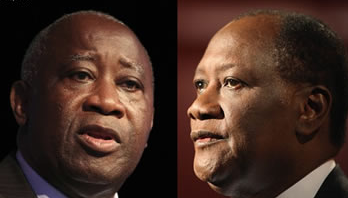
Gbagbo (left) and Ouattara

UN and other mission observers declared that the election globally reflected the will of the people of Cote d’Ivoire. The BBC reports that the country’s military has sealed the borders amid rising tension and confusion over the political stalemate in the country. Mr. Gbagbo has been president since 2000.

For the sake of institutionalism the international community should not allow Mr. Gbagbo to remain in power. His 10-year tenure has not done much in terms of healing relations between the two halves of the country that fought the 2002-04 civil war. The fact that even his incumbency advantage could not help him beat Ouattara signals his general incompetence and the mass’s disaffection with his rule.

Cote d’Ivoire has a population of 21 million people, 49% of whom live in urban areas. Life expectancy in the country is a dismal 56 years. Only 48% of Ivorians  age 15 and over are literate. Ivorians’ per capita income is US $1700 and 68% of them depend on agriculture for livelihood. 42% of Ivorians live below the international poverty line of $2 a day.

Cote d’Ivoire is the world’s largest producer and exporter of cocoa beans and a significant producer and exporter of coffee and palm oil. Because of the political risk in the country Cocoa for March delivery climbed $110, or 4 percent, to $2,868 in New York.

laurent Gbagbo might have lost to Ouattara

There are no prizes for guessing why the government of Ivory Coast is delaying the release of provisional results from Sunday’s presidential runoff. It is almost certain that the challenger, Alassane Ouattara, won against Laurent Gbagbo, who has been dictator president since 2000. Mr. Gbagbo, seeming desperate, has already indicated that he will challenge results from three regions in the north.

I will post the provisional results as soon as I get an inkling of what they look like.

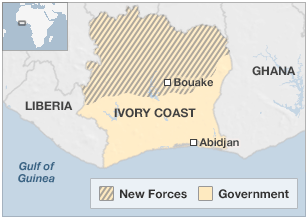
Map of Cote d'Ivoire

The Ivorian civil war (2002-2004) split the country in two, with the rebels (New Forces) controlling the north. Mr. Ouattara is from the north while Mr. Gbagbo is from the south.

The BBC reports that the main election observer missions in the country had no problems with how the election was conducted in the north.

The information vacuum has fueled security uncertainty and speculation. The Daily Nation reports:

“People are going a bit crazy. There are hundreds of rumours of violence so the atmosphere is rather tense,” said Marcel Camara, 37, hunkered down with his aunt and two cousins at their home in the Abobo district of Abidjan, where a curfew has been in force since Saturday.

crucial elections in west africa

The Ivorians have a runoff election tomorrow while the Guineans (Guinea-Conakry) get to find out who will be their president on December 2nd.

The Ivory Coast is still trying to recover from the disastrous turmoil and civil war that visited her following the death of founding president Houphouet Boigny. The civil war split the country in two, with the southerners (actually just nationalist Abidjanites) accusing most northern politicians of being foreigners. Among the said “foreigners” is the challenger in tomorrow’s election, Alassane Ouattara. Mr. Ouattara hopes to unseat Mr. Laurent Gbagbo who has been in power since 2000.

In Guinea the loser in the runoff went to the supreme court to challenge the results. The country is one of the more unstable places on the continent with a military that is lacking in discipline professionalism.

Out of the many trouble spots in West Africa at the turn of the century, Guinea (Conakry), Guinea-Bissau, Ivory Coast and Niger are the main laggards slowing down the region’s match towards political stability, irrespective of regime type.

togo goes to the polls

Togo, a tiny West African country of 6.6 million, goes to the polls today. Faure Gnassingbe, President of Togo and son of the late strongman Gnassingbe Eyadema, is hoping to be re-elected for a second term. His father ruled the country uninterrupted between 1967 until his death in 2005. The younger Gnassingbe was then installed by the military as interim president before elections were held. Most observers believe that these elections were not free and fair. Many hope that this time round things will be different.Yeah right.

African democracy’s teething problems will not go away just yet. 2010’s busy elections schedule will surely bring some of these problems to the fore. The top four to watch include the elections in Rwanda, Ethiopia, Madagascar and Ivory Coast. Paul Kagame will most certainly win in Rwanda, but the question is how much room he will give the opposition this time round. Mr.Kagame has been president since his forces ended the Rwanda genocide in 1994 and has been touted to be among the more economically liberal strongmen on the Continent (he is no Tutu but he is good for business). In Ethiopia Meles Zenawi’s party, Ethiopian People’s Revolutionary Democratic Front (EPRDP), is also expected to win. Mr. Zenawi has been in power since he deposed the tin pot despot Mengistu Haile Mariam in 1991. Here too it remains unclear just how much opposition Mr. Zenawi will tolerate in parliament.

Madagascar, as you may remember had a coup in March of last year. It will be interesting to see who emerges as winner in this election. The contest is between the factions led by former DJ and mayor of Antananarivo Andry Rajoelina and the man he kicked out of office Marc Ravalomanana.The political instability in this island country off the east coast of the Continent has not gone without economic consequences.

Ivory Coast, once a paragon of stability in West Africa, is also holding elections this year. This year’s polls were originally planned to be held in 2005 before a bloody civil war that divided the country in half got in the way. The land of Houphouet-Boigny has not known peace and stability since the strongman’s passing in 1993. Mr. Houphouet-Boigny was president between 1963 until his death in 1993. Among his accomplishments was the relocation of the capital of Ivory Coast to Yamoussoukro, his home town, and the construction there of the US $ 300 million Basilica of Our Lady of Peace (which the Guinness Books of records lists as the largest church in the world).

shame on the Ivorian government

The BBC has this really sad story about the dumping of chemicals in Abidjan, Ivory Coast by Trafigura, an oil trading company.

The story reveals that the company  knew about the harmful effects of the chemicals. Internal emails contained messages like:

This operation is no longer allowed in the European Union, the United States and Singapore” it is “banned in most countries due to the ‘hazardous nature of the waste

And yet the Ivorian government allowed its citizens to be exposed to the waste from Trafigura. Shame shame shame.