Africa’s looming debt crises

The 1980s are calling. According to Bloomberg:

Zambia’s kwacha fell the most on record after Moody’s Investors Service cut the credit rating of Africa’s second-biggest copper producer, a move the government rejected and told investors to ignore…..

Zambia’s economy faces “a perfect storm” of plunging prices for the copper it relies on for 70 percent of export earnings at the same time as its worst power shortage, Ronak Gopaldas, a credit risk analyst at Rand Merchant Bank in Johannesburg, said by phone. Growth will slow to 3.4 percent in 2015, missing the government’s revised target of 5 percent, Barclays Plc said in a note last week. That would be the most sluggish pace since 2001.

The looming debt crisis will hit Zambia and other commodity exporters hard. As I noted two years ago, the vast majority of the African countries that have floated dollar-denominated bonds are heavily dependent on commodity exports. Many of them are already experiencing fiscal blues on account of the global commodity slump (see for example Angola, Zambia and Ghana). This will probably get worse. And the double whammy of plummeting currencies and reduced commodity exports will increase the real cost of external debt (on top of fueling domestic inflation). I do not envy African central bankers.

Making sure that the looming debt crises do not result in a disastrous retrenchment of the state in Africa, like happened in the 1980s and 1990s, is perhaps the biggest development challenge of our time. Too bad all the attention within the development community is focused elsewhere.

Mbembe on the State of South African Politics

Rainbowism and its most important articles of faith – truth, reconciliation and forgiveness – is fading. Reduced to a totemic commodity figure mostly destined to assuage whites’ fears, Nelson Mandela himself is on trial. Some of the key pillars of the 1994 dispensation  – a constitutional democracy, a market society, non-racialism – are also under scrutiny. They are now perceived as disabling devices with no animating potency, at least in the eyes of those who are determined to no longer wait. We are past the time of promises. Now is the time to settle accounts.

But how do we make sure that one noise machine is not simply replacing another?

That is Wits professor Achille Mbembe writing on the state of politics in South Africa. The whole piece is definitely worth reading (also liked this response from T. O. Molefe).

Economic elites in South Africa (both black and white) are playing with fire. The lessons of Zimbabwe were not learned. The implementation of Mugabe’s land reform project was a disaster, but there is no question that the levels of land inequality in Zimbabwe were simply politically untenable. Something had to give.

One need not be against everything neoliberal (whatever that means) to acknowledge that the same situation holds in South Africa, and that something will have to give. Consider Bernadette Atuahene’s observations on the land situation in South Africa:

When Nelson Mandela took power in South Africa in 1994, 87 percent of the country’s land was owned by whites, even though they represented less than ten percent of the population. Advised by the World Bank, the ruling African National Congress (ANC) aimed to redistribute 30 percent of the land from whites to blacks in the first five years of the new democracy. By 2010 — 16 years later — only eight percent had been reallocated.

In failing to redistribute this land, the ANC has undermined a crucial aspect of the negotiated settlement to end apartheid, otherwise known as the liberation bargain. According to Section 25 of the new South African constitution, promulgated in 1994, existing property owners (who were primarily white) would receive valid legal title to property acquired under prior regimes, despite the potentially dubious circumstances of its acquisition. In exchange, blacks (in South Africa, considered to include people of mixed racial descent and Indians) were promised land reform.

Rapid economic growth and mass job creation could have masked the structural inequalities that exist in South Africa. Instead the country got Jacob Zuma and a super wealthy deputy president (and BEE beneficiary), both of whom are singularly out of touch with the vast majority of South Africans.

There is no doubt that South Africa needs a complete reorganization of its political economy. The question is whether the process will be managed by a “moderate” outfit like the ANC; or whether leaders will continue to sit on their hands and allow voices of less moderate groups like the Economic Freedom Fighters to gain traction.

ps: Just in case it is not obvious, South Africans are unambiguously better off now — as a people — than they were under apartheid rule.
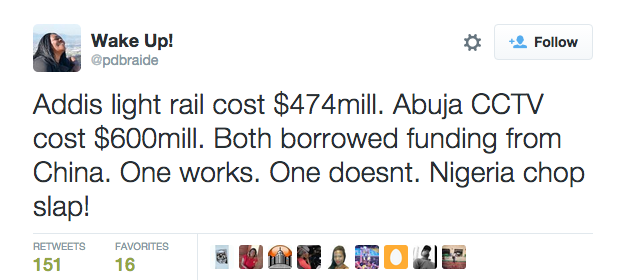
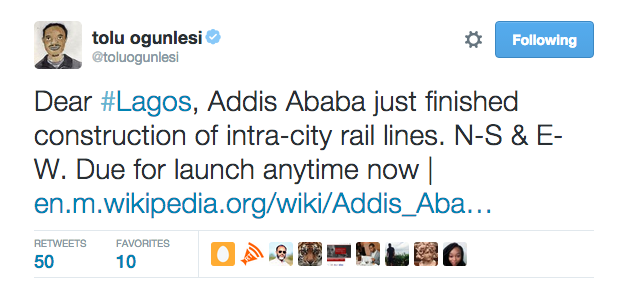
What roughly $470m of borrowed money gets you in Nigeria vs Ethiopia

Ethiopia and Nigeria both borrowed roughly the same amounts of money from China’s EXIM Bank for massive infrastructure investments. The former sought to transform its capital’s transit system with a light rail ($475m); the latter tried to boost security in its capital by installing security (CCTV) cameras ($470m).

The outcomes of the two projects are an indication of what will be the impact of China’s ongoing infrastructure projects in much of SSA. Some countries because of the specificities in their domestic political economy are using borrowed money to deliver on actual tangibles — dams, power lines, stadia, housing projects, railway lines, roads, et cetera (corruption plays a role, but projects get completed). Yet others are accruing loans (albeit on concessionary terms) simply to treat the cash injections in the same manner that political elites have treated windfalls from mineral resources in decades past.

Ethiopia just opened its new light rail system in Addis. Nigeria’s CCTV project was a major flop. Of course this fact was not lost on a section of Nigerians on twitter:

Screen Shot 2015-09-21 at 3.04.19 PM

Screen Shot 2015-09-21 at 3.06.44 PM

Thoughts on the latest coup in Burkina Faso

The Daily Nation reports:

Burkina Faso’s presidential guard declared a coup Thursday a day after seizing the interim president and senior government members, as the country geared up for its first elections since the overthrow of longtime leader Blaise Compaore.

Lieutenant-Colonel Mamadou Bamba appeared on national television to declare that a new “National Democratic Council” had put an end “to the deviant regime of transition” in the west African state.

Announcing the coup, Bamba said that “wide-ranging talks” were being held to form a government leading to “inclusive and peaceful elections.” Presidential guard members linked to ex-leader Compaore had burst into a cabinet meeting Wednesday and seized acting president Michel Kafando, prime Minister Isaac Zida and two ministers. Zida was himself once an officer in Compaore’s powerful Presidential Security Regiment (RSP), before he toppled his old boss after days of street protests in October 2014.

This is the second coup in Burkina Faso in a year, sinking the country deeper into the coup trap (see here and here for brief takes on last year’s coup). Blaise Compaore’s former Chief of Staff, Gen Gilbert Diendere, has declared himself the new head of a military government in Ougadougou.

The coup raises two important questions about the transition process following last year’s coup:

  • Were elections planned too soon?
  • Was it wise for the constitutional court to completely sideline allies of Compaore from government despite the fact that they still wielded considerable de facto power (especially within the armed forces?)

Obviously the international community wanted to exit the scene as soon as possible. And elections provide a nice and easy way to do so. The practice stems from a perverse fetishization of elections as a generator of legitimacy, accountability, and stability. As a student of legislatures in Africa, one of the main takeaways from my work is that we (the international community, development professionals, academics) continue to ignore the role of intra-elite politics (and accountability chains) at enormous cost. We know that the biggest threat to rulers comes from regime insiders and fellow elites. We also know that revolutions and mass protests that topple bad leaders are rare events. So why do we continue to bury our heads in the sand and imagine that voters are the magical answer to problems of weak governance and elite political instability.

This is not to say that elections (i.e. mechanisms that reinforce vertical accountability) are completely useless. Rather, it is a reminder that elections should be designed to serve the dual purpose of keeping elites accountable and strengthening, rather than weakening, systems of intra-elite accountability. The historical experience in Africa and elsewhere and the logics of collective action demand this.

How is the world reacting to China’s rise?

China has experienced a spectacular economic growth in recent decades. Its economy grew more than 48 times from 1980 to 2013. How are the other countries reacting to China’s rise? Do they see it as an economic opportunity or a security threat? In this paper, we answer this question by analyzing online news reports about China published in Australia, France, Germany, Japan, Russia, South Korea, the UK and the US. More specifically, we first analyze the frequency with which China has appeared in news headlines, which is a measure of China’s influence in the world. Second, we build a Naive Bayes classifier to study the evolving nature of the news reports, i.e., whether they are economic or political. We then evaluate the friendliness of the news coverage based on sentiment analysis. Empirical results indicate that there has been increasing news coverage of China in all the countries under study. We also find that the emphasis of the reports is generally shifting towards China’s economy. Here Japan and South Korea are exceptions: they are reporting more on Chinese politics. In terms of global sentiment, the picture is quite gloomy. With the exception of Australia and, to some extent, France, all the other countries under examination are becoming less positive towards China.

That’s Yuan, Wang and Luo writing in a neat paper that analyzes news coverage of China in different countries.

More on this here (HT Jay Ulfelder).

On the Continent opinion survey data from a select set of countries show high favorability ratings for China — by about two thirds or more of survey respondents. The same countries have seen some decline in US favorability ratings over the last few years. As you’d expect, people’s reaction to China’s rise is based on perceptions of the potential material impact it will have on their lives. On average, the survey evidence suggests that most Africans view China’s rise as a good thing.

It is interesting that across the globe young people, on average, have a more positive view of China’s rise than older people. Younger people probably associate China more with glitzy gadgets in their pockets; and less with cultural revolutions and famine-inducing autocracy.

How to increase mass employment in Nigeria (and other developing countries)

David Mckenzie of the Bank writes:

The modal firm size in most developing countries is one worker, consisting of only the owner of the firm. Amongst the firms that do hire additional workers, most hire fewer than ten. In Nigeria survey data indicate that 99.6 percent of firms have fewer than 10 workers. This is in sharp contrast to the United States, where the modal manufacturing firm has 45 workers. Are there constrained entrepreneurs in developing countries with the ability to grow a firm beyond this ten worker threshold? If so, this raises the questions of whether such individuals can be identified in advance, and of whether public policy can help them overcome these constraints to firm growth.

In an attempt to figure out if policy can help grow firms in developing countries, Mackenzie evaluated a program in Nigeria that awarded 1,200 winners about $50,000 each (out of an initial application pool of 24,000; the top 6000 applicants were in the study). See a summary here. And the paper is available here.

………. winning this competition has large positive impacts on both applicants looking to start new firms as well as those aiming to expand existing firms. Three years after applying, new firm applicant winners were 37 percentage points more likely than the control group to be operating a business and 23 percentage points more likely to have a firm with 10 or more workers, while existing firm winners were 20 percentage points more likely to have survived, and 21 percentage points more likely to have a firm with 10 or more workers. Together the 1,200 winners are estimated to have generated 7,000 more jobs than the control group, are innovating more, and are earning higher sales and profits.

Two quick thoughts. First, this is a really cool finding that should get African central bankers excited about how the financial sector can be put to use in boosting mass employment. Second, it is a caution against the odd idea prevalent in development programs of trying to turn poor people into entrepreneurs (see below). The best solution to poverty is jobs. Entrepreneurship is a risk that shouldn’t be imposed on people with already super slim margins of error in terms of income security. As Mckenzie rightly observes:

The results of this evaluation show that a business plan competition can be successful in identifying entrepreneurs with the potential to use the large amounts of capital offered as prizes, and that these individuals appear to be otherwise constrained from realizing this potential. The prize money generates employment and firm growth that would not have otherwise happened. However, the results also highlight the difficulties of picking winners. Conditional on reaching the semi-finalist stage, neither the scores for the business plans, nor individual and business characteristics have much predictive power for predicting which firms will grow faster or benefit most from the program. This remains an area for active research, but also highlights the inherent riskiness of entrepreneurial activity.

Does Kenya have too many MPs?

An article in the Daily Nation asked this provocative question. In the article, the author examined the cost per capita of legislatures in several countries; and concluded that legislatures in OECD democracies tend to be relatively more representative (seats/million people) as well as cost effective (per capita cost per seat) than their counterparts in the developing world.

Of course, linking per capita income to the density of representation has its pitfalls. An assumption that countries with smaller economies should have smaller assemblies, regardless of population size, implicitly undervalues the political voice (and rights) of citizens of poor countries. At the same time, setting an arbitrary upper bound on the remuneration of legislators (and general resourcing of legislatures) has the potential to limit the continued professionalization of legislatures in emerging democracies. Under-resourced legislatures find themselves in a bad equilibrium of high turnovers, weak institutionalization (lack of experience), inability to check the executive or effectively legislate, and a whole lot of dissatisfied voters who invariably choose to go with erstwhile challengers.

How to break out of this bad equilibrium is one of the key questions I grappled with in my book, Legislative Development in Africa. But I digress…

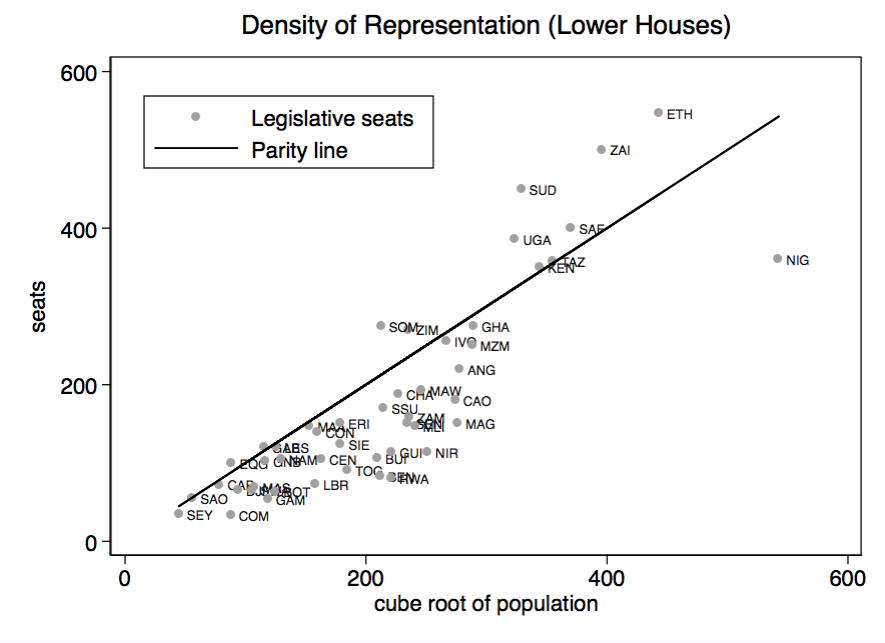
legseatsThe standard metric in Political Science for comparing the density of representation was developed by Rein Taagepera in the early 1970s. The Taagepera formula predicts that assembly sizes tend to approximate the cube root of the total population of states. In the dissertation I looked at how African states faired according to this metric (see figure) and found that the vast majority of countries on the Continent have relatively smaller assemblies than would be predicted by their population sizes (the figure only captures the sizes the lower houses). Somalia, Uganda, Sudan, the DRC, South Africa, and Ethiopia are the clear outliers. Incidentally, Kenya’s National Assembly is right on the parity line.

The usefulness of this metric (at the national level) diminishes beyond a certain population size. For countries with hundreds of millions of people or more, it makes more sense to apply the formula with respect to sub-national assemblies, if they exist. This is for the simple reason that beyond a certain number of seats the legislature would become too big to reasonably be able to conduct its business (see Nigeria).

Pepinsky on what to read in order to write a good dissertation (or book)

Yet it is only possible to read effectively if the thing you are reading is written well. That means that dissertation writers do need to write effectively. And that, in turn, requires dissertation writers to sit down and read books, not for argument, but for style and form and structure. The single most important piece of dissertation writing advice I received was to read more books, and to read them slowly and carefully while actively reflecting on style and structure. “Read this, and then write like that.”

That advice from a decade ago, coupled with several conversations over the past week, has inspired me to put together a collection of books that I think are exemplars of excellent political science writing in book format. That they all happen to be good books too is useful, but not my main point. My point in collecting them here is that these are books to read to learn how to write a good dissertation. Read these, then write like them.

More on this here (must read).

The same applies to papers. It helps to have a folder of “sample papers” to read whenever you experience writer’s block.

Thandika Mkandawire on the “Kenya Debate”

The ‘Kenya debate’ was a debate not among Kenyans but about Kenya by a group of expatriates, most of whom were temporarily resident in Kenya. This may partly explain its abrupt end. Kitching (1985) also suggests that the fact that all the protagonists viewed themselves as progressives precluded the further pursuit of the debate on how a capitalist accumulation process could be promoted.

Ouch. Kenyanists (Kenyan or not) will appreciate the zinger (please bring back economic history!) The quote is from a footnote on page 198.

Mkandawire’s paper on “Thinking About Developmental States in Africa” (not on Kenya) is a must read in any PE class on African development.

A Kenyan Scientist Joins the Worm Wars

For those new to the deworming debate, see here, here, here, here and here (Macartan’s response is worth reading in detail). The famous original deworming study was conducted in western Kenya, so it’s nice to get the perspective of Kenyan scientist Dr. Charles Mwandawiro. Dr Mwandawiro is the Chief Research Officer and Assistant Director of Partnership and Collaboration at the Kenya Medical Research Institute (KEMRI). He writes:

I have studied and seen myself the negative effects chronic parasitic worm infections have on childhood development. Children with severe or recurring infections have impaired growth and cognitive development because the worms lodge in their bodies, stealing the nutrients a child is able to take in. Heavy infections can result in serious clinical disease. To combat infection and give our children a chance at good health, many countries, including Kenya, run school-based mass deworming programmes that have been shown to be a simple and cost-effective strategy to reduce the disease burden of parasitic worms in school-age children, the group at highest risk.

Safe, low-cost drugs are available to treat intestinal worm infections and are the standard of medical care. The World Health Organization (WHO) recommends periodic mass treatment in areas where worm infections are above certain thresholds. Some have challenged this WHO policy, accepting that those who are known to be infected should be treated, but questioning whether the existing evidence base is strong enough to support mass treatment.

Let me say unequivocally: Mass school-based deworming works. Just three years ago, Kenya launched a national deworming program. Prevalence of parasitic worms has been reduced from 35% to 17% and as low as 6% right after a deworming round. Our focus in the National Deworming Programme in Kenya is on the reduction of infection and possibly even elimination of the public health threat of worms.

More on this here.

The WormWars are a fantastic lesson on the complications of policymaking. Contributors have weighed in from different perspectives: Does school-based mass deworming work in reducing the prevalence of parasitic worms?; what is the opportunity cost of deworming kids, thereby improving their developmental prospects?; Does a kid’s health trump everything?; did the Busia intervention increase school attendance?; did the authors adequately address the methodological challenges involved in the study? What is a policymaker to make of all of this?

Because of the complicated nature of the questions involved, the original study is being asked to bear more weight than it can withstand. Like Macartan, I think the focus should be on the school attendance outcomes, which was the primary goal of the original study. This, of course, does not mean we should completely disregard the very important questions relating to the health and developmental prospects of kids in locales with high prevalence rates of parasitic worms. Because of the long-term effects of malnutrition on cognitive development, it is reasonable to make the case that deworming kids should trump most competing uses of resources.

Policymakers, if you can, Please. Deworm. All. The. Kids.

H/T Chris Blattman

A Commentary on Research Priorities in Development Economics

Over at the Bank’s Future Development blog, Princeton Economist Jeffrey Hammer writes:

The Chief Minister posed serious questions that have traditionally been the bread and butter of the economics profession. Unfortunately, we are not even trying to answer them any more. The specific question was “Should I put more money into transport? Infrastructure (power, roads, water)? Law and order? Social services? Or what? And where am I going to get the money?” What questions could be more solidly part of the core of economics than these? Unfortunately none of these were even remotely the focus of the “evidence-based” policy making discussed.

Almost all of the cases analyzed were  single, simple policy “tweaks” that were, first of all, isolated from the broader market context in which they occurred and, second, had no conception of opportunity cost – what we would have to give up to pursue these things? We had an answer to “how to improve a public food distribution system” but even with a precise answer (to whether a tweak would work) we had no idea whether the substantial amount of money funding such a system is a good idea. Maybe the Chief Minister would be better off improving education or road networks or police or rural electricity. Some of these alternative policies could have more impact on food consumption than food distribution if we thought about how the world worked. Getting food to market securely (roads, better cold storage, trustworthy police and safe roads – this is Pakistan, which no one seemed to notice) may increase food availability much more than any tunnel-visioned food program Or not – maybe the food distribution system is better. We just don’t know. And none of us “experts” are trying to find out.

When someone says “we should have more “X” because we have evidence that it works”, the response should be “compared to what?” What should we cut in order to promote your particular interest? My hobby horse these days is more sanitation in South Asia. I should have to defend it against (at least) a few alternatives.

What’s your justification for your latest hobby horse?

My take on the gap highlighted by Hammer is that what is good for reviewers is seldom useful to policymakers. The incentive for academics is to publish. And this will always be reflected in the design and implementation of interventions headed by academics. This is not necessarily a bad thing [For obvious reasons we should firewall academic research from the actual process of policymaking. The latter should be the political process that it is, albeit informed by the former]. I think the widespread acceptance of rigorous evidence-based policymaking has been a net benefit for the developing world. What it means though, is that the “public sector” development research community — i.e. the IMF, the World Bank, & host country research institutes — should do more to ensure that funding for hyper-targeted interventions do not detract from broader macro research (like, when and why did the rain start beating Ghana?)

However, in the long run, developing countries will be better served by having more and more of their own/country-based politically relevant macroeconomists.

This is because answering the types of questions posed by Hammer requires one to also take a political stand (on account of a lack of consensus among economists). Economists who can’t do this will invariably resort to “technical” solutions that can be perceived as “apolitical” by both host governments and the sponsoring foreign development agencies. Again not necessarily a bad thing, just a reflection of the politics of knowledge production.

H/T William Easterly.