More on State Building and the International System

This is a guest post in response to a previous blog post by friend of the blog Matthew Kustenbauder.

Your post highlights the contradictions between today’s human rights regime (which is based on universal concepts of humanity and has its origins in European anti-slavery campaigns and traditions of humanitarianism, and before that debates in Christian theology) and the post-imperial international order (based on the nation state as the fundamental political unit).

Since the rise of nationalism after WWII, new states that were historically part of empires (and thereby incorporated under their systems of law, governance, and trade) have had to make their own way. For most of these states, and especially for the people living within them, the new era of national self-determination has been no more kind than was the Age of Empire. The withdrawal of imperial powers left a vacuum that today’s international system struggles to address with any effect. There are many reasons for this, not the least of which is that it is a fragmented and cumbersome system that gives the impression all states are “equal” — clearly they are not. It also tends to be a forum in which smaller and poorer states invoke language of victimhood in an effort, ironically, to get larger or more wealthy states to step in and do the work that states are meant to do for themselves — namely, govern those residing within their boundaries.

What do I mean by this last point? An illustration by way of anecdote may help clarify. I was recently frustrated watching a BBC World Report special (an outlet for the Bleeding Hearts Industrial Complex that you mentioned in your post) about multinationals and poor working conditions in the developing world. Cotton and chocolate were featured. The reporter investigated big cotton operations in India and cocoa plantations in Cote D’Ivoire. What registered as surprise to the BBC reporter was no surprise to me — He found lots of young women and children working there. But instead of asking why the local government didn’t regulate the industry or why they didn’t enforce the regulations already on the books, he ran off to Switzerland and the UK and America to ask why Nestle and Tommy Hilfiger, etc. don’t monitor their supply chains. I was baffled. This is a classic example of how an international system based on the sovereignty of individual nation states is at odds with universal notions of human rights. In many ways, it is the modern-day replacement for the old global-local tensions that existed between the imperial metropole and its colonies. We might ask, however, whether the current framework in which human rights activism operates is really any better suited to address the ongoing problems that plague developing nations. To my mind’s eye, the focus is on the wrong place … or is at least too focused on the role of businesses and advanced economies and not focused enough on working with multinationals in order to help citizens in poor countries put pressure on their governments to be accountable, competent, and truly sovereign.

The emphasis on human rights by Western governments and development work by NGOs in African countries have, more often than not, undermined the sovereignty of national governments since decolonization. More recently, however, China has emerged as the largest trading partner with many African countries. This is a game changer, not only because the Dragon does not hold human rights sacrosanct, but also because, unlike its Western counterparts, China considers economic growth and trade essential to establishing national sovereignty and the nation-state (not the international community) as the principal guarantor of the well-being of its citizens. The degree to which China can be ‘socialised’ in the ways of the international system, which was after all created by the Great Powers to replace the disintegrating world that western empires had made, remains to be seen. In any event, the long-standing tensions between universal principals of human rights, on the one hand, and the limits placed on intervention into the affairs of one state by another in the name of national sovereignty, on the other, will endure.

=======
Matthew Kustenbauder is a PhD candidate in history at Harvard University.
State-building is not a walk in the park

 “Mauritius’s state building success came on the backs of relentlessly exploited slaves and indentured labourers. Sugar planters compelled the government to ignore mistreatment on sugar estates, implement unreasonable fines and annual passport fees in the name of preventing ‘vagrancy,’ and harass those workers who tried to search for a better life in urban professions. Planters’ actions were expressly designed to subjugate and repress the politically powerless in order to maximise their economic power. Moreover, the fact that class divides coincided with racial difference meant that economic and political contention between elites and labourers on Mauritius became imbued with what was, at times, virulent racism. The worst of these endeavours were related to the planters’ quest to secure an adequate labour supply in the four decades after 1825. Later initiatives, such as railway construction and research and development programmes, were fairly benign. Together, these undertakings transformed the island’s economy and governmental capabilities. In Mauritius, then, one finds something of a developmental paradox: although the long- term consequences of state building have led to a regional ‘miracle’, the way in which the island’s elite and government laid the groundwork for it was normatively reprehensible.”

That is Ryan Saylor writing in the latest edition of Review of African Political Economy.

The paper mostly focuses on the success story that was Mauritian state (capacity) building. But this paragraph is a reminder to those who imagine a whiggish history for much of the developing world to go take a hard, honest look at history.

Throughout most of history, in order to have barons that successfully limited the power of the king or his equivalent (thus creating the roots of post-enlightenment democracy) you needed barons who could extract the life out of peasants. Wars that made states killed lots of young conscripts, confiscated private property and led to the demise of whole peoples’ ways of life (Not all French had French speaking ancestors, for instance). And speaking of the French, they went through lots of republics and dictatorships to become what they are today. Further afield, following its own civil war the institutions of government designed to protect human rights in the US had to look the other way until the 1960s in order to preserve its democracy. In the 20th century, decades of intolerant Kemalist ideological orthodoxy laid the foundation for the Islamic world’s most resilient democracy in Turkey.

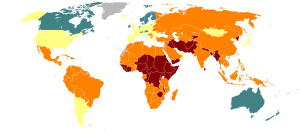
Source Wikipedia. Darker shades indicate state failure.

Source Wikipedia. Darker shades indicate state failure in 2011.

Will Egypt, Rwanda, Kenya and the rest escape these patterns if they are ever to become Denmark, the supposed paragon of liberal democracy?

How does one go about state-building in a modern world with sacrosanct borders and a saner human rights regime?

Recent events in the DRC and CAR confirm the urgency with which we ought to address the question of state-building in the developing world in general, and in Sub-Saharan Africa in particular (see map).

Wars of conquest (which probably would have resulted in Rwanda, Angola and Uganda carving up the DRC) are no longer kosher. Add to that the demands of a tighter and saner human rights regime and you are left with little room to maneuver if you are trying to create an effective state (which occasionally may involve curtailment of political rights). Unless you can somehow insulate yourself from the so called stakeholders, including the International Bleeding Hearts Industrial Complex – like much of east Asia did through the 70s and 80s – you are left with a rather tricky situation of trying to forge a unified state with a million and one centrifugal forces with communal rights backed by threats of donor sanctions. The same system ensures that every rebel group that can cobble together a few guns gets to sit at the table (see Sudan, Mali, Burundi, DRC, CAR, Chad). The UN or some Nordic state pays the hotel bills. Western observers and their sponsoring organizations write reports. Some of them meticulously document human rights abuses by rebels and government troops alike.

Meanwhile censuses are never taken. Taxes are never collected. Little economic activity takes place. And millions of people continue to live just a little bit better than they would in some stateless state of nature.

The present international consensus appears to be one that believes in state-building through democracy and institutions. Lived reality for much of world history appears to contradict this consensus. In most cases democracy and the phantom great institutions appear to lag state-building.

The challenge for those of us interested in state-building is to think of ways to go about the effort in a manner that is sensitive to the present human rights regime and structure of the international system. The present urgency, occasioned by widespread human suffering in the less governed spaces of the globe, requires that all reasonable options (including some uncomfortable ones) be put on the table.

There is no way around the basics: Development will take time

I just read Chris Blattman’s response to the UK Prime Minister’s op-ed in the Journal. It reminded me of a lot of the things that I have been reading lately in preparation for my fieldwork (My dissertation will tackle the subject of legislative (under)development in Africa, with a focus on the Kenyan and Zambian legislatures).

Cameron’s sentiments in the op-ed are emblematic of the problems of development assistance. Like in all kinds of foreign intervention, developed states often try to externalize their institutions (and more generally, ways of doing things). These attempts often ignore the lived realities of the countries being assisted.

Forgetting the history of his own country (think autocratic monarchs, monopolies, limited suffrage), Cameron thinks that democracy, human rights and free markets (all great things) will magically create jobs in the developing states of the world. They don’t. In fact, they often lag the job creation process. For development assistance to be effective it must eschew these feel-good approaches to the problem of underdevelopment.

Blattman is spot on on a number of points:

  1. Unchecked leaders are bad for economic development (this is why I am so much into PARLIAMENTS!!!): Also, democracy is NOT synonymous with limited government. Heads of state like Queen Victoria or Hu Jintao or Bismarck or even Seretse Khama were in no measure democrats. However, they ruled under systems with strong (sometimes extra-constitutional) checks to their power. That made a difference.
  2. Institutions rule, yes, but the right kinds of institutions: 1688 moments do not drop out of the sky. They are often preceded by decades if not centuries of civil strife, economic change and plain old learning. Institutional development takes time. Plus each society requires its own unique and appropriate mix of institutional arrangements to meet unique economic and social needs. A procrustean approach to institutional development (embodied in global capacity building) will inevitably fail. Institutional development must never be allowed to be captured by those who think that we can transform Chad simply by having them adopt Swedish institutions.
  3. Growth will require creation of jobs, i.e. industrial development: The poor countries of the world need real jobs for high school-leavers and other less educated people. The present focus on the “sexy” entrepreneurial sectors – whether they are small businesses for the poor or tech hubs for the very highly educated – as the engines for growth in the developing world is misguided. I reiterate, starting a business is a very risky venture that should be left to the wealthy and the occasional dare devil. The poor in the global south need stable 9-5 jobs. Lots of them.

And lastly, where do strong institutions come from? There is no easy answer to this question. What we know is:

  1. History matters: Present countries with a long history of stateness have a better track record of building strong institutions for development. Yes, they may not always be democratic, but countries with a long history of centralized rule have strong states (and institutions) that deliver for their people (for more on this see Englebert and Gennaioli and Rainer).
  2. Democracy does not always create strong institutions: Since 1945 many have chosen to forget the fact that universal suffrage is a pretty recent phenomenon in the political history of the world. For the longest time world polities were ruled by power barons who held de facto power (as opposed to the procedural de jure power in democracies). When democracy came along after the Enlightenment the resulting structures of rule often reflected these de facto configurations of power. Over time institutions in these countries were cemented enough to allow for complete outsiders like say the current president of the United States to be elected without upsetting the balance of power (in another era he would have had to have mounted a coup). This is the challenge of the democratization in the new post-WWII states. How do you make democracy serve the interests of the people, rather that purely that of the elite? How do you use democracy to create strong institutions? Is this even possible? And if not, what other options do we have?

$500 million, and for what?

Congolese go to the polls on Monday, the 28th of November. The result of the election is almost a foregone conclusion. Incumbent president Joseph Kabila looks set to win another term in office – another 5 years to continue the mismanagement of the DRC’s resources through shady mining deals.

According to the Economist:

Whatever the result, doubts about the election’s fairness will persist, not least because of a perception that the electoral commission’s head is a friend of the president. Logistical problems are also ubiquitous, despite an election budget of $500m or so. As well as 11 presidential candidates, 18,000 hopefuls, including several pop stars and a rebel leader accused of ordering the rape of more than 300 women in eastern Congo last year, are contesting 500 seats in parliament. Some of the ballots will exceed 50 pages, which will surely daunt even the minority of voters who can read.

(Read the whole piece here)

If I were in charge of the promotion of democracy in the DRC I would push for a system of staggered elections, both nationally and at the provincial level. I would also try and broker a deal to create a government of national unity in Kinshasa (representing the provinces) and competitive elections at the provincial level. In my view, the longer that everyone keeps pretending that the Congo – with its 70m+ and landmass the size of Western Europe – can be run by a single central government in Kinshasa – the longer it will take to put the country on the path of institutional development that will be conducive to long run economic growth.

Centralized state development definitely makes sense for smaller African states (think of the infamous trio of the Mano River basin). But if you are the DRC, capacity development in the capital must necessarily be accompanied by the strengthening of institutions at the provincial level – with more emphasis, in my view, on the latter than the former.

The number one problem facing the DRC right now is woeful state incapacity. It is doubtful that elections alone will force politicians’ hand in the right direction.

For more on the elections follow Congo Siasa.