Kerry or Rice? The View From Africa

The window is closing fast on the chances of having an Africanist as US Secretary of State (Minister of Foreign Affairs). Republicans in the US Congress, human rights activists and a section of Africanists have come out in opposition to Ambassador Susan Rice. Republicans insist that she lied to Americans about the real masterminds of the attack on the US embassy in Libya that resulted in the deaths of four Americans, including the ambassador. The Africanists and human rights activists are not enthused by Ms Rice’s cozy relationship with the regimes of Paul Kagame of Rwanda and the late Meles Zenawi of Ethiopia. A section of African elites (the elitist sovereignty crowd) may also be wary of her support for interventionism on humanitarian grounds.
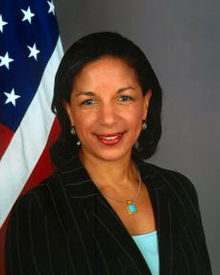
Source: Wikipedia

Source: Wikipedia

As things stand Pres. Obama might be forced to choose Sen. John Kerry over Ms Rice in order to avoid an unnecessary war with a section of Congress at a time when everyone and their dogs and cats should be worrying about the fiscal cliff.

John Kerry would not be a terrible choice. His past focus on drug trafficking in Latin America, free trade agreements and climate change would make him useful to Africa.

As I have written before, Africa is increasingly becoming a transit point for drugs from Asia and Latin America destined for the European market. Africa also needs more trade with the US beyond AGOA. And climate change will probably affect Africans the most since the vast majority of them depend on rain-fed agriculture and live under conditions that can least withstand natural disasters. But Kerry is not an Africa expert and has done little on the region beyond his support for the South Sudanese cause. This makes it hard to see how he will connect his global focus on these important issues to the African context.

Susan Rice on the other hand has studied Africa and has in the past shown a pragmatism that you want in the top US diplomat. Plus it helps that Ms Rice would have Obama’s ear as she is reported to be very close to the president. She has had successes at the UNSC, the highlight of which was the intervention in Libya to stop Gaddafi from butchering civilians in Benghazi. Rice is a smart straight-talker whose undiplomatic streaks can be a plus in a region full of under-achieving strongmen.

For a very long time Foggy Bottom has seen Africa through a humanitarian lens. Even Hillary Clinton, with all her awesomeness, has done little in new initiatives for Africa beyond human rights issues and a campaign that involved providing cameras for rape victims in eastern DRC. These are not unimportant issues. I am not saying that human rights catastrophes in Africa should be ignored. Just that this should not be a secretary of state’s pet project for the entire the region.

In my opinion Ms Rice’s biggest plus is that she gets one of Africa’s biggest challenges: state incapacity.

It would be nice to have a US secretary of state who takes state capacity development in the region as her pet project (and has the guts to at times subordinate democracy promotion to this project). Her praise of Kagame and Zenawi (no doubt both rabid and at times murderous autocrats) was centred around this very same idea (and to be honest, the ghosts of Rwanda circa 1994). Democracy promotion is a noble cause. But it must be done with a sober mind. The last thing you want is a procrustean approach to the promotion of rights, freedoms and liberties like we have seen in the past.

(Just for the record, I am pro-democracy and have criticized the likes of Kagame here and here, among other forums).

Anyone who reads the development reports side by side with the human rights reports from Rwanda and Ethiopia must be conflicted. I have talked to a senior opposition figure from Ethiopia who told me that she thinks the biggest challenge to fighting Meles Zenawi (at the time) is that “people see the dams and the roads.” It is hard to ignore revealed competence. I would hazard to guess that most people would rather live in autocratic Singapore than democratic Malawi. Yes, it is not an either/or argument with these regimes. All I am saying is that interventionism has to be constructive and not lead to the rolling back of hard fought gains against disease, illiteracy and poverty in these states.

As I opined following Obama’s reelection, I think that security will be at the top of the US Africa policy, of course dressed up in rhetoric about democracy and human rights. John Kerry will handle that on auto pilot. His focus will be on the Middle East and South Asia. It would have been better to have an Africanist at the helm who understands more about the continent and could sneak in a few policy agendas here and there that could make a difference on the ground. An aggressive focus on state capacity development could have been one of those policies.

This is a missed opportunity for Africa. For the first time in history Africa had a chance to have the number one American diplomat be a person who is an expert on a section of the region (Ms Rice wrote a thesis on Zimbabwe). Her defense of a couple of African autocrats aside, I think Ms Rice would have been better for Africa than John Kerry – who in all likelihood will focus on the Middle East and South Asia and continue Sub-Saharan Africa’s designation to the “humanitarianism column.”

Who is the M23?

Jason Stearns over at Congo Siasa provides a link to a backgrounder worth reading on the rebel group.

Also with regard to the M23, Onyango-Obbo of the East African has some advice for Kabila:

In the past 15 years, the Banyamulenge have fought the same fight in the DRC [ “the persecution of the Congolese Tutsis”]. Kabila can be smart, offer them a political deal and save DRC, or choose the destructive path preferred by successive Congolese governments of recent years and lose eastern DRC — or even power in Kinshasa.

Criticisms and ultimatums to the eastern DRC rebels like that issued at last week’s Kampala emergency summit, and international condemnation and sanctions, will not change that fact.

I share Onyango-Obbo’s view on this matter.

The international community’s singular focus on the humanitarian disaster in eastern DRC (caused by Rwanda’s and Uganda’s meddling) is giving Kabila a chance to kick the can down the road one more time – until the next time that a group of a few hundred men with guns chase his troops out of town and kill and rape and loot and cause all manner of harm to innocent civilians while they are at it. Then the same dance will be orchestrated – condemnations from the UNSC and bloggers, regional summits, a few resolutions that never get implemented, etc.

The present hue and cry in the media about the M23 misses the fact that you can’t simply wish away the de facto power imbalances in eastern Congo by appealing to humanitarian concerns. The woefully incompetent FARDC and the Kinshasa government cannot tackle the better organized rebels backed by more savvy armies in Uganda and Rwanda.

To end the conflict in eastern Congo Kabila must give a lot of concessions to the rebels. Without concrete concessions the conflict will merely have been postponed to a later date.

The alternative is for Kabila and his Kinshasa cronies to wake up one day and decide to lead a competent government and national armed force that will deter Rwanda, a country that is 88 times smaller with almost 7 times fewer people, from meddling within their country’s territory. That is, if they can.

Is this the beginning of the Third Congo War?

Yesterday Goma fell to the M23, a rebel group in eastern DRC with alleged links to both Rwanda and Uganda. The fall of Goma increases the likelihood of an all out war in eastern Congo that might quickly degenerate into a regional war – just like the Second Congo War was (for more on why peace failed see this ICG report).

I am on record as lacking any sympathies for the Kinshasa regime under Joseph Kabila (see here, here, and here). The horrendous situation in eastern DRC is as much his fault as it is of the alleged meddlers from Kampala and Kigali. The fact that the international community has taken to viewing the conflict as primarily regional is a mistake as it masks Kabila’s own failings in improving governance in the eastern DRC . It also gives him a chance to continue free riding on MONUSCO’s presence in the region.

Sadly, the international community appears set to waste this latest crisis by issuing statements and imposing sanctions which will only tackle the symptoms rather than the real problems behind the conflict. As the ICG argues:

If international donors and African mediators persist in managing the crisis rather than solving it, it will be impossible to avoid such repetitive cycles of rebellions in the Kivus and the risk of large-scale violence will remain. Instead, to finally resolve this conflict, it is essential that Rwanda ends its involvement in Congolese affairs and that the reconstruction plan and the political agreements signed in the Kivus are properly implemented.
For these things to happen Western donors should maintain aid suspension against Rwanda until the release of the next report of the UN group of experts, in addition to issuing a clear warning to the Congolese authorities that they will not provide funding for stabilisation and institutional support until the government improves political dialogue and governance in both the administration and in the army in the east, as recommended by Crisis Group on several previous occasions.
Over at Congo Siasa, the DRC expert Jason Stearns offers some preliminary thoughts on M23’s endgame:
In the past, I have speculated that it will be difficult for the M23 to conquer and hold territory, mostly due to their lack of manpower, which started off at around 400-700 and is probably around 1,500-2,500 now. They have been able to rely on Rwandan (and, to a lesser degree, Ugandan) firepower for operations close to the border (in particular Bunagana and Rutshuru, allegedly also this recent offensive), the farther into the interior they get, they harder it will be to mask outside involvement.
Alliances with other groups­­––Sheka, Raia Mutomboki, FDC, etc.––have acted as force multipliers, but have been very fickle, as the surrender of Col Albert Kahasha last week proved. From this perspective, the M23 strategy could well be more to nettle the government, underscore its ineptitude, and hope that it will collapse from within.
However, the recent offensive on Goma has made me consider another, bolder alternative. If the rebels take Goma, thereby humiliating the UN and the Congolese army, they will present the international community with a fait accompli. Yes, it will shine a sharp light on Rwandan involvement, but Kigali has been undeterred by donor pressure thus far, and has been emboldened by its seat on the Security Council. Also, as the looting by the Congolese army and their distribution of weapons to youths in Goma has shown, the battle for Goma is as much of a PR disaster for Kinshasa as for Kigali.

UGANDA AT 52

This blog wishes all Ugandans around the world a happy independence day!

Is our children learning? (Credit to Bushism)

The Guardian reports:

More than two out of every three pupils who have finished two years of primary school in east Africa fail to pass basic tests in English, Swahili or numeracy, according to a new report, Are our children learning?.

The differences in performance vary both across and within countries:

The report found large differences in average test scores between countries in east Africa. Kenyan pupils perform best in literacy and numeracy. Ugandan children perform worst in the lower school years, but slowly overtake Tanzanian children and outperform them after six years in school.

But it is the within-country differences that are cause for a rethink of education policy in east Africa. Kids in private schools appear to do much better than those in public schools (the gap is most stark in Tanzania, 28 percentage points). The Ugandan school system appears to be the worst, with barely half of EVEN the private school kids passing.

In a finding likely to fuel the debate on public versus private schools, the report said students in private schools perform better than pupils in state schools in all three countries – a difference particularly marked inTanzania, where the pass rate among 10 to 16-year-olds for numeracy and literacy tests was 47% in state schools, compared with 75% in private schools.

“In part, the difference between Tanzania and the other countries is likely to be driven by the much smaller share of pupils attending private schools, even among the non-poor, suggesting they must be particularly selective,” said the report. In Kenya, the pass rate in private schools was 83%, compared with 75% in government schools, while in Uganda the gap was 53% to 36%.

As a product of the Kenyan public school system (and a Wazimba for life), I believe that public schools are the way to go. With some thought and innovation, public schools can be made to work – and in the process serve as the best chance for inter-generational SES mobility. The debate should be about how to improve public schools, as opposed to over the false choice of quantity vs. quality.

A possible model could be something akin to the Kenyan National Schools concept in which select schools across the country get extra resources not only to boost performance but also to act as testing grounds for new learning tools – which can then inform policy to help “Provincial Schools” catch up. Of course this would ineluctably create a multi-tier school system at the beginning, but it is arguably better than a system in which most (if not nearly all, see Uganda and Tanzania) public schools are failing.

It is important to note that in Kenya the best high schools have historically been public. With investment and openness to experimentation and innovation this tradition can be maintained.

H/T @AAA_ipregroup 

Uganda is Not Spain

The Ugandan cyberspace went abuzz (see this, this, and this, for instance) following Spanish PM Mariano Rajoy’s quip a few days ago that Spain is not Uganda. Many commentators lamented at the implicit disdain that the Spanish Premier had for Uganda. Few, however, paused to consider why it is that Uganda is the country that first came to mind when Mr. Rajoy needed a representative state that did not have its sh*t together.

One exception is Daniel K. Kalinaki of the Uganda Monitor who tries to grapple with some of the difficult questions that many have skirted when reacting to Mr. Rajoy’s unfortunate comments:

“As far as making comparisons between the sizes of the two economies and their place in the world, Rajoy was speaking the truth, brutal as it might sound to our patriotic ears. The world would notice if Spain became bankrupt because of the size of its economy, which is several times bigger than ours, and its more central place in the international economy.

……..I am concerned about the ill-advised rants by foreign leaders such as Rajoy. I am concerned about the snide references, from James Bond movies to American TV series, of Uganda as a war-plagued basket case. I am also concerned about the misrepresentation by opportunistic do-gooders like Jason Blair and his Invisible Children.

………… We gloss over newspaper stories that speak to the modern-day horrors of parents tying their ill children to trees because there is no proper medical care available for them from a government that spends Shs350 billion a year in sending its officials and cronies to foreign hospitals. Where is the outrage over that?

……. I am proud to defend my country when our honour and genuine achievements are disparaged, but I am unable to find it within myself to ride the bandwagon of empty, predictable navel-gazing, played to a cyber gallery, while ignoring the potholed boulevard of our broken dreams.”

More on this here.

A Ugandan journalist and a politician respond to Kony 2012

Angelo Izama, Ugandan journalist (and a good friend of yours truly) has a thoughtful op-ed piece in the Times. He makes the case that:

Campaigns like “Kony 2012” aspire to frame the debate about these criminals and inspire action to stop them. Instead, they simply conscript our outrage to advance a specific political agenda — in this case, increased military action.

African leaders, after all, are adept at pursuing their own agendas by using the resources that foreign players inject and the narratives that they prefer — whether the post-9/11 war on terror or the anti-Kony crusade. And these campaigns succeed by abducting our anger and holding it hostage. Often they replace the fanaticism of evil men with our own arrogance, and, worse, ignorance. Moreover, they blind us by focusing on the agents of evil and not their principals.

At the same time over at FP Nobert Mao, politician from northern Uganda and former presidential candidate, has the following to say:

It’s clear that the aim of the video [Kony 2012] was never intellectual stimulation. I don’t think the founders of Invisible Children are the foremost analysts of the complicated political, historical and security dynamics in our troubled part of Africa. They certainly wouldn’t earn high marks in African Studies. But I will go to my grave convinced that they have the most beautiful trait on earth — compassion.

Such sentiments matter, even today.  There are those who say the war is over in Northern Uganda. I say the guns are silent but the war is not over. The sky is overcast with an explosive mix of dubious oil deals, land grabs, arms proliferation, neglected ex-combatants, and a volatile neighborhood full of regimes determined to fish in troubled waters. What we have is a tentative peace. Our region is pregnant with the seeds of conflict. The military action in the jungles of Congo may capture Kony, but we need to do more to plant the seeds of peace founded on democracy, equitable development, and justice. Like peace, war too has its mothers, fathers, midwives, babysitters, and patrons. Perhaps Kony 2012 will help sort out the actors. The video has certainly shaken the fence, making fence-sitting very uncomfortable, indeed.

The two may disagree on the usefulness of tactics such as those that made the now famous video, but they certainly agree on the need to acknowledge agency of local actors in all these problems that require outside intervention.

My two cents on this is that there is definitely room for Africans to shape the narrative and tactics of advocacy in Western capitals (or elsewhere). Emotionally charged  mobilization tactics, like Kony 2012, are definitely a distraction from the real issues. But they also present an opportunity for African actors to leverage international attention and support against their own leaders who refuse to deal with problems that affect their daily lives. I am glad that in the case of Kony 2012 Ugandans have stepped in to provide perspective on the narrative and, hopefully, influence the eventual response by the relevant policymakers in DC.

On the unintended consequences of the Sachs-Kristoff syndrome

Badvocacy alert!

[youtube.com/watch?feature=player_embedded&v=Y4MnpzG5Sqc]

With due apologies to the eminent economist and journalist.

Invisible Children’s Kony 2012 publicity push is generating some backlash. Here is quoting Under the Banyan:

Critics of the Invisible Children campaign say that while it is well-intentioned and while Kony deserves international condemnation, there are questions about the organisation’s methods, money and support for military action that need to be answered. Others are revulsed (sic) by the idea of foreigners thinking they can solve an entrenched and complex problem with goodwill alone.

More on this here. And for those interested in the complexity of the issue click here.

I am still learning to block out all the misguided interventions by the members do-gooder industrial complex of our time. Sometimes I wish I could wave a magic wand and make the tenants of State Houses across the Continent to also ignore the prophets of this axis of distraction-from-the-real-problems.

Also, I only discovered Invisible Children after the latest brouhaha but it turns out that Blattman was already in their case three years ago.

H/T A View from the Cave.

Kenyan Intervention in (al-Shabab dominated) Southern Somalia

The ICG has an excellent new report on the state of the the Kenyan military intervention in Somalia.

The pressing issues raised in the report include economic, political and social concerns:

The slow pace of the military operation and the high cost of keeping troops in the field are the main reasons behind Nairobi’s desire to operate under AMISOM command. The treasury would then not have to pay the full cost of the campaign. It is estimated that Linda Nchi is costing the government at least KSh 210 million ($2.8 million) per month in personnel costs alone in a year of a record KSh 236 billion ($3.1 billion) budget deficit. If the interven- tion’s cost is not contained, already high inflation will spiral, and local discontent could become more serious…..

The intervention in Somalia is likely to have a complex impact on Kenyan Somalis’ political positions, because their attitude toward it is not straightforward. The government’s desire to establish a buffer zone between the border and the rest of Somalia privileges the Ogaden, the majority Kenyan-Somali clan. The possibility of a semi-autonomous state in the south of Somalia politically dominated by Ogaden may not be favoured by the minority, marginalised clans of north-eastern Kenya, such as the Ajuran and Degodia…..

Views within the ethnic Somali and wider Muslim community regarding the war are mixed but predominantly critical. Even those now mildly supportive could easily become hostile, especially if things go badly wrong, and civilian deaths mount. The notion that the war is popular within the Muslim community is wishful thinking, and the potential to exacerbate already worrying radicalisation in the country is very real. The police and other security services have shown some restraint in bigger cities, but there have been numerous reports of abuses in North Eastern Province.

Kenyan Court Orders Bashir Arrest, Sudan Expels Kenyan Ambassador

UPDATE:

The BBC reports:

Sudan ordered the expulsion of the Kenyan ambassador after a Kenyan judge issued an arrest warrant for Sudan’s President Omar al-Bashir, Sudan’s foreign ministry has said.

Mr Bashir is wanted by the International Criminal Court (ICC) for alleged war crimes in Darfur.

Sudan has ordered the Kenyan ambassador to leave the country within 72 hours.

It has also ordered the Sudanese ambassador in Kenya to return to Khartoum.

*************************************************************

A Kenyan court has issued an arrest warrant for Sudan’s President Omar al-Bashir over alleged war crimes in Darfur.

The ruling came after Kenya allowed Mr Bashir to visit in August in defiance of an International Criminal Court (ICC) warrant for his arrest.

The judge said he should be arrested if he “ever set foot in Kenya” again, the AFP news agency reports.

Kenya is a signatory to the treaty which established the ICC in 2002.

The new Kenyan constitution requires that the government implements its international treaty obligations. The ruling, though without much bite – I doubt Bashir will need to be in Kenya any time soon, has immense symbolism in the region.

It also matters for Kenyan domestic politics. Presently, a few high ranking Kenyan politicians – including the Finance minister, two former ministers and former police boss – are on trial at the ICC for crimes against humanity. The accused await judgment on the admissibility of their cases later this year or early next. The Bashir ruling means that if the charges against the “Ocampo Six” are confirmed but the government drags its feet in implementing an arrest warrant then the courts will step in.

More on the Bashir case here and here.

In other news, Uganda and Tanzania have rejected Khartoum’s petition to join the East African Community, citing “several issues like their democracy, the way they treat women and their religious politics.” Yeah right.

Quick hits

Follow the goings on in the DRC (especially this election season) over at Alex Engwete’s blog.

Living under the shadow of Kony and his men in Eastern CAR.

On a related note, the Ugandan army’s dirty war in the Congo and CAR.

Shame on the ANC. But there is still hope for cleaner politics in South Africa. The ANC is an over-size coalition with a high chance of internal breakup in the not so distant future. It might even occur sooner, over the Zuma succession. And this time it might not be a rather benign COPE affair. You can read more on the controversial bill over at the Economist.

Trying God? Churches claim to have cured HIV positive congregants. This goes beyond faith, it is naked exploitation. And a call for government involvement.

And lastly, a very dictator Christmas (via Blattman)

[youtube.com/watch?feature=player_embedded&v=38YWB8iX7OY]

We finally have a winner for the Mo Ibrahim Prize

UPDATE: Check out the Mo Ibrahim Index of Governance here. The usually suspects – Botswana, Cape Verde and Mauritius –  lead the pack.

*************************************************

The BBC reports:

Former Cape Verde President Pedro Verona Pires has been awarded this year’s $5m (£3.2m) Mo Ibrahim prize for good governance in Africa.

The prize committee said Mr Pires, who stepped down in August, had helped make the archipelago off the West African coast a “model of democracy, stability and increased prosperity”.

The prize is supposed to be awarded each year to a democratically elected leader who has voluntarily left office.

There has been no winner for two years. The committee said there had been no suitable candidate.

The $5m award, given over 10 years followed by $200,000 a year for life, is the world’s most valuable individual prize. The previous winners are Botswana’s President Festus Mogae and Mozambique’s Joaquim Chissano.

In case you are wondering why African incumbents – including Cameroon’s Paul Biya and Senegal’s Wade – do not find the world’s most valuable individual prize worth their time check out an earlier post in which I attempted to calculate the opportunity cost of accepting the award. Notice that my calculation did not factor in the probability of not winning the prize even after stepping down or that of winding up at the Hague or dead.

The prize is a nice carrot and is part of a larger and highly commendable, I should add, attempt at an ideational change on what it means to be a good president. But it almost naively assumes that the only reason autocrats stay in power beyond their “use by” date is for the money.

If that were the case Gbagbo and Gaddafi would surely have done the right thing.

If I were on the committee I would ask Mo to consider channeling some of the money from years without winners to countries with promise – to help facilitate institutional reforms – all in an attempt to make the environment safe for the incumbent and his cronies in case he chooses to step down.

The other dimension of the (origins of) Congolese Conflict

UPDATE: Stay updated on the run-up to the elections in the DRC here.

**************************************************

In reaction to Dodd-Frank many in the blogosphere, including yours truly, have insisted that the problem in eastern Congo is not a law enforcement problem but a governance problem whose solution must come primarily from Kinshasa.

Often ignored is the regional dimension of the conflict.

The involvement of Rwanda and Uganda in eastern DRC (in the first and second Congo wars) have been excellently documented in Dancing in the Glory of Monsters (the author also blogs at Congo Siasa).

The invading forces may have left, but the geopolitical posturing remains and has consequences for the flow of arms and mushrooming of militias in the region.

Here’s a short documentary on the same.

This is not to simply vilify Uganda and Rwanda – one could argue that the presence of rebels from both countries in the Congo provided legitimate grounds for an invasion.

The point here is that the regional dimension of the conflict should not be ignored even as we insist that attention should shift to Kinshasa in an attempt to provide a lasting end to the conflict in eastern DRC.

More on Eritrea and armed groups in eastern Africa

While Eritrea has in the past been repeatedly accused of supporting Somalia’s Islamist militia Al Shabaab, a charge it strenuously denies, the current report catalogues Afewerki’s growing notoriety in the world of terrorism finance, and in particular the global web through which these funds are routed, with Kenya serving as a global transaction distribution hub.

The report details the country’s activities in funding the terror group, following the money trail from its citizens in the diaspora in Europe and North America, through Dubai and the Eritrean embassy in Nairobi, and into the hands of Al Shabaab, all the while concealed in convoluted and opaque informal financial networks.

That is The East African reporting on Eritrea’s support for armed groups in the wider eastern African region. Mr. Afewerki’s actions are a threat to regional security for the following reasons:

1. Eritrea’s (opportunistic and cynically instrumental) use of Islam as a galvanizing force (against “Christian” Ethiopia) threatens to ignite a wider regional conflict that would probably include North Sudan and Egypt. The reason this is likely is because:

       (a) Remember that the use of the waters of the Nile continues to be a source of friction between Egypt and the riparian states of eastern Africa. Egypt itself has in the past been linked to armed groups in Somalia opposed to Ethiopian rule of the Ogaden region. Both countries have a history of funding rival clan militias in Somalia. In all of this the principle of my enemies’ enemies’ are my friends will most likely apply.

        (b) Because of its own problems with South Sudan, North Sudan might have an interest in using Eritrea’s networks to destabilize its southern neighbor. Recently the government of South Sudan banned all people of Somali origin from entering the country by land for security reasons. Juba clearly suspects either direct or indirect links between Khartoum and the myriad armed groups in war-torn Somalia

2. Given that the groups it supports (e.g. al-Shabaab) have other enemies besides Ethiopia, President Afewerki has effectively declared war on countries like Uganda, Burundi, South Sudan and Kenya that have also either been attacked or threatened by al-Shabaab. I wouldn’t be surprised if one or two of these EAC states decided to materially support the Ethiopian side the next time Addis and Asmara fight over their barren disputed border lands.

Will be blogging sporadically for the next week

Dear readers, I have been away for a bit. Research/work and running the San Francisco half marathon (see images below) have kept me from blogging. I am back but will only be blogging sporadically for the next week or so.

In other news, next Thursday I head home to Kenya for a short vacation. My trip will also include brief visits to Uganda and Tanzania and an extended trip to Zambia (I will be there for the elections) before coming back to the Bay Area for year 3 of (hopefully) 5 of grad school.

Stay tuned.

Here are my marathon pictures.