Tyler Cowen thinks they can’t:
American fascism cannot happen anymore because the American government is so large and unwieldy. It is simply too hard for the fascists, or for that matter other radical groups, to seize control of. No matter who is elected, the fascists cannot control the bureaucracy, they cannot control all the branches of American government, they cannot control the judiciary, they cannot control semi-independent institutions such as the Federal Reserve, and they cannot control what is sometimes called “the deep state.” The net result is they simply can’t control enough of the modern state to steer it in a fascist direction.
This yields a new defense of Big Government, which is harder to take over, and harder to “turn bad,” than many a smaller government. Surely it ought to give us pause that the major instances of Western fascism came right after a time when government was relatively small, and not too long after the heyday of classical liberalism in Europe, namely the late 19th century. No, I am not blaming classical liberalism for Nazism, but it is simply a fact that it is easier to take over a smaller and simpler state than it is to commandeer one of today’s sprawling bureaucracies.
This argument is only moderately convincing. The bureaucratic argument is pretty weak historically. In fact, there is work that suggests that high levels of social capital and the presence of a rationalized bureaucracy made it easy for the Nazis to take over. The argument would have been stronger if Cowen focused on the ways in which the federal system and the decentralization of hard power in America provides real barriers to countrywide fascistic rule (but he is an economist, so “size of government” is a readily available metric).
The other weakness in the argument is that Cowen sounds like he has in mind “Rule of Law Fascists” (at least at the beginning). But by definition, these chaps would probably engage in a lot of extra-constitutional means of gaining and maintaining power. And at that point, the only stumbling bloc would be the hard power dispersed in the states.
American has a fairly decentralized system of internal projection of coercive capacity (police units are run by states, counties, and cities). These security units could be commandeered by would-be dissenters to challenge a fascist in Washington (states would presumably also race to control all the American military’s weaponry within their borders). America is also too culturally heterogenous to enable a quick takeover by fascists. The fascists would first have to kill a significant number of not only non-European-Americans (going by the demographics of current American fascists) but also a lot of European-Americans before they could install their rule. In the process of doing so, they would begin to undermine the very ethnic and cultural basis of their fascistic rule.
A high level of ethnic (and ideological) heterogeneity would therefore mitigate against a rapid rise and consolidation of fascist rule.
Finally, while the risk of an outright fascist takeover is remote, the likelihood of ever-spreading pockets of fascism in the American state is very real. Here, too, decentralization plays a role. Because of America’s highly decentralized coercive capacities, pockets of unchecked predatory authoritarianism (fascism-lite, if you will) continue to exist throughout the country — see here, here and here. These pockets persist, in part, because the federal government is considered to be fairly faithful to the ideals of the American constitution. So while fascists may not take over the federal government, they can certainly control local police departments, or even pockets of the federal bureaucracy.

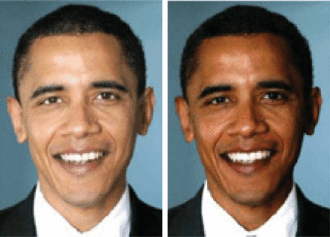 There is strong evidence linking skin complexion to negative stereotypes and adverse real-world outcomes. We extend these findings to political ad campaigns, in which skin complexion can be easily manipulated in ways that are difficult to detect. Devising a method to measure how dark a candidate appears in an image, this paper examines how complexion varied with ad content during the 2008 presidential election campaign (study 1). Findings show that darker images were more frequent in negative ads—especially those linking Obama to crime—which aired more frequently as Election Day approached. We then conduct an experiment to document how these darker images can activate stereotypes, and show that a subtle darkness manipulation is sufficient to activate the most negative stereotypes about Blacks—even when the candidate is a famous counter-stereotypical exemplar—Barack Obama (study 2). Further evidence of an evaluative penalty for darker skin comes from an observational study measuring affective responses to depictions of Obama with varying skin complexion, presented via the Affect Misattribution Procedure in the 2008 American National Election Study (study 3). This study demonstrates that darker images are used in a way that complements ad content, and shows that doing so can negatively affect how individuals evaluate candidates and think about politics.

 kenopalo.com