Museveni: UN missions stifling state capacity development in Africa

The Daily Nation reports:

Ugandan President Yoweri Museveni has said UN peacekeeping missions [especially in the DRC] are derailing efforts by African governments to end conflicts.

He criticised the UN system of peacekeeping saying: “External support by the UN makes governments lazy and they don’ t focus on internal reconciliation.”

“The mistake is internal actors with no correct vision and the UN which does not focus on internal capacity building but instead focusing on peace keeping all the time. Without the internal solutions, you can’t have peace, ” Mr Museveni said in a statement on Thursday.

Some Congolese and experts on the DRC may disagree with Museveni’s analysis but it has some truth to it. As I pointed out in an African Arguments post several months ago, there is no short cut to fixing the Congo. State capacity development must be THE overriding concern (for more on this see here and here).

Also, The International Crisis Group has a nice piece on the recent takeover of the mining town of Lubumbashi by Mai-Mai fighters. The writer notes:

Since President Joseph Kabila’s controversial election victory in November 2011, government control over DRC territory has been in drastic decline. Beyond the fall of Goma to the M23 rebellion, Kinshasa has failed to repel the activities of various other armed groups: the Mai-Mai Morgan in Province Orientale, the Ituri Resistance Patriotic Front (FRPI) and the Mai-Mai Yakutumba in South Kivu, Rayia Mutomboki in North and South Kivu, as well as the Mai-Mai Gédéon in Katanga. (On the eastern Congo armed groups, see the October 2012 briefing Eastern Congo: Why Stabilisation Failed. On the Katanga armed groups, see the report Katanga: The Congo’s Forgotten Crisis.)

US Africa Policy, A Response

This is a guest post by friend of the blog Matthew Kustenbauder responding to a previous post.

On the question of human rights guiding America’s foreign policy in Africa, I agree with you; it shouldn’t be the first priority. The US needs a more pragmatic development diplomacy strategy, which would help African countries develop just as it would help American businesses thrive.

But I disagree with your characterization of Hillary’s position in this respect. Here’s Secretary Clinton’s own words:
“Last year I laid out America’s economic statecraft agenda in a series of speeches in Washington, Hong Kong, San Francisco, and New York. Since then, we’ve accelerated the process of updating our foreign policy priorities to take economics more into account. And that includes emphasizing the Asia Pacific region and elevating economics in relations with other regions, like in Latin America, for example, the destination for 40 percent of U.S. exports. We have ratified free trade agreements with Colombia and Panama. We are welcoming more of our neighbours, including Canada and Mexico, into the Trans-Pacific Partnership process. And we think it’s imperative that we continue to build an economic relationship that covers the entire hemisphere for the future.” 
“Africa is home to seven of the world’s ten fastest-growing economies. People are often surprised when I say that, but it’s true. And we are approaching Africa as a continent of opportunity and a place for growth, not just a site of endless conflict and crisis. All over the world, we are turning to economic solutions for strategic challenges; for example, using new financial tools to squeeze Iran’s nuclear program. And we’re stepping up commercial diplomacy, what I like to call jobs diplomacy, to boost U.S. exports, open new markets, lower the playing field – level the playing field for our businesses. And we’re building the diplomatic capacity to execute this agenda so that our diplomats are out there every single day promoting our economic agenda.” 

One of the problems, however, is that the pragmatic approach articulated by the Secretary doesn’t trickle down through the bureaucracy. This is especially true, ironically, of the State Department’s primary development diplomacy arm, USAID, which has a deeply entrenched culture of being anti-business. It’s a huge problem, and part of the reason why American foreign policy in Africa has been so slow to adjust to new economic realities.

Security drives US Africa Policy

Security drives US Africa Policy

Academics schooled in all the latest development orthodoxies but lacking the most basic understanding of economic or business history have flocked to USAID, so that the suggestion that American economic interests should guide development policy – making it a win-win for Africa and America – is anathema. It’s also why the Chinese are running all over the US in Africa.

As a prominent economic historian recently remarked in the Telegraph, “While we [Western governments] indulge our Victorian urge to give alms to the Africans, Beijing is pumping black gold.” And this is just it. As long as the US approaches Africa as a beggar needing to be saved and not as a business partner worthy of attention, both sides will continue to lose out.

In this respect, what Africa does not need is another “old Africa hand” steeped in conventional development ideas and old dogmas about what’s wrong with Africa and why the US must atone for the West’s sins. For this reason alone, John Kerry – not Susan Rice – probably stands a better chance, as the next Secretary of State, at putting American foreign policy toward Africa on a more solid footing.

- Matthew Kustenbauder is a PhD candidate in history at Harvard University.

More on the DRC

CFR has a nice interview with Jason Stearns, DRC expert and author of Dancing in the Glory of Monsters. Jason in part notes that:

This crisis has brought about a shift in international donor policy for the region, in particular criticism and financial sanctions against Rwanda, which is something that’s new. However, using aid as leverage only makes sense in the context of a larger political process. Bashing Rwanda just for the sake of bashing Rwanda is not a solution. There needs to be a comprehensive political process into which that kind of pressure can be funneled and channeled. But there is no such process at the moment. What you have are talks mediated by a regional body—the International Conference for the Great Lakes Region (ICGLR)—that has the irony of being presided over by Uganda, which is itself playing a role in the conflict by supporting the M23. These talks have been largely limited to an evaluation of the March 23, 2009 peace deal, and the potential formation of a regional military force to deal with the FDLR and M23. But the causes of the crisis run much deeper and involve the failure of local governance, the weakness of the Congolese army, and the persistent meddling of neighboring countries in Congolese affairs.

This is precisely what informs my contention that there is too much focus on the international dimension of the conflict at the expense of the kinds of reforms that Congo needs in order to improve state capacity in Sub-Saharan Africa’s biggest country.

You can’t do business, implement a human rights regime, or even pretend to have democratic governance in a stateless environment (Unless, of course, you live in a state of nature in which everyone has capacity to defend themselves against aggression by others).

Some, including very serious and influential people, think that the solution to Congo’s weakness is to plea with its neighbors not to prey on it. I disagree. I believe that the best solution ought to be the strengthening of Congo so it can deter its neighbors. The international community just wasted a good opportunity to force a cornered Kabila to agree on a peace deal that is self-enforcing, i.e., that reflects the power balance in eastern Congo.

As things stand the continuation of the power vacuum in the Kivus will continue to attract rebels, foreign-sponsored or not.

More on this here.

Also here is a  glimpse of some of the actions by Kabila and his Kinshasa cabal which make it extremely unlikely that the situation in Congo will improve under his rule.

Governing on the cheap in Africa

What is striking and surprising here is just how easy it can be to take over some African states, or large parts of them.  The post-independence historical record provides numerous examples where dozens or a few hundred armed men have done it.  This is generally just assumed to be the way things are in Africa, but when you think about it it is actually really puzzling.  Being the president in African countries (and many others besides) can be an incredibly lucrative deal.  Why don’t these rulers, in their own self-interest, take some of that money and use it to build crack units, presidential guards, or strong and loyal army divisions that would protect their hold on power against two dozen putchists, or a hundred or a couple thousand rebels armed with rifles and maybe some mortars?

I don’t think we have really good explanations for this in the relevant Pol Sci literatures.  Maybe the most promising hypothesis is that African presidents are so afraid of coups and attacks from inside their regime that they don’t want to support the construction of any organization that would be competent at using force.  Keeping the military weak  may lower their coup risk somewhat, but effectively trades coup risk off against higher risks of rural rebellion, insurgency, and foreign depredations such as we are seeing in Eastern Congo.

That is Jim Fearon writing over at Monkey Cage. More on this here.

Jim’s concern extends beyond security matters. Much of Africa remains under-governed in other regards as well – tax collection, garbage collection, provision of public goods like water and sanitation, roads, etc etc.

One key driver of this phenomenon, I believe, is the manner in which sectional elites (and those that they purportedly represent) are incorporated into the national system.

You see, many African national governments tend to have a president surrounded by a coalition of ethnic/sectional elites representing specific geographic regions or communities. This sort of incorporation of elites and the regions/social groups that they represent allows African central governments to govern on the cheap since as long as ethnic chief from region X can bring his people and sort of make them feel represented in the centre then the government has no reason to establish a strong presence in the chief’s homeland region (unless that region is economically viable).

A keen observer may ask why co-ethnics of these “ethnic chiefs” never demand for more from their supposed representatives at the centre.

The answer lies in the nature of citizenship in most of Africa. In many countries citizenship (and the associated claims on the state) tends to be mediated through one’s ethnic group. Talk of “our people” is common across much of the region. Even educated people have internalized the fact that you can only get jobs if a co-ethnic is in a high position in government. Everyone therefore invests in having a powerful ethnic representative at the centre that can effectively bargain with whoever is president (or in the core of the governing coalition) to get enough jobs for the boys and girls from back home.

But having such a person obviates the need for the central government to establish its presence at the local level since it is much cheaper to give the ethnic chief his own fiefdom in the name of a cabinet ministry. Barriers to entry allow for very long tenures for these ethnic chiefs thus breeding incompetence of the worst possible kind – like the case of Kenyan police officers accepting bribes from al-Shabab operatives to allow for passage of explosives destined for Nairobi.

From the president’s/government’s perspective, all you have to do to prevent an all out rebellion is be on good terms with enough of these ethnic chiefs or make it beneficial for them to live under your rule.

Seen this way, under-government is not just for the sake of coup-proofing but also an unintended consequence of the manner in which the masses and their representative elites are incorporated into the national government/state.

The best book out there that I have read on this subject is Catherine Boone’s Political Topographies of the African State. Boone is best read with Jeffrey Herbst’s States and Power in Africa, although Herbst’s conclusions are too deterministic for my liking.

Is this the beginning of the Third Congo War?

Yesterday Goma fell to the M23, a rebel group in eastern DRC with alleged links to both Rwanda and Uganda. The fall of Goma increases the likelihood of an all out war in eastern Congo that might quickly degenerate into a regional war – just like the Second Congo War was (for more on why peace failed see this ICG report).

I am on record as lacking any sympathies for the Kinshasa regime under Joseph Kabila (see here, here, and here). The horrendous situation in eastern DRC is as much his fault as it is of the alleged meddlers from Kampala and Kigali. The fact that the international community has taken to viewing the conflict as primarily regional is a mistake as it masks Kabila’s own failings in improving governance in the eastern DRC . It also gives him a chance to continue free riding on MONUSCO’s presence in the region.

Sadly, the international community appears set to waste this latest crisis by issuing statements and imposing sanctions which will only tackle the symptoms rather than the real problems behind the conflict. As the ICG argues:

If international donors and African mediators persist in managing the crisis rather than solving it, it will be impossible to avoid such repetitive cycles of rebellions in the Kivus and the risk of large-scale violence will remain. Instead, to finally resolve this conflict, it is essential that Rwanda ends its involvement in Congolese affairs and that the reconstruction plan and the political agreements signed in the Kivus are properly implemented.
For these things to happen Western donors should maintain aid suspension against Rwanda until the release of the next report of the UN group of experts, in addition to issuing a clear warning to the Congolese authorities that they will not provide funding for stabilisation and institutional support until the government improves political dialogue and governance in both the administration and in the army in the east, as recommended by Crisis Group on several previous occasions.
Over at Congo Siasa, the DRC expert Jason Stearns offers some preliminary thoughts on M23′s endgame:
In the past, I have speculated that it will be difficult for the M23 to conquer and hold territory, mostly due to their lack of manpower, which started off at around 400-700 and is probably around 1,500-2,500 now. They have been able to rely on Rwandan (and, to a lesser degree, Ugandan) firepower for operations close to the border (in particular Bunagana and Rutshuru, allegedly also this recent offensive), the farther into the interior they get, they harder it will be to mask outside involvement.
Alliances with other groups­­––Sheka, Raia Mutomboki, FDC, etc.––have acted as force multipliers, but have been very fickle, as the surrender of Col Albert Kahasha last week proved. From this perspective, the M23 strategy could well be more to nettle the government, underscore its ineptitude, and hope that it will collapse from within.
However, the recent offensive on Goma has made me consider another, bolder alternative. If the rebels take Goma, thereby humiliating the UN and the Congolese army, they will present the international community with a fait accompli. Yes, it will shine a sharp light on Rwandan involvement, but Kigali has been undeterred by donor pressure thus far, and has been emboldened by its seat on the Security Council. Also, as the looting by the Congolese army and their distribution of weapons to youths in Goma has shown, the battle for Goma is as much of a PR disaster for Kinshasa as for Kigali.

Six Questions You Always Wanted to Ask About Africa….

Rohac and co-authors provide answers (from Rwanda) to six questions you always wanted to ask about Africa. The questions and answers revolve around issues of rule of law, police-making, institutions, development assistance, human capital and culture.

Check out the publication here.

Give Kagame a break!

I admire Richard Dowden, Director of the Royal African Society. That said, I disagree with the concluding paragraph in his latest post on the Rwandese military’s involvement in eastern Congo over at African Arguments:

“When a similar situation occurred in Sierra Leone, the Special Court for Sierra Leone went after the main supporters and funders of the rebel movement, in particular the President of Liberia, Charles Taylor. He was recently sentenced to 50 years in jail for his part in funding the murder and destruction of Sierra Leone. Yet the evidence of Rwanda’s support for warring groups in Congo is as strong – if not stronger – than the evidence that convicted Taylor. But because of the genocide in Rwanda and because both Uganda and Rwanda have good development programmes that western donors love to fund, they will not be criticised. Eastern Congo will continue to suffer.”

Following the damning UN report on Kigali’s adventures in the Congo and concerted campaigns by human rights activists, a number of donor countries, including the US, UK, Germany and the Netherlands, have (unwisely) stopped sending aid money to Kigali.

I am inclined to believe that there is truth to the claim that Rwanda supports the M23. But that does not necessary lead me to conclude that Rwanda should therefore be ostracized by the international community, for the following reasons:

  • Rwanda faces a real security threat from rebels in eastern Congo. Kagame is a dictator, no doubt about that (He is not your average tin pot dictator, but that’s beside the point for now). But he is also a purveyor of order in this rather volatile region of central Africa. The last thing eastern and central Africa needs is a slow motion civil war as is currently underway in Burundi. As long as Kinshasa’s incompetence continues to provide a safe launching base for rebels aiming to depose Kagame, Kigali will have no option but to (rightly so) intervene in eastern Congo. Let us not pretend otherwise.
  • The insurgencies in eastern Congo are a direct result of Kinshasa’s calculated inability to project power and control. In this instance, I think the Huntongian view that degree of government matters trumps concerns over the type of government. Eastern Congo needs order, period. Attempts at political negotiations with the numerous rebel factions must also be accompanied with strong military action to defeat all the rebel movements that refuse to come to the table. Kinshasa’s continued failure at either attempt leaves Rwanda no option but to step in in light of the observation above.

In a way the campaign to have Rwanda punished for its adventures in the DRC is emblematic of the problems associated with “mono issue activism” (Remember the danger of a single story?)

This is not a defense of Kagame’s human rights record. Everyone knows it is in the toilet. It is also not a blanket endorsement of foreign interventionism. What it is is an acknowledgement of the very complex context in which Kagame acted, and a consideration of the unintended consequences of cutting aid to Rwanda.

Rwanda’s involvement is a symptom of, and not the cause of the mess that is eastern DRC.

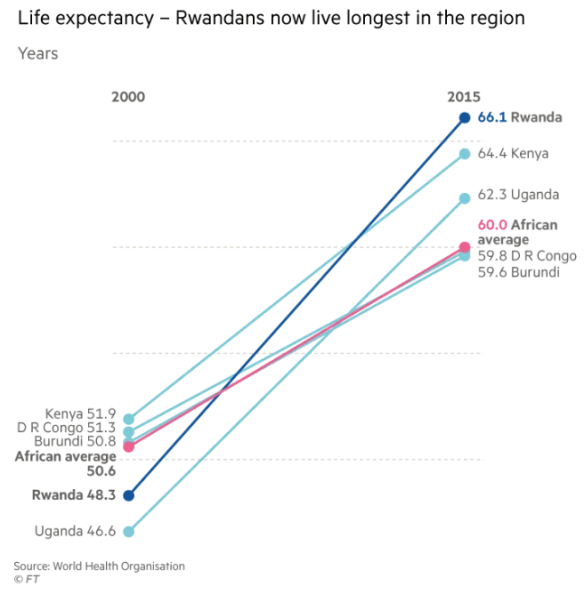
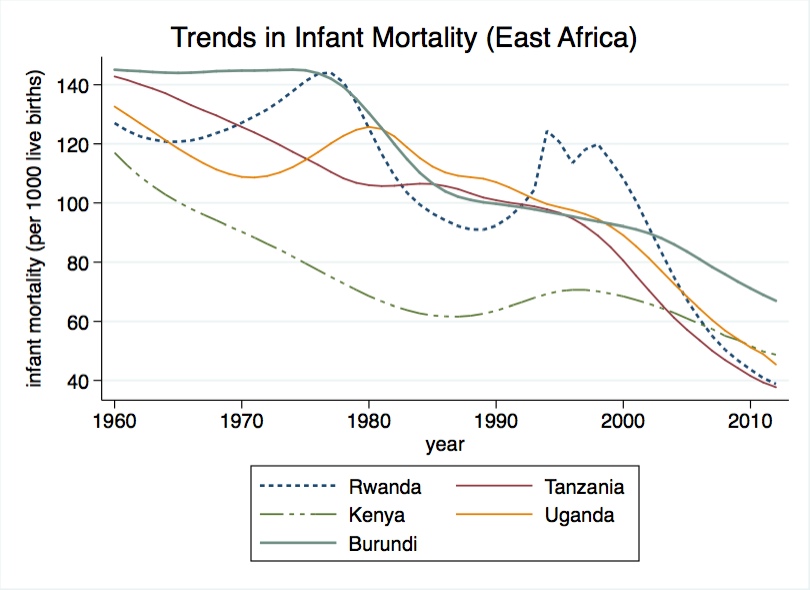
To those that want Kigali punished, I ask: What would it mean for Rwanda’s and the wider region’s security? What would it mean for economic growth and development for the 12 million Rwandese? What would it mean for infant and maternal mortality that have been on the decline (more rapidly than in most of the developing world) over the last decade?

Punishing Kagame (and the people of Rwanda) for Kinshasa’s ineptitude will not solve the problems in eastern Congo. That is just a fact.

UPDATE:

Please check out the comments section below for some insightful discussion on this subject. Despite the combativeness of some of the comments, they all raise some important points that I could not have incorporated in a short blog post.

On Rwanda’s brand of Developmental Authoritarianism

Many, including yours truly, have a love-hate relationship with Paul Kagame and his RPF regime in Rwanda.

On the one hand, his adventures in eastern DRC; alleged involvements in the assassination of opposition figures both at home and abroad; and overall restriction of political space in Rwanda are cause for concern. But on the other hand, he seems to be doing a marvelous job on the economic front (see here and here, for instance).

Source: Kigali City Official Website

In the latest issue of African Affairs, Booth and Golooba-Mutebi explore the nature of state-led development in Rwanda, with particular attention to how state-run companies are “ice breakers” for private sector firms in different sectors of the economy. The paper also observes Kagame’s strict separation of state and private accumulation of wealth, a fact that is demonstrated by Rwanda’s comparatively good performance on corruption indices. It is definitely worth reading.

Here is part of the abstract:

This article addresses one thematic gap – the distinctive approach of the RPF-led regime to political involvement in the private sector of the economy. It does so using the framework of a cross-national study which aims to distinguish between more and less developmental forms of neo- patrimonial politics. The article analyses the RPF’s private business operations centred on the holding company known successively as Tri- Star Investments and Crystal Ventures Ltd. These operations are shown to involve the kind of centralized generation and management of economic rents that has distinguished the more developmental regimes of Asia and Africa. The operations of the military investment company Horizon and of the public–private consortium Rwanda Investment Group may be seen in a similar light. With some qualifications, we conclude that Rwanda should be seen as a developmental patrimonial state.

I often tell my friends that at the end of the day, really, all that matters is that we bring down infant mortality to under 10/1000 live births [this is a good proxy for quality of life] and improve the standards of living for the average person, everywhere.

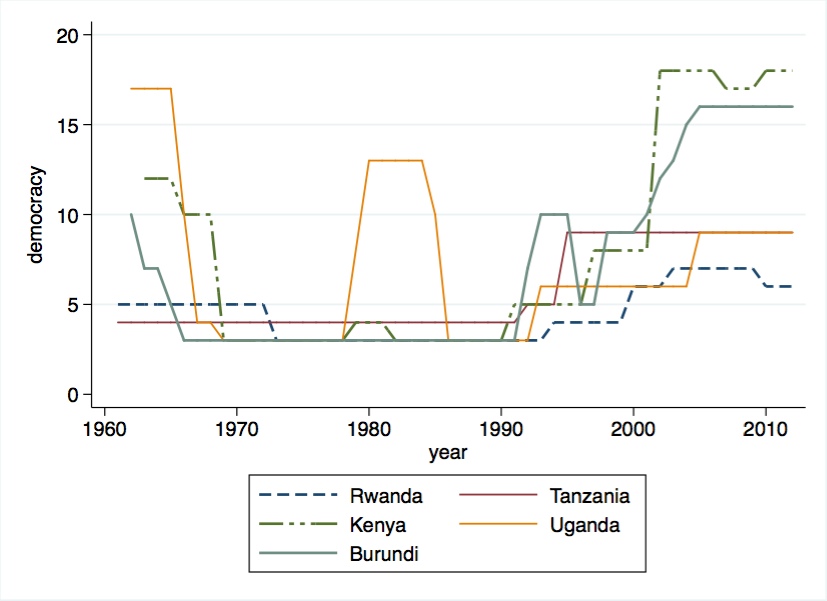
With that in mind, the favored retort among anti-democracy crowds in Sub-Saharan Africa – that “you can’t eat democracy” – has some truth in it. I bet most people would rather live in authoritarian Singapore than democratic Malawi (feel free to disagree).

The point here is that good governance (and for that matter, democracy) are means to an end, and we should never forget what the end is – that is, the improvement of the human condition for all. And yes, I agree that democracy, i.e. political freedom, could also be an end in itself, with the qualifier that those most likely to enjoy freedom are those that are already fed, clothed and housed, with a little more time to spare to blog and read Chinua Achebe, Ngugi wa Thiong’o or Okot P’Bitek.

China and Vietnam in Asia, and now Rwanda and Ethiopia in Africa, are cases that will continue to invigorate the debate over how to improve living standards for the largest number of people in the least amount of time.

For now my love-hate relationship with Paul Kagame and Meles Zenawi [of Ethiopia] continues….

Africa’s Singapore or Uganda waiting to happen?

Yet Rwanda has one huge advantage: the rule of law. No African country has done more to curb corruption. Ministers have been jailed for it. Transparency International, a watchdog, reckons Rwanda is less graft-ridden than Greece or Italy (though companies owned by the ruling party play an outsized role in the economy). “I have never paid a bribe and I don’t know anyone who has had to pay a bribe,” says Josh Ruxin, one of the owners of Heaven, a restaurant in Kigali, the capital.

The country is blessedly free of red tape, too. It ranks 45th in the World Bank’s index of the ease of doing business, above any African nation bar South Africa and Mauritius. Registering a firm takes three days and is dirt cheap. Property rights are strengthening, as well—the government is giving peasants formal title to their land.

That is the Economist on Rwanda. I remain cautiously optimistic about Kagame’s brand of effective authoritarianism. I just hope that he will not be tempted to degenerate into the Musevenis of this world.

The other dimension of the (origins of) Congolese Conflict

UPDATE: Stay updated on the run-up to the elections in the DRC here.

**************************************************

In reaction to Dodd-Frank many in the blogosphere, including yours truly, have insisted that the problem in eastern Congo is not a law enforcement problem but a governance problem whose solution must come primarily from Kinshasa.

Often ignored is the regional dimension of the conflict.

The involvement of Rwanda and Uganda in eastern DRC (in the first and second Congo wars) have been excellently documented in Dancing in the Glory of Monsters (the author also blogs at Congo Siasa).

The invading forces may have left, but the geopolitical posturing remains and has consequences for the flow of arms and mushrooming of militias in the region.

Here’s a short documentary on the same.

This is not to simply vilify Uganda and Rwanda – one could argue that the presence of rebels from both countries in the Congo provided legitimate grounds for an invasion.

The point here is that the regional dimension of the conflict should not be ignored even as we insist that attention should shift to Kinshasa in an attempt to provide a lasting end to the conflict in eastern DRC.